
Dear Friends,
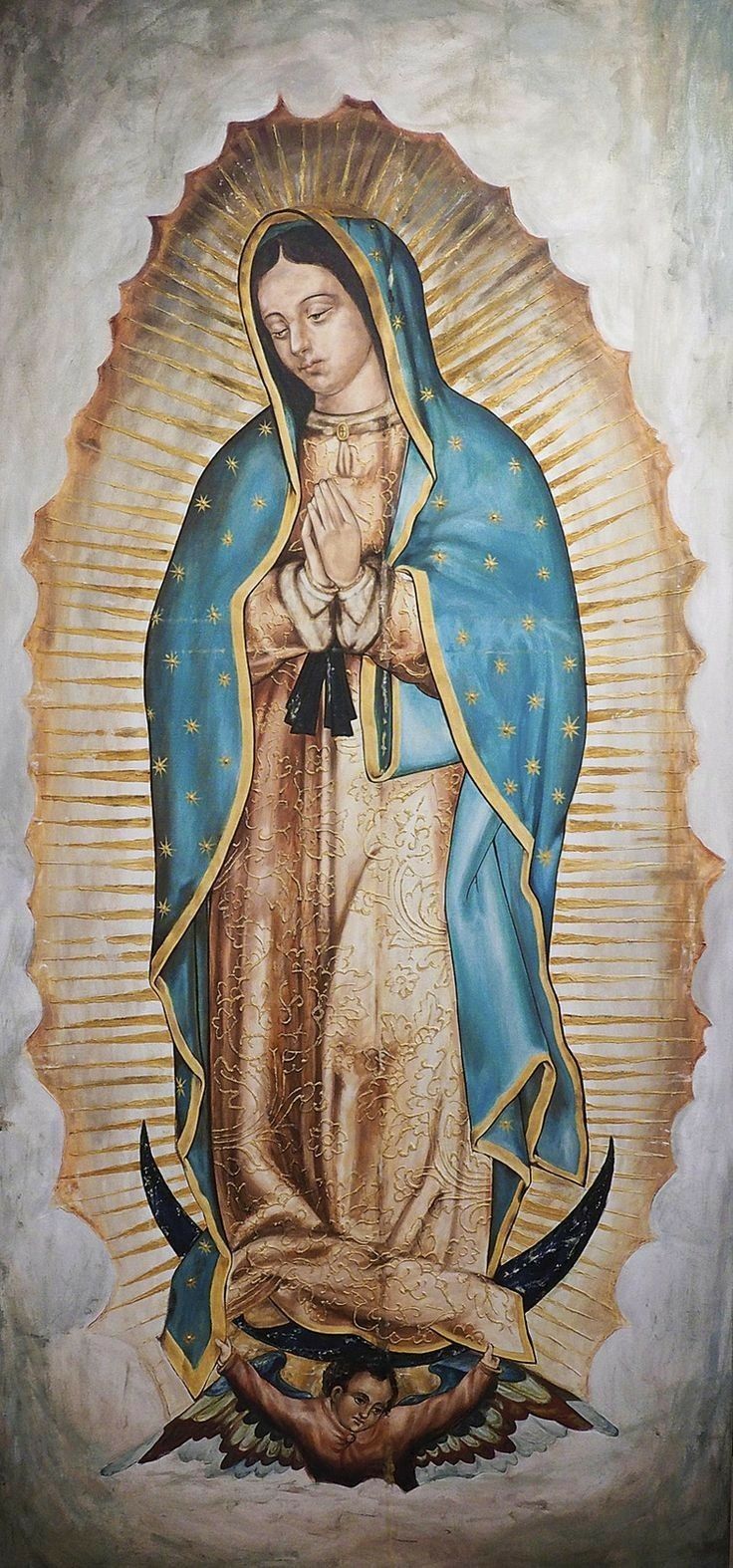
Since we do not know each other, yet, please allow me to take a few minutes to tell you a bit of my story, and to share with you how it was that I came to have a great devotion to the Blessed Virgin Mary, the Mother of Our Lord, Jesus Christ, whom we honor and celebrate as Our Lady of Guadalupe.
I was raised on a farm in the Old Beech Mountain Community of Avery County in the Blue Ridge Mountains of Western North Carolina. From my infancy, I know what it was like to live “on the border,” because I lived only a few miles from Watauga County (where most of my ancestors had lived since the middle of the 1700’s. I also lived only a few minutes from Carter and Johnson Counties in Eastern Tennessee. My paternal grandmother was a Bunton, and her mother was a Brockwell and Helton from Unicoi and Washington counties. Mammaw was from a mixed-race family and was quite proud of her Cherokee ancestry.
When I was a junior at Avery County High School, I was selected to attend the Governor’s School of North Carolina, and spent a Summer at Salem College (originally a Moravian College for Women in Winston-Salem, North Carolina). I was selected to study Spanish.
During that Summer, I—who had been raised in a very traditional and conservative Southern Baptist family discovered the Roman Catholic Church. As part of that process, I was exposed to the numerous Marian apparitions: Our Lady of Lordes, Our Lady of Fatima—and most importantly, to Our Lady of Guadalupe. I suppose that the latter apparition was the most interesting to me, because of my interest in the Spanish language, but also because The Virgin Mary was depicted as an Indigenous Aztec Princess who had chosen an indigenous peasant, Juan Diego, to be her spokesperson to the powerful Franciscan Bishop of Mexico who, (blinded by his own privilege), could not imagine that such an occurrence was possible!
Because I was fearful of the response that I would likely encounter if it became common knowledge that I was contemplating converting and becoming Roman Catholic, I did not have many people with whom I could discuss these delightful new discoveries. The one person whom I did trust was my Spanish teacher. Interestingly enough, he had been raised in Colombia—the child of fundamentalist Presbyterian missionaries, who had gone there to convert as many Roman Catholics as possible. Needless to say, that family became quite alarmed when they began to suspect what I was thinking.
One day, I had a conversation with my teacher which wound up being one of the most important moments of my entire life. After dismissing some of the things about the apparition a Tepeyac, which had captured my attention, as “superstitious,” he then made an astonishing personal comment.
“In Colombia, you would not be considered white—you would be considered mestizo.” It was truly a moment of revelation. All at once, a whole series of things which had troubled me for years came together. It was at that moment that I finally understood a big part of who I am. I am not white! No wonder I had never really “fit in” with so much of the culture in which I had been raised. In that culture, “whiteness” was a treasured reality. Anyone who was not “white” was viewed as inferior, as less, as other. Because so many people in the mountains where I was raised had indigenous ancestry (or claimed to), that was not viewed as harshly. Blackness, though, was another matter. I grew up commonly hearing racial slurs, and witnessing the ways in which black persons were mistreated, abused, and intimidated. That was especially surprising, because there were so few of them.
So, the whole realization of my mixed-race status was closely connected with the indigenous apparition of Our Lady of Guadalupe!
Almost immediately, I realized that, without understanding the implications of this, I had never considered myself white, that I had no desire to “pass as white.” Since that day, I have never thought of myself as white. Even more interestingly, years later, I was delighted when DNA tests revealed that I had African ancestry (from the Gambia) and Iberian Sephardic Jewish ancestry. So, I was not of Latino descent, but of Peninsular descent. I was also delighted when I was able to document descent, through the Helton family, real Cherokee ancestry. So, in the case of my family, this was not just something that we had been told—we were able to show a “paper trail” to people were the “real thing.”
As I prayed about, and reflected on all this, I came to feel a close personal connection to Our Lady of Guadalupe. How fascinating that the Mother of God appeared as “one of us.” How incredible that she spoke to us with native ancestry as “her beloved Children.” And the child to whom she appeared was not European. Even more importantly, she addressed him in his own language and in ways which validated and affirmed his culture. Long before I had the opportunity to formally study “theology of inculturation,” I experienced the power that symbols have–to embrace, to celebrate, and to validate. Somehow in this apparition, I felt closer to God. And, I felt that God was closer to me.
Dear Siblings, we live in a time in which those who have mixed ancestry once again experience prejudice, persecution, and marginalization. This feast is an opportunity for us to cry out from the very depths of our hearts, “We matter. We too, are beloved of God. We too are called to share our own unique gifts in every place in which we live, move and have our being.”
Blessed Mother of Tepeyac, pray for us, that we may be made worthy of the promises of Christ. Holy Juan Diego, pray for us, that we may persevere—in the face of all adversity—in being faithful disciples of Our Lord, Jesus Christ.
If you are interested in viewing the bulletin which I prepared for the Service (in Spanish), here is the link.

 Seeking God