
A SERMON FOR THE EPISCOPAL CHURCH OF THE BUEN PASTOR in Durham, NC
The Sixth Sunday of Easter C
Dear Sisters and Brothers,
I greet you in the name of Our Resurrected Lord and Savior, Jesus the Christ, and in the names of his humble disciples Francis and Clare—who accepted his call to help rebuild the Church, which was in ruins. In our own time and place, I pray for the wisdom for each of us as we move forward to welcome the Lord, ever more completely into our minds, hearts, and lives, and for opportunities for us to work to build up and to strengthen authentic Beloved Community.
Before I continue with the words which I have prepared to share with you today, I would like to do something which I very rarely do. I would like to begin with a personal note. Thank you for your warm and gracious welcome to me. I would like to especially acknowledge and thank Father Ricardo for the amazing support, encouragement, and affirmation which he has given me over the past few months. I have so enjoyed the occasions in which I have been blessed to worship with you—and to take photos, which I pray will be of some small use to this community, to the Communications Ministry of the Diocese of North Carolina, and to the Office of Latino/Hispanic Ministries of the Episcopal Church.
To my great surprise and delight, this is a Eucharist which has special meaning for me. It is the first time, since the Reception of my Ordination as Priest in the Episcopal Church that I have had the opportunity to Preside at the Eucharist. For that reason, please know that, going forward, you will have a very special place in my heart.
Song:
Un mandamiento Dios nos ha dado. Que nos amemos unos a otros
Que nos amemos, que nos amemos. Que nos amemos unos a otros
My dear friends, if we hear nothing else today—other than the simple words of this song—we have heard the proclamation of the Holy Gospel! The message is simple, clear, and direct—Our Lord has commanded us to love each other!
This direct and immediate command is one that could cause lawyers to be begin to ask questions, but who is the other that I am commanded to love? It is not unlike that question posed to Jesus, but who is my neighbor?. It is not unlike that question Cain posed to God, who is my brother? In every case, the answer will be that there are no exceptions. We do not get to choose who we will love. Jesus’ command is that we love everyone!
We can not help but think of that often quoted comment by our former Presiding Bishop and Primate, Bishop Michael Curry, “If it’s not about love, it’s not about God!” The good bishop rooted his theology in the shocking reality of the Primitive Church. A group of believers in the Syrian (gentile) city of Antioch took everyone by surprise. There was something different about them, something unexpected about them, something that no one could ever recall seeing or experiencing before. They loved each other! And because of the power of that witness, those around them searched for some motivation. What was it that caused them to not only profess that they loved each other but to demonstrate that belief in the way that they treated each other. The only conclusion that outsiders could come to was that they were acting a lot like that Jesus. And so it was that they began to call them, for the first time, Christians.
It was not that the believers in Antioch began to pat themselves on the back and say, “Wow, we are doing a good job of being disciples of Jesus.” Rather, it was that others were so surprised by their behavior that they began to remark on it and labeled them as disciples, as friends, and as followers of the Christ. And thus we gained our name. All because of love. It was love that formed us into a community and made us Christians!
These days it feels as if though love is a rare commodity. In a time of division, polarization, and disharmony, we do not see a lot of love, we do not hear love expressed, and we do not feel that we are loved—or that others who are important to us are loved or valued. Honestly, it can feel that we are being attacked, that our Church is under attack, and that those we love are not safe. What are we to do in such a time? How are we to respond to those perceived attacks?
It would be simple if the opposite of love was hate. That is far too simple. It does not take much effort to find those who spew fountains of hateful words—words of racism and prejudice, words of misogyny, words of homophobia, bigotry, xenophobia, and words which deny the basic goodness and dignity of any person. What is more disturbing, more frightening, and more destructive is not hatred—it is antipathy. It is not that some choose to hate, it is that they choose not to care—and are unwilling to take a stand. They are unwilling to speak truth because it is inconvenient. In a few cases people are afraid—and with good reason. But in the vast majority of cases, they choose not to speak our because it will make their lives uncomfortable. It is time for each of us to ask the difficult question—is that hypothetical “they” of which I was just speaking “me.” Is it I?
The Hebrew Scriptures make it abundantly clear that there are three groups of people who are sacred—who are holy—to God: Widows, orphans, and aliens. In other words, any who are on the margins, who are vulnerable to be abused and exploited are precious to God. And, as children of God, we are commanded to love them, to care for them, to speak out on their behalf, to defend them, and to do all in our power to assist them. If we fail to do that, we run the risk of hypocrisy. Our mouths profess our belief in God, but our actions do not give testimony to that profession. As Saint Paul might tell us, our words are like “noisy musical instruments,” which only distract. They are ultimately meaningless.
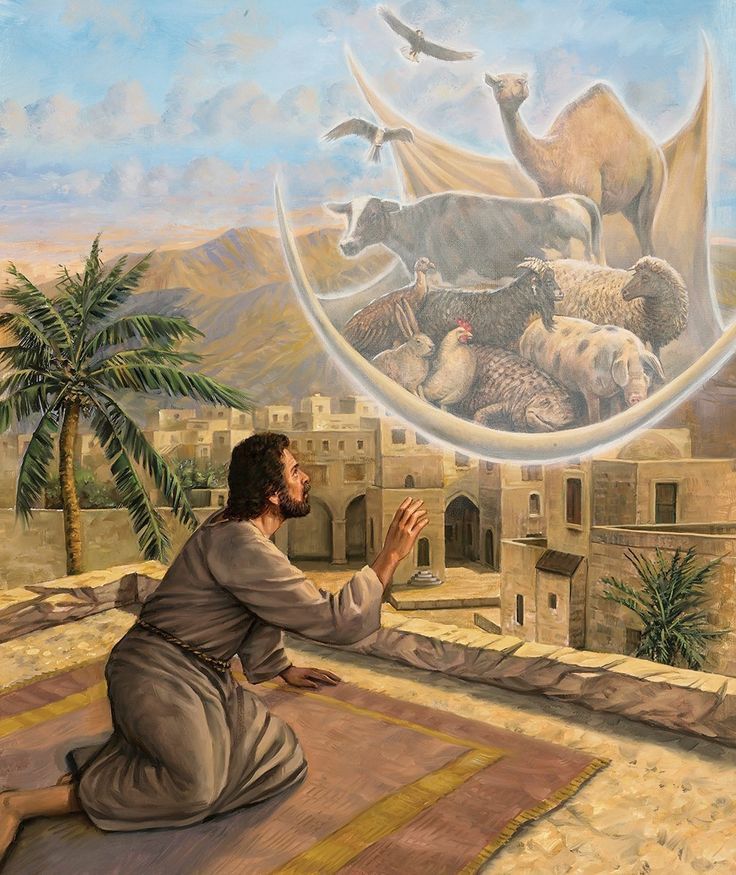
Our reading today, from the Acts of the Apostles (the sequel to the Holy Gospel according to Saint Luke) reminds us of a moment of conversion in the life of the Apostle Peter. Peter is taken by surprise to discover that God is inviting gentiles into full and active membership in the Church. It is not that Peter hated Gentiles. It is just that he did not really spend any time thinking about them. For him, they were “other.” He had not considered that they were worth bothering with. When he is given a vision which calls into question everything he thought he knew, he is shaken. The very foundations of his faith are knocked over. He was sure that he knew what God wanted. He is invited—in a very dramatic way, kind of like Paul had been on Damascus Road—to reconsider what God is all about. Peter comes to understand that God does not consider anyone—anyone at all—to be unclean, impure, throw away, trash. In God’s eyes none of the distinctions which humans are prone to make matter. Every person is beautiful, worthy, and holy—because every person, without exception, reflects the reality of the Creator of all.
My dear friends, we are called today to be persons who love—deeply, and without reservation. We are called to be such faithful followers of Jesus that others will look through us to see the love of Jesus which impels us. May we never grow weary in loving, in serving, and in caring for those who God has placed all around us. For in loving and in serving them, we will love and serve Jesus—present in them.
Jesus has indeed given us a new commandment—that we love one another!!
 Seeking God