
Sermon for the Third Sunday after Pentecost,
June 29, 2025
The Episcopal Church of the Holy Spirit in Greensboro, North Carolina
אֵלִיָהוּ הַנָבִיא, אֵלִיָהוּ הַתִּשְׁבִּי, אֵלִיָהוּ הַגִלְעָדִי בִּמְהֵרָה יָבוֹא אֵלֵינוּ עִם מָשִׁיחַ בֶּן דָוִד
Eliyahu HaNavi, Eliyahu haNavi, Eliyahu haTishbi, Eliyahu haGil’adi, Bim’hera v’yameinu yavoh eleinu, im mashiach ben David.
Elijah the Prophet, Elijah the Tishbite, Elijah the Gileadite, Speedily and in our days, Come to us, With the messiah, the son of David, With the messiah, son of David.
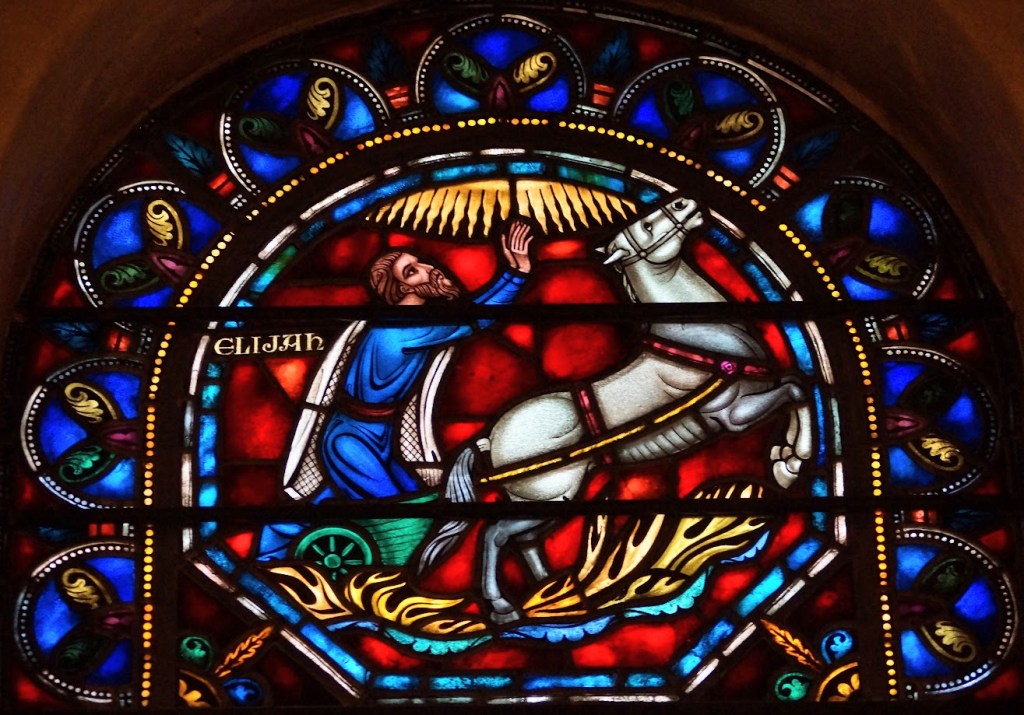
The Prophet Elijah is one of the most fascinating characters to be found in the Hebrew Scriptures. His name means “Adonai is my God,” and he is called “The man of God.” He ministered at a difficult and painful time of transition and struggled to make sense of the chaos that surrounded him. It was a confusing time of religious turmoil and political upheaval. Elijah struggled to discern God’s will and then, at great personal risk to his own life, persevered in carrying out the mission that God had entrusted to him.
When we think of any of the Prophets, but most especially of Elijah, we are invited to let go of many of the preconceptions which we have of the role and of the office of Prophets. In the popular imagination, they are like fortune-tellers, people who predict what is going to happen in the immediate future and in the more distant future. This makes good religious fiction, and perhaps good storytelling, but completely misses the point.
In seminary, we were given two catch phrases, which I have not forgotten to help us better understand what the prophets were really up to!
“The role of the Prophet is to afflict the comfortable, and to comfort the afflicted.”
“The role of the Prophet is to ‘forth-tell,’ not to ‘foretell.”
In other words, the Prophet is someone who is blessed with God’s vision and insight. The Prophet sees things as God does, and speaks that insight calmly, clearly, and without hesitation. It is a message which inevitably brings controversy because it challenges those who abuse the poor, needy, and marginalized. And it always calls the People of God to change, growth, and conversion.
In the particular context of the story of Elijah—are two of the most evil, merciless, and corrupt rulers in the history of Israel—Ahab and Jezebel. Even to this day, the name Jezebel is used as an insult to those who are only concerned about themselves and who do not care who they hurt.
These shameless rulers attempted to use religious figures who would support them without question, and who would claim that the gods (in this case the god Baal) had blessed all their actions. Baal wanted them to live lives of fame and luxury while others starved in the streets. Israel had endured a horrible three-year drought, and there was no help for the poor, the weak, and the oppressed. In the midst of that, Ahab and Jezebell were partying it up in the remodeled palace in Jerusalem, and using murder as a tool to get their way.
After having received push back from the priests of the God of Israel, Jezebel decided to have them all eliminated. So, she took out a series of contracts and the hit-men began to eliminate her opponents one by one. In the end, only Elijah remained.
When Elijah called down fire from heaven and eliminated the priests of Baal, he was forced to flee for his life. On Mount Carmel, in a cave, he encountered God and was affirmed in his vocation as Prophet. In a dramatic turn of events, Ahab and Jezebel’s chickens “came home to roost,” and then things return to some semblance of normalcy.
The passage which we heard today, from the Second Book of Kings tells the story of the conclusion of Elijah’s ministry and of his miraculous entry into glory.
Transitions are never easy—even if welcomed. For Elisha, Elijah’s disciple and successor, and for the People of Israel, it was difficult to lose Elijah. He had guided them through very difficult times, and offered them safety, security, and stability. They did not know what they would do without him. How could they move forward? It was for that very reason that Elisha made the request to have a “double portion of Elijah’s spirit.” He knew that had “big shoes to fill.” Unless God helped him, he was afraid of literally taking up the mantle of his teacher and mentor Elijah.
In Jewish thought, though, Elijah plays another role. Since he was kind of “beamed up to heaven” in a fiery chariot, there is the notion that he is waiting on the margin for the proper time to return. And, it was believed, Elijah’s return will inaugurate the “messianic era,” because he will prepare the way for the coming of the messiah. As the song which I shared with you at the beginning states, “May he soon bring with him the Messiah, the Son of David.”
It is no coincidence that many in Israel believed that John the Baptizer was “Elijah returned.” And in the accounts of the Transfiguration, it is Elijah and Moses who appeared to Jesus, Peter, James, and John on the mountain. This is a clear indication that they were ushering in Jesus as the Messiah—and immediately afterwards Jesus headed down the mountain with his face set toward Jerusalem.
To this day, there is an empty place left for the Prophet Elijah at the Passover Seder, and at the conclusion of the Seder, the door is opened to welcome Elijah—and the messianic era.
Today we find ourselves in a confusing, difficult, and frightening time. We witness the abuse of migrants, refugees, and the oppressed. We fear that many may soon lack the essential necessities for life—medical care, food, clothing, shelter, and the resources necessary to pay their basic bills. In such a context, the story of Elijah reminds us that, even if those in power ignore the lowly ones in our world, God does not forget them. In their suffering and misery, God will be present to them and with them.
We are also reminded that God is counting on each of us to do what we can to stand with them, to love them, to serve them, and to protect them. We must never loose hope because God will be with us in the midst of chaos and terror–and will give us every resource that is needed to care for all.
Elijah the Prophet, Elijah the Tishbite, Elijah from Gilead, be with us now and assist us in making real, present, and effective, the love of our Lord Jesus, the “Christ,” the Messiah, the Son of God.
A Summary of the Sermon in Spanish and English
Hoy nos encontramos, en nuestra primera lectura del Segundo Libro de los Reyes, quizás con las personas más interesantes de todas las Escrituras Hebreas, el profeta Elías —el “hombre de Dios”— y los malvados gobernantes Acab y Jezabel.
Acab y Jezabel viven el “estilo de vida de los ricos y famosos” en lujosos palacios de Jerusalén y se afanan en robar a los pobres y maltratados. Se trata de “todo acerca de ellos”. La única persona que se interpone en el camino de sus planes, una “espina en su costado” es el profeta Elías. Los desafía constantemente, señala la crueldad y la inmoralidad de sus acciones y los llama a rendir cuentas por sus pecados contra el Pueblo de Dios.
Intentan repetidamente eliminarlo, matarlo, asesinarlo, pero Dios lo protege y, en última instancia, usa su ministerio para hacerlos responsables de sus acciones.
El pasaje que escuchamos hoy es el relato de la partida de Elías para estar con Dios cuando deja la tierra en un carro en llamas. Es un recordatorio de que Elías no muere, es llevado al cielo. Por lo tanto, en el pensamiento judío, existe la creencia muy real, entonces, como ahora, de que Elías regresará para traer al Mesías. En los evangelios, Elías aparece con Jesús (y Moisés) en la Transfiguración. Esto prueba que Jesús es verdaderamente “El Cristo,” “El Ungido,” El Mesías.
En nuestra propia época confusa en la que los pobres son abusados y explotados, los migrantes y refugiados son señalados para el maltrato, y el estado de derecho parece estar desmoronándose, necesitamos escuchar a personas como Elías hablar en nombre de Dios y decir que esto está mal. Esto no es lo que Dios desea. Que cada uno de nosotros haga su pequeña parte para apoyar a los oprimidos, abusados y explotados, con los más vulnerables en nuestra sociedad. Y que nosotros también trabajemos para defender el respeto, la dignidad y el valor de cada persona, creada a imagen y semejanza de Dios.
We encounter today, in our first reading from the Second Book of Kings, perhaps the most interesting persons in all of the Hebrew Scriptures, the Prophet Elijah—the “man of God”—and the evil rulers Ahab and Jezebel.
Ahab and Jezebel are living the “lifestyles of the rich and famous” in luxurious palaces in Jerusalem and are busily robbing from the poor and abused. It is “all about them.” The one person who stands in the way of their plans, a “thorn in their side” is the Prophet Elijah. He constantly challenges them, points out the cruelty and immorality of their actions, and calls them to account for their sins against the People of God. They try repeatedly to have him eliminated, killed, murdered—but God protects him, and ultimately uses his ministry to make them accountable for their actions.
The passage we hear today is the account of the departure of Elijah to be with God as he leaves earth in a flaming chariot. It is a reminder that Elijah does not die, he is taken up to heaven. So, in Jewish thought, there is the very real belief—then, as now—that Elijah will return to bring the Messiah. In the gospels, Elijah does appear with Jesus (and Moses) at the Transfiguration. This acknowledges that Jesus truly is “The Christ,” “The anointed one,” The Messiah.
In our own confusing time in which the poor are abused and exploited, migrants and refugees are singled out for mistreatment, and the rule of law seems to be falling apart, we need to hear people like Elijah speak up for God and say that this is wrong. This is not what God desires. May each of us do our own small part to stand with the oppressed, abused, and exploited—with those who are most vulnerable in our society. And may we too work to uphold the respect, dignity, and value of every person, created in the image and likeness of God.

 Seeking God