
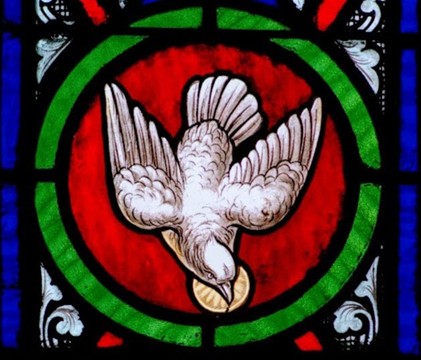
The Seventh Sunday of Easter at the Episcopal Church of the Holy Spirit in Greensboro, North Carolina.
Many years ago, when I was a seminarian at St. Vincent Seminary, in Latrobe, Pennsylvania, I was blessed to have an incredible professor, Fr. Bede Peay, O.S.B., who was the teacher of homiletics. In later years, Fr. Bede, joined the Episcopal Church, and became the Rector and Dean of Nashota House. Fr. Bede, early on in our first class with him, made a technical distinction, which I have found quite helpful over the years, between the “sermon” and the “homily.”
The sermon, he told us, is normally longer, is more thorough, and often deals with an issue or theme, such as a matter of doctrine, and explores it in some detail. He used the example of the sermon during the Great Awakening in this country. It was not uncommon for them to last several hours. I imagine that many of us would feel that we had been taken hostage is we walked into that kind of preaching, without realizing it!
The homily, by contrast, is shorter, and tends to be more devotional in nature. The goal of this kind of preaching is to challenge, encourage, and motivate. Since we knew that those attending the Eucharist in the Roman Catholic Church had the expectation (or should I say the hope) of “getting in and out” in less than an hour, that meant that the preacher normally had about eight minutes. In the Episcopal Church, by contrast, where there is not the sense of urgency, it is more common for the preaching to take 15 to 20 minutes.
I personally tend to fall somewhere in between the two models, my own “middle way,” or “via media.” On the Sundays that I have the opportunity to be with you, and to preach, I will attempt to do so in a bilingual way, as we go. I do prepare a written text, though, and will place the text on my blog, most likely only in English.
One of the great treasures of belonging to a tradition which values the liturgy is that each celebration has a unique context in the framework of the “Year of Grace.” For instance, we think of the liturgical year as one which is divided into seasons. We begin with Advent, move into the Christmas Season, and then into the Sundays after the Epiphany. After the long season of Lent, we move into the Triduum of Holy Thursday, Good Friday, and the culmination of the year in the celebration of the Easter Vigil of the Resurrection. Easter is a season lasting fifty days (intentionally longer than the forty days of Lent) which concludes with the Feast of Pentecost. After Trinity Sunday, we enter into the final season of the Sundays after Pentecost (in some traditions known as “ordinary” time because the Sundays are counted.). And what an array of colors we use to celebrate these seasons-blue, rose, white, gold, purple, red, and green. Each of these colors enhances the season, and the particular Eucharist which is being celebrated.
And so, it is important on this Sunday, perhaps more than at any other time, to take a moment to consider the liturgical context in which we find ourselves. Today we celebrate what is really the last Sunday in the Easter Season, if we allow that the Feast of Pentecost has a unique and different character. But we are also in the nine day period following the Ascension of Our Lord. Thus we are in the
“novena” in which the disciples continued to gather in the Upper Room in prayer following the departure of Jesus—preparing for the coming of the Advocate, the Holy Spirit—even though they were clueless as to what that would mean!
For Second Century Judaism, there were three pilgrim festivals which took place each year, and Jews, who had the resources to do so, traveled to Jerusalem to celebrate them. Passover recalled the escape from the slavery of Egypt and the beginning of the journey to the land of promise. Shavuot took place fifty days later (hence the Greek name “Pentecost” meaning fifty) and recalled the giving of the law to Moses on Mount Sinai (which had taken place fifty days after the first Passover Meal). Finally, “Booths,” or “Tabernacles,” (in Hebrew Succoth) commemorated the forty years of wandering in the wilderness. It was not uncommon for Jerusalem to fill to almost overflowing for these Feasts, which Jews from all over the diaspora, all around the Mediterranean Sea—an amazing variety of cultures, languages, and styles of clothing. And yet, all were united in the worship of the One God of Abraham, Isaac, and Jacob, the God of Moses, David, and of the Prophets.
So, what was going on in the Upper Room? The disciples were exhausted. Their three years of following Jesus in the many adventures of his public ministry had come to a shocking and disappointing end with the passion and crucifixion. They were completely demoralized and scattered. And so, they fled, to the last place where they had gathered in community with Jesus—the Upper Room. They were terrified that someone was going to come looking for them too-they were not quite sure who it might be, Jewish authorities, or Roman soldiers. So, they locked the doors!
Jesus appeared to him in his resurrected body and gave them hope! Perhaps it had not ended after all. And yet, they were so shell shocked that they left and went back home to Galilee. Over a period of forty days, Jesus appeared to them in various places, to console them, to encourage them, and to prepare them for his departure. When he ascended into heaven, they were left alone. They returned to the Upper Room and entered into a time of intense prayer. It was a prayer of desperation, and of total surrender. It was a prayer in which they begged God to help them, to lead them, and to guide them. Because they realized that, on their own, they were hopeless, clueless, and powerless.
I will not steal the thunder of Father Javier for next Sunday when he shares with you the account of the outpouring of the Holy Spirit on the Feast of Pentecost—and to the transformation of the disciples from terrified, trembling, and weeping prisoners of the Upper Room into bold, and fearless missionaries for Jesus.
We are not yet at Pentecost. We are in an in-between time, a time between the Ascension, and the coming of the Paraclete. And, so, during these nine days, the invitation is offered to us to unite with the disciples in that Upper Room. To that end, I have prepared a handout with the text of the traditional Prayer to the Holy Spirit. We will pray it today, and I invite you to please pray it each day until next Sunday.
Through this prayer, may we prepare ourselves to renew the gift of our own Confirmation—the gift of the Holy Spirit through the laying on of hands by a Bishop, a successor of the Apostles. And may the power which we were given through this Holy Sacrament continue to transform and to empower us to bring to completion the Good Work which God began in us.
A Novena to the Holy Spirit:
Come Holy Spirit, fill the hearts of your faithful and kindle in them the fire of your love.
Send forth your Spirit and they shall be created.
And You shall renew the face of the earth.
O, God, who by the light of the Holy Spirit,
did instruct the hearts of the faithful, grant that by the same Holy Spirit we may be truly wise and ever enjoy His consolations,
Through Christ Our Lord, Amen.
 Seeking God