The Baptismal Covenant

The Feast of All Saints with the Renewal of Baptismal Vows at St. Paul’s Episcopal Church in Wellsboro, Pennsylvania. November 2, 2025.

The Episcopal Church asks us to renew our Baptismal Vows four times each year. That really is quite astonishing. I am not honestly aware of any other Christian denomination that places such an emphasis on Baptism. 

At the very center of that renewal is the Baptismal Covenant. It is, without doubt, the single best liturgical text  which the Episcopal Church has produced. I have not seen anything quite like it in all my years of exploring various expressions of Christian faith.

If someone were to ask me, “Where would I find a quick overview of what it means to be a Christian, or an Episcopalian, where would I look?” Without a moment’s hesitation, I would ask them to get out a copy of the Book of Common Prayer and to turn to page 292.

I would hope that they would remark—this is taken from the Liturgy of the Great Vigil of Easter. That would then give me the opportunity to share that the Easter Vigil is the single most important Service of the entire year. It is the Liturgy which embodies the essence of the Christian faith. The amazing symbolism of this Feast of the Resurrection of Our Lord Jesus Christ, gives us the lens which we need to most fully understand who Jesus was and is, and to contemplate what it ultimately means for us to be incorporated, as Saint Paul, our Patron, tells us, into the very life, passion, death, and resurrection of the Lord.

At the heart of that lovely Service is the moment in which we welcome those who wish to be united with us through the Sacrament of Holy Baptism. It is also the moment in which we, as individuals accomplish the goal for which we have been preparing from Ash Wednesday, the moment in which we recommit ourselves to lives of love, discipleship, worship, and community as members of Christ’s one, holy, catholic, and apostolic Church.

Of course, this annual recommitment, this reaffirmation of our faith, has as much to do with us collectively, as it does for us as individuals. It is the moment in which we as a Community of Faith—as a diocese, and as an integral part of the Anglican Communion—accept the invitation of Jesus to become light, salt, and yeast. In other words, it is at this moment that we accept the call to work in the Lord’s Vineyard, to rebuild Christ’s Church—and through it, to work to make the promise of Beloved Community real, present and effective.

But, what is it about the Baptismal Covenant that places it at the heart of our personal and collective call to discipleship?

The first section of the Baptismal Covenant takes us from a renunciation of evil, and to a commitment to Jesus the Christ. This symbolism derives from the Catechumenate of the Primitive Church. It was acted out, by asking the Candidate for Holy Baptism to first turn towards the West (the place of sunset, of darkness, and orientation away from God). There they would renounce evil, and then breathe out. Afterwards, they would turn around to face towards the East (the place of sunrise, of light, and orientation towards God). They would breathe in, pause in the light of the Paschal Candle, and then make a Profession of Faith using the model of the Apostles Creed.

It is at this point in that Easter Liturgy, that the brilliant theological insight of The Episcopal Church is revealed. Because the Liturgy does not conclude with the Profession of Faith!

There follows a dialogue, a call and response, if you will, in which the Community is guided through a reflection on discipleship. In five questions, the People of God are invited to move beyond a simple recital of the essentials of the Faith into a journey of discernment and discovery. How can these words which we have just professed be put into action, so that we move beyond theory into practice? How can we live authentic, transparent, and faithful lives—lives of integrity—which make the saving presence of Jesus visible in our homes, in our communities, and in our world?

It also strikes me as intentionally symbolic that there are five of these questions. They recall for us the importance of the number five in our Jewish and Christian Tradition. 

The Torah of the Hebrew Scriptures begins with five books—Genesis, Exodus, Leviticus, Numbers, and Deuteronomy. We sometimes use the Greek term, “Pentateuch,” or the “Five Books,” to describe these foundational books in the Hebrew Canon.

Some Scripture Scholars have suggested, for instance, that the Book of Psalms may be divided into five sections—based on content and theology.

We speak of the five wounds of Christ (hands, feet, and side). And that symbolism is replicated in various ways on each altar which we use to celebrate the Holy Eucharist.

There were five Churches in antiquity—Jerusalem, Rome, Constantinople, Alexandria, and Antioch. The lovely Jerusalem Cross contains that symbolism.

As each of the questions is posed, we are invited to respond “I will, with God’s help.” This is more than an act of piety. From the beginning we acknowledge our complete and total dependence on God. Without God’s help it would be impossible for us to accomplish anything that we resolve to do. There is a beautiful prayer, derived from the first chapter of the Letter to the Philippians, which expresses this reality, “May God bring to completion the good work which he began in you.”

The first question anchors our actions in the context of community. Here we are presented with gifts—treasures—which are offered to us to enable us to live out our vocation as disciples of Jesus: the apostles’ teaching (we might use the word Tradition to describe this), fellowship, the breaking of bread, and prayer.

None of these are solitary in nature. Each invites us to a life of cooperation, collaboration, and incorporation into community. They remind us that it is the community which helps us to discern how best to use our own gifts, strengths, and talents to repair and to restore Christ’s church.

It seems entirely appropriate on this Feast of All the Holy Ones to acknowledge that beautiful passage from the twelfth chapter of the Letter to the Hebrews: “Therefore, since we are surrounded by so great a cloud of witnesses, let us also lay aside every weight and the sin that clings so closely, and let us run with perseverance the race that is set before us, looking to Jesus, the pioneer and perfecter of faith, who for the sake of the joy that was set before him endured the cross, disregarding its shame, and has taken his seat at the right hand of the throne of God.”

Each of these tools feeds us; physically, emotionally, and spiritually. Through them we are strengthened, built up, and then sent out in mission. Perhaps more importantly, they serve for us as a guide or model. We are called to imitate them, and be so transformed by them that they become an automatic way of thinking, acting, and being.

The second question is, perhaps, the most overlooked, the least understood, and the least applied to our lives. It reminds us that we are called to a life of ongoing conversion, rather than to a single act of commitment. We are asked to change daily, sometimes, hourly. This means that, as we focus on Jesus, our attitudes, our preconceptions, and our world-view change. Little by little we begin to think with God, to act for God, and to love as God.

The question is an honest one—and one that pierces through all our defenses, to open our hearts to the possibility of change and growth. It does not say, “if you fall into sin,” it says “whenever you fall into sin.” And it provides the answer, the solution as to how we go about getting “back on track.” We are invited to repent and to return to the Lord. This life of ongoing conversion, of renewal, and reorientation is exemplified by the Greek word, “metanoia.” Metanoia is a rather dramatic word. It suggests that we suddenly realize (with the help of God’s grace) that we are walking on the wrong path—a path that leads to death and to destruction rather than to life. And so, we do an about-face. We turn our back on the way we were going, turn in the completely opposite direction, and begin to walk away from sin, and, now, towards God. We turn from evil to good, from darkness to light, from despair to hope. It is important to remember that this is not only a personal movement, it is also a collective call. We honestly acknowledge and admit that we sin, not only personally, but also collectively. And thus, as a Church, we are called to conversion, to growth in holiness, and to acts of reparation to any whom we have failed to love as God loves.

The third question speaks of how we live out that call after we have reoriented ourselves in Christ. We are called to serve as evangelists—quite literally as messengers who bear good news. But, we are called to proclaim this good news not only with our words, but by our actions. We are called to be not only “hearers” but also “doers.” There is an old saying, attributed to Saint Francis, “Preach the Gospel at all times, and, if necessary, use words.” Even if Francis did not actually say that, the sentiment is true!

The Fourth question invites us imitate Jesus, who came to “serve and not to be served.” It reminds us that discipleship is not just a theory, it is carried out through concrete actions. It is a proactive call, we do not passively wait by the side, hoping that God will send someone our way to love and to serve. No, we go looking for them. We seek them out. We search for those who are in need of God’s love. Then, as Jesus reminds us in the twenty fifth chapter of the Gospel according to Saint Matthew, when we love and serve anyone–but most especially the hungry, thirsty, homeless, naked, the stranger, the sick, and those in prisons—we are actually caring for them, but also for Jesus who is present in them! How fascinating that this question asks us to go beyond acts of kindness and generosity—essential though they are—to loving them and to acknowledging them as neighbor. We are only able to do this if we also learn to love ourselves—recognizing that we too were created in the image and likeness of God, and celebrating the all-encompassing love that God has for us. Love is the secret ingredient: love of God, love of neighbor, love of self. As Bishop Curry so often reminded us, “If it is not about love, it is not about God.”

The final question really seems, to me, to embody the heart of communal discernment. While it is something that we are called to practice as individuals, it is at the very core, a reminder of the power that we have as a community of faith to work to build and strengthen Beloved Community. We are challenged to strive for justice, to work for peace, and to respect the dignity of every human being (without exception). What a daunting task, it seems impossible. But, if it is rooted in relationships, it is entirely doable.

To give one example, the best kind of feeding program is one that not only provides for the physical needs of those who show up at the doors (food, clothing, supplies, etc), it is one in which those serving spend time getting to know those who are being served. Rather than thinking of the guests as a group to be fed and sent on their way, they think of them as unique persons with feelings and needs. Have they been hurt, are they wounded emotionally and spiritually. Do they feel loved? Do they feel that they matter? Has anyone taken the opportunity to sit down with them, to eat with them, to listen to them. Has anyone asked them what they need, what they want, what they desire? Do they feel heard? Do they feel visible? Do they feel validated, affirmed, and loved. Do they feel loved?

I rejoice each year, on this great Feast, when I hear those shocking words of Jesus from the Gospel of Luke, taken from the great Sermon on the plain. Using a series of contrasting images (blessings and woes) Jesus gets to the heart of the matter. As unbelievable as it seems, he tells us that those whom we might have been tempted to believe are cursed are actually blessed; the poor, the hungry, those who weep and mourn, those who are hated, excluded, reviled, and defamed. They are sacred to God, and God is present to them in their vulnerability, in their suffering, and in their pain. God shows them love, and compassion.

The woes remind us of the danger of depending on ourselves, on our own strengths, on our own resources, rather than trusting in and depending on God. It is in our weakness and vulnerability that we allow God’s strength, rather than our own, to become active and transformative!

The Gospel concludes with a call to action. There are a series of concrete things which we can do to be part of the solution rather than contributors to the problem: love, do good, bless, pray, be generous, and commit to non-violence.

In just a few minutes we will renew our Baptismal Vows. May God bring to completion, to fulfillment, the good work begun in each of us through the power of the Sacrament of Holy Baptism in which we were “sealed by the Holy Spirit and marked as Christ’s own forever.”

What is best for us

A Sermon for the Sixth Sunday after Pentecost at

The Episcopal Church of the Holy Spirit

in Greensboro, North Carolina.

Martha, Mary and Jesus by David Lindley

There is an old saying in Latin, “The corruption of the best is the worst.” It seems sad to apply it to Sacred Scripture, but the truth is that over two millennia, Christians have done some horrible things with Scripture. More often than not, the problem arises when certain texts are taken out of their proper context. We call this “proof-texting,” or sometimes “cherry picking.” Disconnected from a context that gives meaning and nuance, such texts are used to justify almost anything. How sad it is to see something beautiful and constructive—created to give life, hope, and courage-used to tear down, destroy, and diminish others.

I can not think of a single text which has been more horribly misused that the passage from the Holy Gospel according to Saint Luke giving the account of the conversation which we heard today between Jesus and Martha.

What is the proper context?

The first thing to take into consideration is that Jesus and Martha know each other well. If Jesus actually had a “home away from home,” it would be the home of Martha, Mary, and Lazarus in Bethany. When he is with them, he is not a guest, he is family.

They have been so loving, so gracious, and so welcoming, that they have provided Jesus with a refuge-with a place to rest, recover, and heal from the unceasing demands placed on him.

With these beloved friends, he is able to be himself, and he does not have to worry about what anyone is going to think or say about him. What an amazing and rare thing in his life. What an incredible blessing they have given to him!

Over a period of years, the four have come to know each other very well. As a result, they are open, honest, and vulnerable to each other. They are so comfortable that they do not mince words. They say exactly what they think and feel. There is no pretense. As in most families, they have no doubt shared the same thought, or opinion more than once! Thus, I doubt that Martha said anything to Jesus in this conversation that he had not heard more than once, perhaps many times, perhaps hundreds of times.

In my own reflection on this passage, over many years, I have come to imagine that there is a clear birth order. Martha comes across to me as the oldest child, Mary, as the often-forgotten middle child. Lazarus, I think, must be the baby. Only son of the family, he has two older Sisters. I can relate to that. And thus, thinking of my own family, I can see what that means.

The oldest child so often has an exaggerated sense of responsibility. They sometimes struggle with perfectionism. They want everything to have a kind of order, to be done in a certain way, and to not have any loose ends.

Normally, this is a quite good thing. It inspires them to take the extra step, to go out of their way, and to do things rather than asking anyone else for help, because they have learned that “if you want something done right, you do it yourself.”

The eldest child often takes on a quasi-parental role, and sometimes becomes a second mother, or father. It is not so much about control as it is a desire to have the younger siblings do what is right, what is just, what is fitting. They want to be proud of their siblings, and have others be proud of them too!

So, I would not be at all surprised if Martha had often complained about Mary as being “irresponsible,” “out of touch with reality,” and a “dreamer.” She does not like that Mary does not listen to her, proves to be independent and autonomous, and “just does what she wants.”

I am not even going to start on how both Martha and Mary view the baby of the family! Poor Lazarus—drowned with love and with expectation at the same time.

This conversation is different, though, from many others. In listening to Martha—and Jesus is a very good listener—he realizes that Martha is not in a good place. Words that may have previously been made with humor are now spoken harshly. Martha is angry and unhappy. She feels overwhelmed, unappreciated, and discouraged. Jesus gets it and says to her, “Martha, Martha, you are worried and distracted by many things.”

Jesus acknowledges her hurt, her confusion, and the out-of-control feeling that she has. He takes her seriously. So seriously that it is as if asks her, “what is really going on here?” “What is this really all about.”

But then Jesus goes a step further by suggesting that Martha is making a mistake focusing outside herself. Rather than worrying about Mary, or Lazarus, or about supper, he invites her to understand just what it is that has caused he to reach this boiling point.

That is the only way for her to move forward.  If she wants peace in her own life, in her own mind, in her own heart, she will have to do the hard work of examining her own conscience. What does Martha need? I suspect that is something which she has never been asked before. I imagine that she is taken by surprise. And yet, what amazing possibilities emerge from this invitation.

I personally think that this passage only makes sense when I see what happens in the Eleventh Chapter of John. The account of the “Raising of Lazarus” provides a fascinating bookend. Here we encounter a more mature, more thoughtful, and more insightful Martha. It concludes with one of the greatest affirmations of faith that we find in the New Testament. Martha concludes her honest remarks to Jesus by confessing that in him she finds the very presence of God—”She said to him, “Yes, Lord, I believe that you are the Messiah,[g] the Son of God, the one coming into the world.”

The problem is that others, reading into this passage, have chosen to pit Martha against Mary in a kind of competition to see who is better! It is almost like asking, “who is the favorite child.” They interpret
Jesus words to Martha as a kind of put down. He is telling her what it what and putting her in her place! Even worse, the passage has been used over the centuries to suggest that the Marys of the world are holier than the Marthas. It was used to suggest that Mary is a contemplative and Martha is apostolic. So, the cloistered religious has a “higher calling” than the one who is “working in the field caring for those in need.” How many have been hurt and wounded by this distortion of Holy Scripture.

Jesus remark that “Mary has chosen the better part, which will not be taken away from her” seems to have a clear meaning to me. Mary has chosen what is best for Mary! Let her be. You do you and let Mary do Mary! I think that he is also, subtly, encouraging Martha to find what is best for her, and to go for that.

The ultimate point of all this, is don’t make comparisons. Martha can’t judge Mary, and Mary can’t judge Martha. This is not a blanket statement about holiness, or the lack thereof. In this world, and in our Church, we need Martha, Mary, and Lazarus. Each has a unique, valuable, and essential role to play. We need to stop making judgements about them, about what they have to offer, and about how important and significant their calls are. Odious comparisons always create wounds. Someone must be superior, someone has to be inferior, and that never accomplishes anything good.

When I was a college student at Appalachian State University in Boone, in the early 1980’s, I encountered the amazing music of Nancy Honeytree-a Southern Contemporary Gospel Singer. In one of her most beautiful songs she had this line, “He has chosen me to bless me, and to lead me into what is best for me.” Now that is good news. What Jesus is saying to every Martha, to every Mary, to every Lazarus, and to each of us, is–do not worry. I have chosen you to bless you! Trust in me, and I will lead you into what is best for you!

Summary in English and in Spanish

Todos luchamos por dar sentido a lo que estamos llamados a ser y llegar a ser. El proceso de discernimiento nunca es fácil, porque en parte, no nos conocemos realmente bien a nosotros mismos. También puede suceder a menudo que otros intenten ayudarnos, pero si no tienen cuidado, nos darán consejos que nos muestran qué opciones son las mejores para ellos, no para nosotros. A veces, incluso instituciones, como las Iglesias, pueden hacer lo mismo sin querer.

El famoso relato de la conversación entre Marta y Jesús proporciona una visión fascinante de cómo puede desarrollarse esto. No tengo ninguna duda de que Marta ama a su hermana María. Y, sin embargo, no respeta las decisiones que María ha tomado en su propio intento de responder a la llamada de Dios en su vida. Marta está segura de que sabe lo que es mejor para María y se siente infeliz cuando María no hace lo que ella le pide que haga. ¡Tal vez ella es sobreprotectora, tal vez es controladora, tal vez simplemente tiene ideas de lo que María debería hacer!

Jesús, sin embargo, realmente tiene el mejor interés de María en el corazón. Porque ama tanto a Marta como a María, escucha a Marta, escucha lo que ella tiene que decir y luego la desafía a dejar de lado sus propios deseos y anhelos, y a permitir que María siga el camino al que Dios ha invitado a María.

Debemos tener cuidado con una cosa. El consejo que Jesús da a Marta y a María es un consejo destinado a Marta y María. No debemos cometer el error de aplicar los detalles de ese consejo a nuestra propia vida o a la vida de los demás.

Jesús nos invita a encontrar “lo que es mejor para nosotros” y a decir sí al llamado único de Dios hacia nosotros.

We all struggle to make sense of what we are called to be, and to become. The process of discernment is never an easy one, because in part, we do not really know ourselves well. It can also often happen that others try to assist us, but if they are not careful, they will give us advice that shows us options which are best for them, not for us. At times, even institutions, such as Churches can unintentionally do the same.

The famous account of the conversation between Martha and Jesus provides a fascinating insight into how this can play out. I have no doubt that Martha loves her Sister Mary. And yet, she does not respect the choices that Mary has made in her own attempt to respond to the call of God in her life. Martha feels sure that she knows what is best for Mary, and is unhappy when Mary does not do what she asks her to do. Perhaps she is overprotective, perhaps she is controlling, perhaps she just has ideas of what Mary ought to do!

Jesus, though, truly has Mary’s best interest at heart. Because he loves both Martha and Mary, he listens to Martha, hears what she has to say, and then challenges her to let go of her own wishes and desires, and to allow Mary to follow the path to which God has invited Mary.

We must be careful of one thing. The advice that Jesus gives to Martha and to Mary is advice intended for Martha and Mary. We should not make the mistake of applying the specifics of that advice to our own lives or to the lives of others. Jesus invites us to find “what is best for us” and to say yes to God’s unique call to us.

“El Obrero merece su salario,” “The Worker should be paid.”

Pentecost 4C—Proper 9, July 6, 2025

The Episcopal Church of the Holy Spirit

in Greensboro, North Carolina

In the Spring of 1985, I completed my first year as a Seminarian for the Roman Catholic Diocese of Charlotte at St. Mary’s Seminary and University in Baltimore Maryland. For me, it was the first year of a five-year program. The intellectual formation program for the Roman Catholic Church was an intense one. For those who, like me, had earned a bachelor’s degree, there was the requirement of completing one year of philosophy before beginning the four-year study of theology.

Since I had, to this point, studied philosophy, and a few basic classes to give an overview of the faith, I had not yet benefited from any of the classes which would later be so useful to me—such as Scripture Classes, and homiletics or preaching classes.

The custom was for each Seminarian to be given a summer assignment. Since I had earned a B.A. in history, with minors in French and Spanish from Appalachian State University, the decision was made to put my Spanish to use.

And so, I found out that I was to serve that Summer as Director of the Greensboro Vicariate Migrant Ministry Program. I lived at Our Lady of Grace, here in Greensboro, but during the day, worked out of Holy Infant Church in Reidsville. I was to travel the back roads of Rockingham, Guilford, Davidson, and Randolf counties, with an occasional visit to Stokes County.

On one level, it was a completely different world. I had never known migrants or spent any time with them. And yet, they were engaged in various forms of farm work. That, I knew all too well, having been raised as a farm boy on Old Beech Mountain on the borders of Avery and Watauga counties—and on the border of Carter and Johnson counties in Tennessee.

I quickly came to understand that these migrants, and occasionally migrant families, did not have easy lives. They invited me to their homes and were quick to share with me whatever they had. I was shocked to see the living conditions—especially those of the single men—and to hear the stories of their meager pay and bad working conditions. I saw with my own eyes the places where they worked, and the run-down shacks they were given to live in.

 Oddly enough, they took all of this with the most amazing spirit. I almost never heard a complaint from any of them. Although they missed Mexico and the Central American Countries they were from—El Salvador, Honduras, and Nicaragua, they were very happy to be in the Piedmont of North Carolina, working hour after hour under the scorching sun. They were working to send money home to their families, and to save for a better future for themselves.

Each Sunday, I worked with Priests, from across the Vicariate to organize a Spanish Mass in the afternoon—after all the English activities had concluded at Holy Infant. Usually, following the Eucharist, there would be a feast—provided by a different parish from the Vicariate. Normally, I contacted the Priest who was coming, and the parish preparing the food about a week in advance.

About the third week that I was there, I contacted the Priest who would be coming the following week. He was very kind and gracious. However, he quickly took me by surprise. He did not really speak Spanish, he told me, but was willing to celebrate the Eucharist to the best of his ability. But, he would not preach. That, he felt, was beyond his ability, and he just did not have the time or the energy, on top of everything else that he was doing in his own parish, to try to prepare a sermon in Spanish.

He would come, he told me, under one condition. And that condition was that I would preach! I nearly had a litter of kittens right there on the spot. I hastened to tell him that I had completed one year of philosophy. I had not studied Scripture, I had not had any preaching classes, I had not even studied church history, for goodness sake. I was young, inexperienced, and really quite clueless. I had never preached, and was not honestly sure how to even go about it!

He told me that he was well aware of all that, and that none of that mattered. It was not about me, he said, but about the migrants. They deserved to have someone speak to them in their own language, which they would be able to understand, and to hopefully give them some words of encouragement and hope.

It quickly became apparent that his mind was made up. If I wanted a Spanish Mass, that was the price to be paid for it. I told him that I would try, that was all I could promise. He hastened to assure me that would be more than enough.

I agonized, prayed, read the readings a dozen times, and, in the end, wrote up a page or so. I was a nervous wreck. I was not afraid of the migrants, and felt very comfortable with them, but I was afraid that, as a preacher, I would be a failure!

Now I had heard many sermons in my life. I had a childhood full of Southern Baptist ones, and numerous ones in the five years that I had been a member of the Roman Catholic Church. But, it had never been me who was trying to preach—and in Spanish, no less. Talk about feeling completely “in over my head.”

Finally, the day came, and there I stood in front of the congregation for my first sermon! Interestingly enough, the Gospel passage was the very one we just heard the Deacon proclaim to us, from the tenth chapter of the Holy Gospel according to Saint Luke—the account of the sending out of the seventy.

As I looked out at the attentive congregation before me, something completely unexpected happened. It was as my eyes were opened to a completely new and different reality! I suddenly realized that those words I had just heard:

See, I am sending you out like lambs into the midst of wolves. Carry no purse, no bag, no sandals; and greet no one on the road. Whatever house you enter, first say, `Peace to this house!’ And if anyone is there who shares in peace, your peace will rest on that person; but if not, it will return to you. Remain in the same house, eating and drinking whatever they provide, for the laborer deserves to be paid. Do not move about from house to house. Whenever you enter a town and its people welcome you, eat what is set before you; cure the sick who are there, and say to them, `The kingdom of God has come near to you.’”

Words that the people in front of me had taken literally! They left everything behind them to travel, with great difficulty, and some danger, to a new country, to a new culture, to a new place to work. They were honestly like lambs, and some knew firsthand what it was to work for wolves. They had to accept whatever conditions they found the cost of even finding work. I was overwhelmed by the realization that they were amazing people of faith. They somehow trusted that God would be with them, would help them, and would provide the essentials that they needed to survive. Wow! And I suddenly realized that I was not sure that I had that kind of faith or trust.

Rather than having powerful words to share with that congregation, they ministered to me. Their own witness inspired me, challenged me, and encouraged me to view solidarity with the poor, marginalized, oppressed, and exploited to be at the very core of what it means to be a follower of Jesus the Christ.

There was a single line from that Gospel passage that was like an arrow, piercing my heart, “El obrero merece su salario!” “The laborer deserves to be paid!” That line has stayed with me all these years. It was really, my first introduction to the concept of “liberation theology,” of “social justice,” and of the theology, later to be so powerfully articulated of a “just living wage,” by John Paul II.

That one line, “the worker deserves to be paid,” was like putting on a new pair of glasses and finally seeing something important which I had never really seen previously. It would be easy to focus on a theology centered on heaven, and the things to come. Jesus, though, challenges us to combat injustice and oppression in the here-and now.

Are there hungry persons among you, feed them. Are there naked persons among you, clothe them. Are there sick persons among you, care for them. Are there people in prisons, and nursing homes, and hospitals, visit and comfort them!

And, in that moment, I came to understand that I would never forget that first sermon, that I would never forget the faith of those brave migrants, and that somehow I really wanted to work with them, for them, and to help, in whatever small way I could, to make their lives better.

My dear friends, some have been reluctant to speak of the good news which the Gospels share with the poor, the oppressed, the exploited, and the marginalized. Some of those who benefit from the status quo are quick to accuse those who speak out of engaging in partisan politics. And yet the Gospel of Jesus Christ will not be bound or limited by politics.

It is no accident that among those who first became followers of Jesus were many who were poor, destitute, looked down on, and marginalized. Even in the watch in the courtyard during the trial of Jesus, those gathered to watch made fun of the accents of Peter and the other disciples. They were poor fishermen from the middle of nowhere. They were not wealthy, powerful, well-educated or cultured. They spoke like country bumpkins, had calloused hands, and may have smelled like hard workers. And yet, they were the very ones Jesus chose to proclaim the good news!

In these difficult days which we face as a state and as a nation, I pray that we will not forget the hungry, homeless, and the marginalized. I pray that we will stand up for those who live in fear of harassment, deportation, and of abuse. If we do, I know that in loving them, in caring for them, and in attempting to meet their basic needs, we will also minister to Jesus, who has sent them to be our guests.

Summary of the Sermon in English and Spanish

El primer sermón que prediqué se basó en este pasaje del Evangelio de Lucas. El sermón fue en español. En el verano de 1985, yo estaba sirviendo como Director del Programa del Ministerio Migrante de Greensboro, trabajando en la Parroquia Santo Nino en Reidsville. El sacerdote que vino a celebrar la Eucaristía en español me dijo que solo vendría a presidir si yo accedía a predicar. Fue una experiencia aterradora, y me sentí completamente desprevenida e inadecuada. Sin embargo, al final, no pude decirle que no a Dios, y estaba dispuesta a al menos intentarlo.

Fue una experiencia que transformó completamente mi comprensión del ministerio y de la fe. En las personas reunidas ante mí ese día, encontré una mayor fe y confianza en Dios de lo que jamás había visto. En lugar de tener palabras poderosas para compartir con esa congregación, me ministraron a mí. Su propio testimonio me inspiró, me desafió y me animó a considerar que la solidaridad con los pobres, marginados, oprimidos y explotados está en el centro mismo de lo que significa ser un seguidor de Jesús el Cristo.

Esa frase, “el trabajador merece su salario”, me ha acompañado todos estos años. Sería fácil enfocarse en una teología centrada en el cielo y en las cosas por venir. Jesús, sin embargo, nos desafía a preocuparnos por la injusticia y la opresión en el aquí y ahora. ¿Hay personas con hambre, dales de comer? Están allí desnudos, vístelos. ¿Hay enfermos, cuídalos? ¿Hay personas en prisiones, hogares de ancianos y hospitales, visítalas y consuélalas?

¡Esta es la buena noticia de Jesús para todos nosotros hoy!

The first sermon which I preached was based on this passage from the Gospel of Luke. The sermon was in Spanish. I was serving as the Director of the Greensboro Migrant Ministry Program in the summer of 1985, working out of Holy Infant Parish in Reidsville. The Priest who came to celebrate the Eucharist in Spanish told me that he would only come to preside if I agreed to preach. It was a frightening experience, and I felt completely unprepared and inadequate. However, in the end, I could not say no to God, and I was willing to at least try.

It was an experience which completely transformed my understanding of ministry, and of faith. In the persons gathered before me that day, I encountered greater faith in and trust in God that I had ever seen. Rather than having powerful words to share with that congregation, they ministered to me. Their own witness inspired me, challenged me, and encouraged me to view solidarity with the poor, marginalized, oppressed, and exploited to be at the very core of what it means to be a follower of Jesus the Christ.

That one line, “the worker deserves to be paid,” has stayed with me all these years. It would be easy to focus on a theology centered on heaven, and the things to come. Jesus, though challenges us to worry about injustice and oppression in the here-and now. Are there hungry, feed them. Are there naked, clothe them. Are there sick, care for them. Are there people in prisons, and nursing homes, and hospitals, visit and comfort them!

This is the good news of Jesus to all of us today!

Let us see as God sees and speak God’s truth

Sermon for the Third Sunday after Pentecost,

June 29, 2025

The Episcopal Church of the Holy Spirit in Greensboro, North Carolina

אֵלִיָהוּ הַנָבִיא, אֵלִיָהוּ הַתִּשְׁבִּי, אֵלִיָהוּ הַגִלְעָדִי בִּמְהֵרָה יָבוֹא אֵלֵינוּ עִם מָשִׁיחַ בֶּן דָוִד

Eliyahu HaNavi, Eliyahu haNavi, Eliyahu haTishbi, Eliyahu haGil’adi, Bim’hera v’yameinu yavoh eleinu, im mashiach ben David.

Elijah the Prophet, Elijah the Tishbite, Elijah the Gileadite, Speedily and in our days, Come to us, With the messiah, the son of David, With the messiah, son of David.

The Prophet Elijah is one of the most fascinating characters to be found in the Hebrew Scriptures. His name means “Adonai is my God,” and he is called “The man of God.” He ministered at a difficult and painful time of transition and struggled to make sense of the chaos that surrounded him. It was a confusing time of religious turmoil and political upheaval. Elijah struggled to discern God’s will and then, at great personal risk to his own life, persevered in carrying out the mission that God had entrusted to him.

When we think of any of the Prophets, but most especially of Elijah, we are invited to let go of many of the preconceptions which we have of the role and of the office of Prophets. In the popular imagination, they are like fortune-tellers, people who predict what is going to happen in the immediate future and in the more distant future. This makes good religious fiction, and perhaps good storytelling, but completely misses the point.

In seminary, we were given two catch phrases, which I have not forgotten to help us better understand what the prophets were really up to!

“The role of the Prophet is to afflict the comfortable, and to comfort the afflicted.”

“The role of the Prophet is to ‘forth-tell,’ not to ‘foretell.”

In other words, the Prophet is someone who is blessed with God’s vision and insight. The Prophet sees things as God does, and speaks that insight calmly, clearly, and without hesitation. It is a message which inevitably brings controversy because it challenges those who abuse the poor, needy, and marginalized. And it always calls the People of God to change, growth, and conversion.

In the particular context of the story of Elijah—are two of the most evil, merciless, and corrupt rulers in the history of Israel—Ahab and Jezebel. Even to this day, the name Jezebel is used as an insult to those who are only concerned about themselves and who do not care who they hurt.

These shameless rulers attempted to use religious figures who would support them without question, and who would claim that the gods (in this case the god Baal) had blessed all their actions. Baal wanted them to live lives of fame and luxury while others starved in the streets. Israel had endured a horrible three-year drought, and there was no help for the poor, the weak, and the oppressed. In the midst of that, Ahab and Jezebell were partying it up in the remodeled palace in Jerusalem, and using murder as a tool to get their way.

After having received push back from the priests of the God of Israel, Jezebel decided to have them all eliminated. So, she took out a series of contracts and the hit-men began to eliminate her opponents one by one. In the end, only Elijah remained.

When Elijah called down fire from heaven and eliminated the priests of Baal, he was forced to flee for his life. On Mount Carmel, in a cave, he encountered God and was affirmed in his vocation as Prophet. In a dramatic turn of events, Ahab and Jezebel’s chickens “came home to roost,” and then things return to some semblance of normalcy.

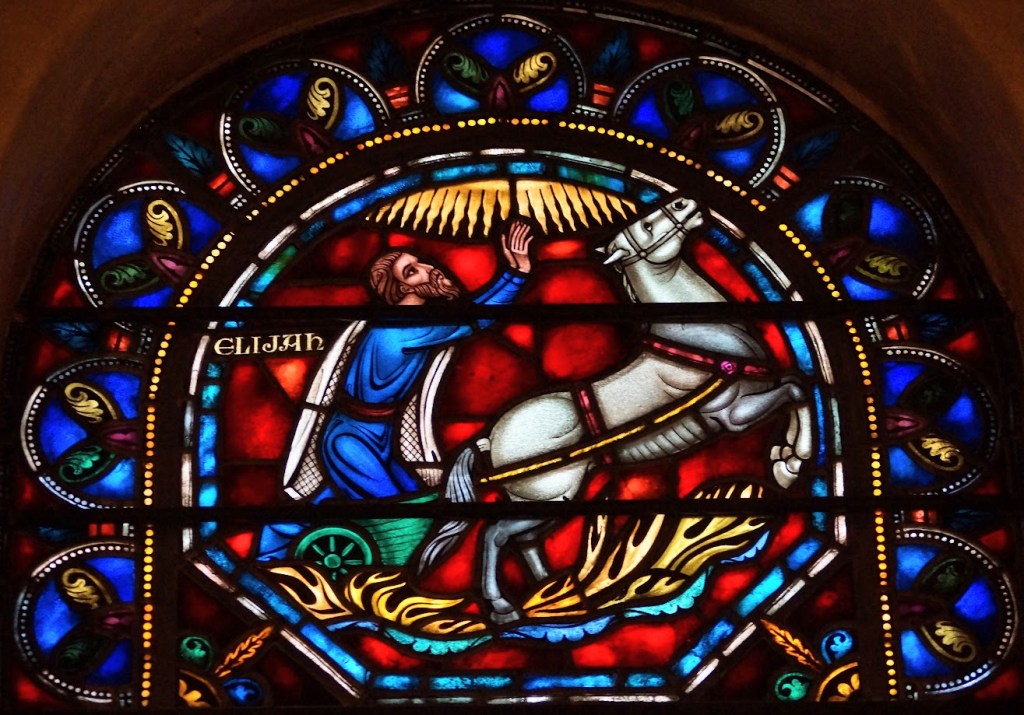
The passage which we heard today, from the Second Book of Kings tells the story of the conclusion of Elijah’s ministry and of his miraculous entry into glory.

Transitions are never easy—even if welcomed. For Elisha, Elijah’s disciple and successor, and for the People of Israel, it was difficult to lose Elijah. He had guided them through very difficult times, and offered them safety, security, and stability. They did not know what they would do without him. How could they move forward? It was for that very reason that Elisha made the request to have a “double portion of Elijah’s spirit.” He knew that had “big shoes to fill.” Unless God helped him, he was afraid of literally taking up the mantle of his teacher and mentor Elijah.

In Jewish thought, though, Elijah plays another role. Since he was kind of “beamed up to heaven” in a fiery chariot, there is the notion that he is waiting on the margin for the proper time to return. And, it was believed, Elijah’s return will inaugurate the “messianic era,” because he will prepare the way for the coming of the messiah. As the song which I shared with you at the beginning states, “May he soon bring with him the Messiah, the Son of David.”

It is no coincidence that many in Israel believed that John the Baptizer was “Elijah returned.” And in the accounts of the Transfiguration, it is Elijah and Moses who appeared to Jesus, Peter, James, and John on the mountain. This is a clear indication that they were ushering in Jesus as the Messiah—and immediately afterwards Jesus headed down the mountain with his face set toward Jerusalem.

To this day, there is an empty place left for the Prophet Elijah at the Passover Seder, and at the conclusion of the Seder, the door is opened to welcome Elijah—and the messianic era.

Today we find ourselves in a confusing, difficult, and frightening time. We witness the abuse of migrants, refugees, and the oppressed. We fear that many may soon lack the essential necessities for life—medical care, food, clothing, shelter, and the resources necessary to pay their basic bills. In such a context, the story of Elijah reminds us that, even if those in power ignore the lowly ones in our world, God does not forget them. In their suffering and misery, God will be present to them and with them.

We are also reminded that God is counting on each of us to do what we can to stand with them, to love them, to serve them, and to protect them. We must never loose hope because God will be with us in the midst of chaos and terror–and will give us every resource that is needed to care for all.

Elijah the Prophet, Elijah the Tishbite, Elijah from Gilead, be with us now and assist us in making real, present, and effective, the love of our Lord Jesus, the “Christ,” the Messiah, the Son of God.

A Summary of the Sermon in Spanish and English

Hoy nos encontramos, en nuestra primera lectura del Segundo Libro de los Reyes, quizás con las personas más interesantes de todas las Escrituras Hebreas, el profeta Elías —el “hombre de Dios”— y los malvados gobernantes Acab y Jezabel.

 Acab y Jezabel viven el “estilo de vida de los ricos y famosos” en lujosos palacios de Jerusalén y se afanan en robar a los pobres y maltratados. Se trata de “todo acerca de ellos”. La única persona que se interpone en el camino de sus planes, una “espina en su costado” es el profeta Elías. Los desafía constantemente, señala la crueldad y la inmoralidad de sus acciones y los llama a rendir cuentas por sus pecados contra el Pueblo de Dios.

Intentan repetidamente eliminarlo, matarlo, asesinarlo, pero Dios lo protege y, en última instancia, usa su ministerio para hacerlos responsables de sus acciones.

 El pasaje que escuchamos hoy es el relato de la partida de Elías para estar con Dios cuando deja la tierra en un carro en llamas. Es un recordatorio de que Elías no muere, es llevado al cielo. Por lo tanto, en el pensamiento judío, existe la creencia muy real, entonces, como ahora, de que Elías regresará para traer al Mesías. En los evangelios, Elías aparece con Jesús (y Moisés) en la Transfiguración. Esto prueba que Jesús es verdaderamente “El Cristo,” “El Ungido,” El Mesías.

 En nuestra propia época confusa en la que los pobres son abusados y explotados, los migrantes y refugiados son señalados para el maltrato, y el estado de derecho parece estar desmoronándose, necesitamos escuchar a personas como Elías hablar en nombre de Dios y decir que esto está mal. Esto no es lo que Dios desea. Que cada uno de nosotros haga su pequeña parte para apoyar a los oprimidos, abusados y explotados, con los más vulnerables en nuestra sociedad. Y que nosotros también trabajemos para defender el respeto, la dignidad y el valor de cada persona, creada a imagen y semejanza de Dios.

We encounter today, in our first reading from the Second Book of Kings, perhaps the most interesting persons in all of the Hebrew Scriptures, the Prophet Elijah—the “man of God”—and the evil rulers Ahab and Jezebel.

Ahab and Jezebel are living the “lifestyles of the rich and famous” in luxurious palaces in Jerusalem and are busily robbing from the poor and abused. It is “all about them.” The one person who stands in the way of their plans, a “thorn in their side” is the Prophet Elijah. He constantly challenges them, points out the cruelty and immorality of their actions, and calls them to account for their sins against the People of God. They try repeatedly to have him eliminated, killed, murdered—but God protects him, and ultimately uses his ministry to make them accountable for their actions.

The passage we hear today is the account of the departure of Elijah to be with God as he leaves earth in a flaming chariot. It is a reminder that Elijah does not die, he is taken up to heaven. So, in Jewish thought, there is the very real belief—then, as now—that Elijah will return to bring the Messiah. In the gospels, Elijah does appear with Jesus (and Moses) at the Transfiguration. This acknowledges that Jesus truly is “The Christ,” “The anointed one,” The Messiah.

In our own confusing time in which the poor are abused and exploited, migrants and refugees are singled out for mistreatment, and the rule of law seems to be falling apart, we need to hear people like Elijah speak up for God and say that this is wrong. This is not what God desires. May each of us do our own small part to stand with the oppressed, abused, and exploited—with those who are most vulnerable in our society. And may we too work to uphold the respect, dignity, and value of every person, created in the image and likeness of God.

A Community of Love

SERMON FOR TRINITY SUNDAY—JUNE 15, 2025

THE EPISCOPAL CHURCH OF THE HOLY SPIRIT

In Greensboro, North Carolina

Theologians in the early Church spoke of the Most Holy Trinity as a “mystery.” In doing so, they were not suggesting that the Trinity was an intellectual “riddle” or “puzzle” to be deciphered, unraveled or explained. In fact, their words suggest quite the opposite—mystery is an invitation to explore, discover, and experience.

Interestingly enough, the same word, “Mysterion” in Greek was translated into Latin as “Sacramentum,” or “Sacrament.” To claim that the Holy Trinity is Sacramental is to suggest that an experience of the Trinity has the power to be life-altering, life-changing, and utterly transformative.

These words were written with great humility. They acknowledged that greatness of God and the limitations of humanity. God is so beyond our ability to understand and to comprehend that even the words we use fail to adequately describe the reality, the essence, the nature of God. And so, rather than attempting to explain or articulate, they concluded that we are best invited to contemplate who and what God is—for us!

Even so, there are occasionally exceptional theologians who give us some insight which we had previously lacked—who enable us to think in a new way. One of my favorites is the amazing German Jesuit, Karl Rahner. In a fascinating and thought-provoking article having to do with the “ontology of the symbol,” Rahner explained in as simple, direct, and helpful way—as I have yet to discover, a radically different way to think about God. Here I am paraphrasing in my own simplistic way a powerful, complex, and profound insight.

God, Rahner tells us, can best be understood as the fullest expression of love. God is love. A love that is so powerful, so fertile, so self-giving that God chooses to be real, effective, and present. In so doing, God reaches out in an act of love that completely changes and transforms love. In that act of self-less and generative love, the Eternal Son of God, Jesus, the Christ, is engendered (as the Creed explains clearly, “is begotten, not created). The Son, in turn, loves the Father with an all-encompassing love. That reciprocal love between the Father and the Son is the Holy Spirit.

So, the Holy Trinity could be best thought of as a Community of Love. It was, perhaps, this insight which caused our former Presiding Bishop, Michael Curry to say so often, “If it’s not about love, it’s not about God.”

Rather than thinking of this as a nice thought, or perhaps a platitude, it is a shocking invitation to enter into that love, to be transformed by that love, to be empowered by that love—and to imitate it by becoming a source, a channel of love. Really, this is at the heart of our Baptismal Covenant. Because God has so fully, and totally loved us, we are called to become a People of Love-a Beloved Community. A Community that so loves, and is so loving that it welcomes the wounded, and helps them to move towards healing and wholeness. A Community that sees a broken world, and works for justice, forgiveness, healing, and reconciliation.

In such a Community we see

-the sin of racial hatred and racism and say, “No, we reject that and will work to overcome it.”

-the sin of misogyny, the exploitation and devaluation of women, and say, “No, we reject that and will work to overcome it.”

-the sin of homophobia, transphobia, and violence against our LGBTQIA Siblings and say, “No, we reject that and will work to overcome it.”

-the sin of xenophobia, mistreatment, abuse, and exploitation of immigrants, migrants, and refugees, and say, “No, we reject that and will work to overcome it.”

-the sin of Anti-Judaism, Islamophobia, bigotry, and intolerance, and say, “No, we reject that and will work to overcome it.”

-the sin of marginalizing, excluding, belittling, or “othering” of any beloved person created in the image and likeness of God, and say, “No, we reject that and will work to overcome it.”

The invitation to become an authentic Beloved Community is one that challenges us to give witness-through words, but more importantly, through action. It reminds us that, if we really are incorporated into the very life of the Most Holy Trinity through the Sacraments of Baptism, Confirmation, and the Holy Eucharist, we must put our faith into action. That requires some courage. The Greek word of “witness” is “martyria.” From it we derive the English word, “martyr.” To be a witness does not necessarily mean that we will be asked to die for the faith we profess. But, it does mean that we will be willing to accept that there will be push-back, intolerance, and perhaps even encounter violence.

Yesterday, I traveled to Lexington, to the Davidson County Courthouse to join the national Protest against unjust and immoral policies and actions taken by our government. In doing so, I intentionally stated that I joined with our Latino Sisters and Brothers who most recently have experienced profiling, discrimination, racial hatred, and violence. We have been called to reach out, especially to recent arrivals (migrants, refugees, and travelers)—as well as those whose families have been in this country for generations—including many whose families were already present here in what is now the United States generations before the first settlers from England arrived—with love, care, and welcome.

I honestly had no idea what to expect, and so traveled to Lexington with some nervousness, and even fear. I knew that I would be one small witness in a large arena. To my delight, it was a wonderful experience. Several hundred people gathered to peacefully protest. There was a joyous spirit in those gathered. To my delight, they were kind and gentle—even, for example, when a lady, driving by, rolled down her window and cursed us, using shocking and vicious profane words. She told us that we would be going to hell for our actions! The amazing thing is that she was the exception! Many people cheered us, beeped their horns in support, and waved at us. Truly, this encouraged me and gave me hope!

Our celebration today of the Most Holy Trinity reminds us that God is love! May that love fill our hearts, transform our lives, and empower us to become loving people who truly care for every person we encounter.

A final note—today is Father’s Day. So, we also acknowledge and celebrate the gift of Fatherhood. We pray in thanksgiving for faithful and loving Fathers, Grandfathers, Stepfathers, Foster Fathers, Godfathers, Uncles, Mentors, and for all who take the place of Fathers in the lives of children. We ask God to bless them in their vocation, and to encourage them to be supportive, affirming, caring, and truly loving with those who have been entrusted to their care.

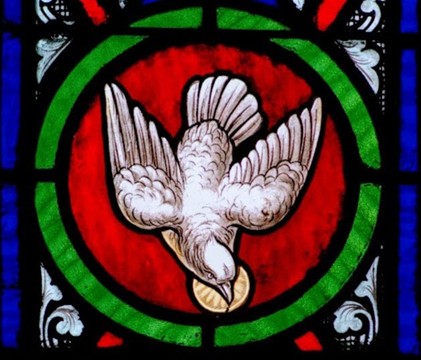
Come, Holy Spirit

The Seventh Sunday of Easter at the Episcopal Church of the Holy Spirit in Greensboro, North Carolina.

Many years ago, when I was a seminarian at St. Vincent Seminary, in Latrobe, Pennsylvania, I was blessed to have an incredible professor, Fr. Bede Peay, O.S.B., who was the teacher of homiletics. In later years, Fr. Bede, joined the Episcopal Church, and became the Rector and Dean of Nashota House. Fr. Bede, early on in our first class with him, made a technical distinction, which I have found quite helpful over the years, between the “sermon” and the “homily.”

The sermon, he told us, is normally longer, is more thorough, and often deals with an issue or theme, such as a matter of doctrine, and explores it in some detail. He used the example of the sermon during the Great Awakening in this country. It was not uncommon for them to last several hours. I imagine that many of us would feel that we had been taken hostage is we walked into that kind of preaching, without realizing it!

The homily, by contrast, is shorter, and tends to be more devotional in nature. The goal of this kind of preaching is to challenge, encourage, and motivate. Since we knew that those attending the Eucharist in the Roman Catholic Church had the expectation (or should I say the hope) of “getting in and out” in less than an hour, that meant that the preacher normally had about eight minutes. In the Episcopal Church, by contrast, where there is not the sense of urgency, it is more common for the preaching to take  15 to 20 minutes.

I personally tend to fall somewhere in between the two models, my own “middle way,” or “via media.” On the Sundays that I have the opportunity to be with you, and to preach, I will attempt to do so in a bilingual way, as we go. I do prepare a written text, though, and will place the text on my blog, most likely only in English.

One of the great treasures of belonging to a tradition which values the liturgy is that each celebration has a unique context in the framework of the “Year of Grace.” For instance, we think of the liturgical year as one which is divided into seasons. We begin with Advent, move into the Christmas Season, and then into the Sundays after the Epiphany. After the long season of Lent, we move into the Triduum of Holy Thursday, Good Friday, and the culmination of the year in the celebration of the Easter Vigil of the Resurrection. Easter is a season lasting fifty days (intentionally longer than the forty days of Lent) which concludes with the Feast of Pentecost. After Trinity Sunday, we enter into the final season of the Sundays after Pentecost (in some traditions known as “ordinary” time because the Sundays are counted.). And what an array of colors we use to celebrate these seasons-blue, rose, white, gold, purple, red, and green. Each of these colors enhances the season, and the particular Eucharist which is being celebrated.

And so, it is important on this Sunday, perhaps more than at any other time, to take a moment to consider the liturgical context in which we find ourselves. Today we celebrate what is really the last Sunday in the Easter Season, if we allow that the Feast of Pentecost has a unique and different character. But we are also in the nine day period following the Ascension of Our Lord. Thus we are in the
“novena” in which the disciples continued to gather in the Upper Room in prayer following the departure of Jesus—preparing for the coming of the Advocate, the Holy Spirit—even though they were clueless as to what that would mean!

For Second Century Judaism, there were three pilgrim festivals which took place each year, and Jews, who had the resources to do so, traveled to Jerusalem to celebrate them. Passover recalled the escape from the slavery of Egypt and the beginning of the journey to the land of promise. Shavuot took place fifty days later (hence the Greek name “Pentecost” meaning fifty) and recalled the giving of the law to Moses on Mount Sinai (which had taken place fifty days after the first Passover Meal). Finally, “Booths,” or “Tabernacles,” (in Hebrew Succoth) commemorated the forty years of wandering in the wilderness. It was not uncommon for Jerusalem to fill to almost overflowing for these Feasts, which Jews from all over the diaspora, all around the Mediterranean Sea—an amazing variety of cultures, languages, and styles of clothing. And yet, all were united in the worship of the One God of Abraham, Isaac, and Jacob, the God of Moses, David, and of the Prophets.

So, what was going on in the Upper Room? The disciples were exhausted. Their three years of following Jesus in the many adventures of his public ministry had come to a shocking and disappointing end with the passion and crucifixion. They were completely demoralized and scattered. And so, they fled, to the last place where they had gathered in community with Jesus—the Upper Room. They were terrified that someone was going to come looking for them too-they were not quite sure who it might be, Jewish authorities, or Roman soldiers. So, they locked the doors!

Jesus appeared to him in his resurrected body and gave them hope! Perhaps it had not ended after all. And yet, they were so shell shocked that they left and went back home to Galilee. Over a period of forty days, Jesus appeared to them in various places, to console them, to encourage them, and to prepare them for his departure. When he ascended into heaven, they were left alone. They returned to the Upper Room and entered into a time of intense prayer. It was a prayer of desperation, and of total surrender. It was a prayer in which they begged God to help them, to lead them, and to guide them. Because they realized that, on their own, they were hopeless, clueless, and powerless.

I will not steal the thunder of Father Javier for next Sunday when he shares with you the account of the outpouring of the Holy Spirit on the Feast of Pentecost—and to the transformation of the disciples from terrified, trembling, and weeping prisoners of the Upper Room into bold, and fearless missionaries for Jesus.

We are not yet at Pentecost. We are in an in-between time, a time between the Ascension, and the coming of the Paraclete. And, so, during these nine days, the invitation is offered to us to unite with the disciples in that Upper Room. To that end, I have prepared a handout with the text of the traditional Prayer to the Holy Spirit. We will pray it today, and I invite you to please pray it each day until next Sunday.

Through this prayer, may we prepare ourselves to renew the gift of our own Confirmation—the gift of the Holy Spirit through the laying on of hands by a Bishop, a successor of the Apostles. And may the power which we were given through this Holy Sacrament continue to transform and to empower us to bring to completion the Good Work which God began in us.

A Novena to the Holy Spirit:

Come Holy Spirit, fill the hearts of your faithful and kindle in them the fire of your love.

Send forth your Spirit and they shall be created.

And You shall renew the face of the earth.

O, God, who by the light of the Holy Spirit,

did instruct the hearts of the faithful, grant that by the same Holy Spirit we may be truly wise and ever enjoy His consolations,

Through Christ Our Lord, Amen.

A New Commandment–“Love each other”

A SERMON FOR THE EPISCOPAL CHURCH OF THE BUEN PASTOR in Durham, NC

The Sixth Sunday of Easter C

Dear Sisters and Brothers,

I greet you in the name of Our Resurrected Lord and Savior, Jesus the Christ, and in the names of his humble disciples Francis and Clare—who accepted his call to help rebuild the Church, which was in ruins. In our own time and place, I pray for the wisdom for each of us as we move forward to welcome the Lord, ever more completely into our minds, hearts, and lives, and for opportunities for us to work to build up and to strengthen authentic Beloved Community.

Before I continue with the words which I have prepared to share with you today, I would like to do something which I very rarely do. I would like to begin with a personal note. Thank you for your warm and gracious welcome to me. I would like to especially acknowledge and thank Father Ricardo for the amazing support, encouragement, and affirmation which he has given me over the past few months. I have so enjoyed the occasions in which I have been blessed to worship with you—and to take photos, which I pray will be of some small use to this community, to the Communications Ministry of the Diocese of North Carolina, and to the Office of Latino/Hispanic Ministries of the Episcopal Church.

To my great surprise and delight, this is a Eucharist which has special meaning for me. It is the first time, since the Reception of my Ordination as Priest in the Episcopal Church that I have had the opportunity to Preside at the Eucharist. For that reason, please know that, going forward, you will have a very special place in my heart.

Song:

Un mandamiento Dios nos ha dado. Que nos amemos unos a otros

Que nos amemos, que nos amemos. Que nos amemos unos a otros

My dear friends, if we hear nothing else today—other than the simple words of this song—we have heard the proclamation of the Holy Gospel! The message is simple, clear, and direct—Our Lord has commanded us to love each other!

This direct and immediate command is one that could cause lawyers to be begin to ask questions, but who is the other that I am commanded to love? It is not unlike that question posed to Jesus, but who is my neighbor?. It is not unlike that question Cain posed to God, who is my brother? In every case, the answer will be that there are no exceptions. We do not get to choose who we will love. Jesus’ command is that we love everyone!

We can not help but think of that often quoted comment by our former Presiding Bishop and Primate, Bishop Michael Curry, “If it’s not about love, it’s not about God!” The good bishop rooted his theology in the shocking reality of the Primitive Church. A group of believers in the Syrian (gentile) city of Antioch took everyone by surprise. There was something different about them, something unexpected about them, something that no one could ever recall seeing or experiencing before. They loved each other! And because of the power of that witness, those around them searched for some motivation. What was it that caused them to not only profess that they loved each other but to demonstrate that belief in the way that they treated each other. The only conclusion that outsiders could come to was that they were acting a lot like that Jesus. And so it was that they began to call them, for the first time, Christians.

It was not that the believers in Antioch began to pat themselves on the back and say, “Wow, we are doing a good job of being disciples of Jesus.” Rather, it was that others were so surprised by their behavior that they began to remark on it and labeled them as disciples, as friends, and as followers of the Christ. And thus we gained our name. All because of love. It was love that formed us into a community and made us Christians!

These days it feels as if though love is a rare commodity. In a time of division, polarization, and disharmony, we do not see a lot of love, we do not hear love expressed, and we do not feel that we are loved—or that others who are important to us are loved or valued. Honestly, it can feel that we are being attacked, that our Church is under attack, and that those we love are not safe. What are we to do in such a time? How are we to respond to those perceived attacks?

It would be simple if the opposite of love was hate. That is far too simple. It does not take much effort to find those who spew fountains of hateful words—words of racism and prejudice, words of misogyny, words of homophobia, bigotry, xenophobia, and words which deny the basic goodness and dignity of any person. What is more disturbing, more frightening, and more destructive is not hatred—it is antipathy. It is not that some choose to hate, it is that they choose not to care—and are unwilling to take a stand. They are unwilling to speak truth because it is inconvenient. In a few cases people are afraid—and with good reason. But in the vast majority of cases, they choose not to speak our because it will make their lives uncomfortable. It is time for each of us to ask the difficult question—is that hypothetical “they” of which I was just speaking “me.” Is it I?

The Hebrew Scriptures make it abundantly clear that there are three groups of people who are sacred—who are holy—to God: Widows, orphans, and aliens. In other words, any who are on the margins, who are vulnerable to be abused and exploited are precious to God. And, as children of God, we are commanded to love them, to care for them, to speak out on their behalf, to defend them, and to do all in our power to assist them. If we fail to do that, we run the risk of hypocrisy. Our mouths profess our belief in God, but our actions do not give testimony to that profession. As Saint Paul might tell us, our words are like “noisy musical instruments,” which only distract. They are ultimately meaningless.

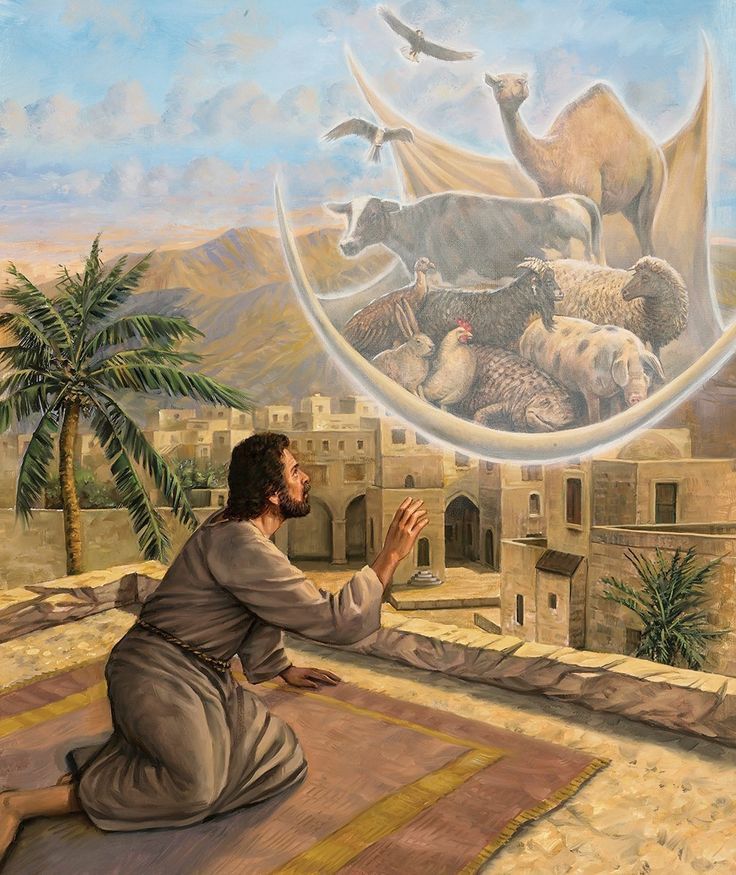
Our reading today, from the Acts of the Apostles (the sequel to the Holy Gospel according to Saint Luke) reminds us of a moment of conversion in the life of the Apostle Peter. Peter is taken by surprise to discover that God is inviting gentiles into full and active membership in the Church. It is not that Peter hated Gentiles. It is just that he did not really spend any time thinking about them. For him, they were “other.” He had not considered that they were worth bothering with. When he is given a vision which calls into question everything he thought he knew, he is shaken. The very foundations of his faith are knocked over. He was sure that he knew what God wanted. He is invited—in a very dramatic way, kind of like Paul had been on Damascus Road—to reconsider what God is all about. Peter comes to understand that God does not consider anyone—anyone at all—to be unclean, impure, throw away, trash. In God’s eyes none of the distinctions which humans are prone to make matter. Every person is beautiful, worthy, and holy—because every person, without exception, reflects the reality of the Creator of all.

My dear friends, we are called today to be persons who love—deeply, and without reservation. We are called to be such faithful followers of Jesus that others will look through us to see the love of Jesus which impels us. May we never grow weary in loving, in serving, and in caring for those who God has placed all around us. For in loving and in serving them, we will love and serve Jesus—present in them.

Jesus has indeed given us a new commandment—that we love one another!!

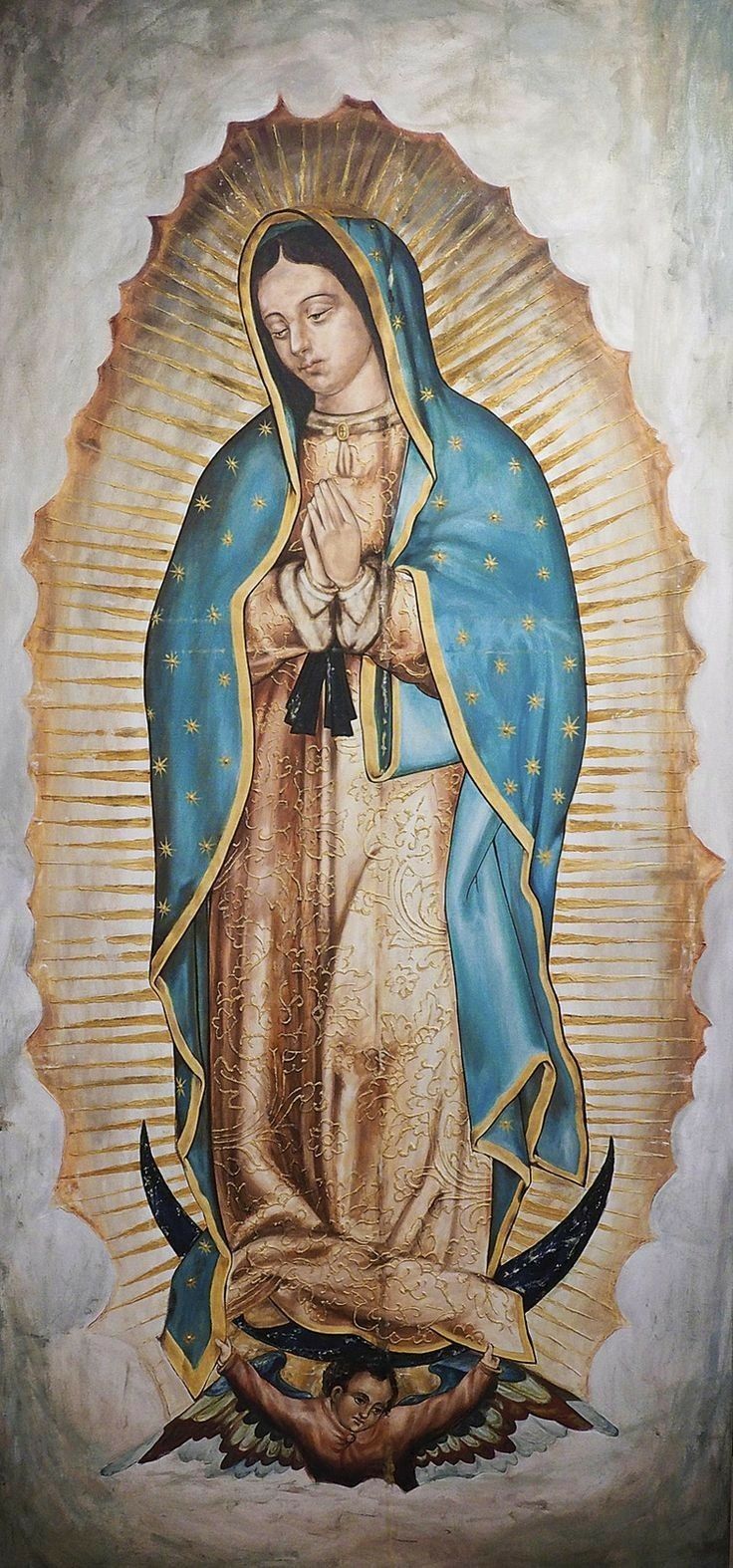
Our Lady of Guadalupe

Dear Friends,

Since we do not know each other, yet, please allow me to take a few minutes to tell you a bit of my story, and to share with you how it was that I came to have a great devotion to the Blessed Virgin Mary, the Mother of Our Lord, Jesus Christ, whom we honor and celebrate as Our Lady of Guadalupe.

I was raised on a farm in the Old Beech Mountain Community of Avery County in the Blue Ridge Mountains of Western North Carolina. From my infancy, I know what it was like to live “on the border,” because I lived only a few miles from Watauga County (where most of my ancestors had lived since the middle of the 1700’s. I also lived only a few minutes from Carter and Johnson Counties in Eastern Tennessee. My paternal grandmother was a Bunton, and her mother was a Brockwell and Helton from Unicoi and Washington counties. Mammaw was from a mixed-race family and was quite proud of her Cherokee ancestry.

When I was a junior at Avery County High School, I was selected to attend the Governor’s School of North Carolina, and spent a Summer at Salem College (originally a Moravian College for Women in Winston-Salem, North Carolina). I was selected to study Spanish.

During that Summer, I—who had been raised in a very traditional and conservative Southern Baptist family discovered the Roman Catholic Church. As part of that process, I was exposed to the numerous Marian apparitions: Our Lady of Lordes, Our Lady of Fatima—and most importantly, to Our Lady of Guadalupe. I suppose that the latter apparition was the most interesting to me, because of my interest in the Spanish language, but also because The Virgin Mary was depicted as an Indigenous Aztec Princess who had chosen an indigenous peasant, Juan Diego, to be her spokesperson to the powerful Franciscan Bishop of Mexico who, (blinded by his own privilege), could not imagine that such an occurrence was possible!

Because I was fearful of the response that I would likely encounter if it became common knowledge that I was contemplating converting and becoming Roman Catholic, I did not have many people with whom I could discuss these delightful new discoveries. The one person whom I did trust was my Spanish teacher. Interestingly enough, he had been raised in Colombia—the child of fundamentalist Presbyterian missionaries, who had gone there to convert as many Roman Catholics as possible. Needless to say, that family became quite alarmed when they began to suspect what I was thinking.

One day, I had a conversation with my teacher which wound up being one of the most important moments of my entire life. After dismissing some of the things about the apparition a Tepeyac, which had captured my attention, as “superstitious,” he then made an astonishing personal comment.

“In Colombia, you would not be considered white—you would be considered mestizo.” It was truly a moment of revelation. All at once, a whole series of things which had troubled me for years came together. It was at that moment that I finally understood a big part of who I am. I am not white! No wonder I had never really “fit in” with so much of the culture in which I had been raised. In that culture, “whiteness” was a treasured reality. Anyone who was not “white” was viewed as inferior, as less, as other. Because so many people in the mountains where I was raised had indigenous ancestry (or claimed to), that was not viewed as harshly. Blackness, though, was another matter. I grew up commonly hearing racial slurs, and witnessing the ways in which black persons were mistreated, abused, and intimidated. That was especially surprising, because there were so few of them.

So, the whole realization of my mixed-race status was closely connected with the indigenous apparition of Our Lady of Guadalupe!

Almost immediately, I realized that, without understanding the implications of this, I had never considered myself white, that I had no desire to “pass as white.” Since that day, I have never thought of myself as white. Even more interestingly, years later, I was delighted when DNA tests revealed that I had African ancestry (from the Gambia) and Iberian Sephardic Jewish ancestry. So, I was not of Latino descent, but of Peninsular descent. I was also delighted when I was able to document descent, through the Helton family, real Cherokee ancestry. So, in the case of my family, this was not just something that we had been told—we were able to show a “paper trail” to people were the “real thing.”

As I prayed about, and reflected on all this, I came to feel a close personal connection to Our Lady of Guadalupe. How fascinating that the Mother of God appeared as “one of us.” How incredible that she spoke to us with native ancestry as “her beloved Children.” And the child to whom she appeared was not European. Even more importantly, she addressed him in his own language and in ways which validated and affirmed his culture. Long before I had the opportunity to formally study “theology of inculturation,” I experienced the power that symbols have–to embrace, to celebrate, and to validate. Somehow in this apparition, I felt closer to God. And, I felt that God was closer to me.

Dear Siblings, we live in a time in which those who have mixed ancestry once again experience prejudice, persecution, and marginalization. This feast is an opportunity for us to cry out from the very depths of our hearts, “We matter. We too, are beloved of God. We too are called to share our own unique gifts in every place in which we live, move and have our being.”

Blessed Mother of Tepeyac, pray for us, that we may be made worthy of the promises of Christ. Holy Juan Diego, pray for us, that we may persevere—in the face of all adversity—in being faithful disciples of Our Lord, Jesus Christ.

If you are interested in viewing the bulletin which I prepared for the Service (in Spanish), here is the link.

We begin anew

It has been a good two years since I last wrote a post for this blog. Originally, it had served as a place for me to not only share what I was thinking, learning, and experiencing–it was also a place for me to post the sermons that I had been preaching at Trinity in Bethlehem (my home parish) and at the Cathedral in Bethlehem (where I served an internship with the Latin Community).

In August of 2022 my orders were received in The Episcopal Church and I accepted a call to serve at St. Thomas in Morgantown. To my surprise, a few people told me that they preferred a more “laid back” preaching style, and so during the time that I was there, I did not write out my sermons. It was, oddly enough, a return to the many years when I had preached as a Roman Catholic deacon and priest. I almost never wrote my sermons in those days. The fascinating thing is that it takes as much preparation–whether the sermon is written or not. But writing the sermon does allow it to be shared with a wider audience. It also provides a handy resource to look back on when those particular texts re-appear in three years. Thus, it allows the preacher to reflect on where she or he is now, contrasted with three years earlier. So, there is a part of me that is sad that I do not have a record of the sermons which I preached during the first two years of my ministry as an Episcopal priest.

I am at a time of transition now. I accepted a call to serve at two parishes in the Southern Piedmont of Virginia. In the end, it was not a good fit, and for numerous reasons it did not work. Those things do happen in the Church world too. And so, I am now discerning and actively seeking a new call.

There have been some unexpected blessings in the past few months. For one thing, I wound up having time to rest and to recover from the stress of challenging ministry over the past few years. It took some time to “decompress,” but at the end of the first month, I felt much better. It also has given me time to think, to pray, and to dream about what the remaining years of ministry could be for me. For that, I am truly grateful.

The greatest single blessing in my life these past few years has been my membership in the Community of Francis and Clare. The encouragement, affirmation, hope and love which I have received from my Franciscan siblings has truly been transformative. They have held me in prayer at difficult moments, and have shared with me the joy of their lives and their own vocation to “rebuild the Church.” I am grateful for each and every one of them.

“This is how we love our neighbor!”

A Sermon for the Fifth Sunday after Pentecost

Preached at Christ the Mediator Episcopal Church

In Allentown, Pennsylvania

The Liturgy of the Word

Saturday, July 9, 2022

O God, you made us in your own image and redeemed us

through Jesus your Son: Look with compassion on the whole

human family; take away the arrogance and hatred which

infect our hearts; break down the walls that separate us;

unite us in bonds of love; and work through our struggle and

confusion to accomplish your purposes on earth; that, in

your good time, all nations and races may serve you in

harmony around your heavenly throne; through Jesus Christ

our Lord. Amen.

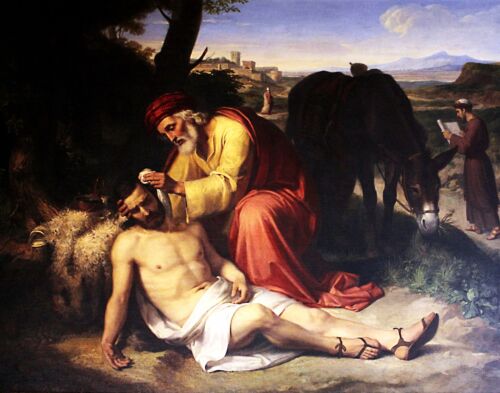
The Good Samaritan by Spanish Pelegrín Clavé.

V’ahavta

et Adonai Elohecha

B’chol l’vavcha, uv’chol nafshecha

uv’chol me’odecha.

And you shall love

The Lord your God

With all your heart, all your soul

and all your might.

After two millennia, I think that it is correct to say that most in the Christian Tradition have lost any real contact with the context of the most famous of all the Parables of Our Lord, Jesus Christ, that most commonly known as “The Good Samaritan.” Having lost that living connection, we often seem to struggle to make sense of this beautiful passage from the Holy Gospel according to Saint Luke. It is often enlightening to see how Christians approach this passage—and especially those who are called to preach on it every time it appears in the three-year cycle of readings of the Revised Common Lectionary.

It is especially sad to listen to these preachers who come to the most astonishing, and flawed conclusions about “the Lawyer,” “the Priest,” “and the Levite.” It is also astonishing to hear the way in which Second Temple Judaism is depicted—as something which was antithetical to the ministry and teaching of Jesus. Such approaches are quite harmful, unintendedly anti-Jewish, and fail to acknowledge that essential truth that Jesus was Jewish—from his first breath to his last. He had far more in common with either the Pharisees or Sadducees than things which separated him from them. And, the power of the story which he shares in the Gospel today will only make sense if understood in the Jewish context in which it was first shared.

One of my favorite Scripture Scholars, Dr. Brant Pitre, suggests that “lawyer” is not an accurate translation of the Greek word “nomikos.” When we hear the word, we tend to automatically think of someone we hire when we have a brush with the law—or of someone we pay to help us prepare a will. The law referred to here, is the Torah, or the Pentateuch—the first five books of the Hebrew Bible. And so, it would make more sense, Dr. Pitre tells us, to think of someone who is a biblical scholar.

Interestingly enough, this interaction between Jesus and the biblical scholar suggests an interaction of mutual interest, and even amical collegiality, rather than disagreement or hostility. That is important to note. This scholar is not trying to trip up Jesus, or to embarrass him. Rather, he reached out to him as a colleague—asking an open-ended question. Despite the language of eternal life (which in itself is a progressive theology supported by the Pharisees—in opposition to the Sadducees—who were the biblical fundamentalists of that age), I think that a good way of paraphrasing the question in a more contemporary way would be something like, “Jesus, how are we supposed to go about living out a loving, covenantal relationship with God?”

Jesus, of course, turns the question back around and asks the biblical scholar, “Well, what do the Scriptures tell us?” The scholar could have responded in any number of ways, and I suspect that the conversation might have well taken any number of different paths thereafter. But, the answer which the scholar gives focuses on what he perceives as the essential element of the Jewish Faith. The teaching Moses “our Rabbi, “Moshe Rabbeinu,” is that it is all about love. We are called to love God, and to love our neighbor!”

His quote is taken directly from the most important prayer in Judaism—the Shema. It is a prayer which was, and is, prayed three times each day by observant Jews. The prayer begins with an invitation—and an affirmation of faith. “Hear, O Israel, the Lord, the Lord our God is one.” But then it spells out that the observant Jew is not only called to listen, to hear, and to believe, they are called to love! In a way that summarizes or recapitulates the very essence of the ten commandments, humans are called to be in relationship, in community, with God, with others, and with creation!

To cut to the chase, I think that we can ask an important question. What does it mean to love others, to love our neighbor, and who is it, in fact, that we are called to love anyway? It reminds us of that devastating insight from the Book of Genesis. We are our brothers’ and sister’s keepers! We can not actually love God, if we refuse to love others! And here is the difficult lesson which Jesus wishes to teach us. We are called to love, treasure, value, affirm and care for every single person—without exception! We don’t have to agree with them, we don’t have to like them, but we do have to love them!

As shocking as that is, the parable which Jesus shares goes even further! The kind of love that Jesus speaks about is not an abstract theoretical emotion. It is made real, present, and effective through concrete actions.

  • We love the hungry by feeding them.
  • We love the homeless by helping them find a safe place to live.
  • We love the naked by providing them clothes.
  • We love the foreigner, or stranger, by welcoming them.
  • We love the enslaved by liberating them from the chains and shackles that bind them.
  • We love the abused, neglected, and exploited by caring for their physical, emotional, and personal needs.
  • We work for justice, for equality, and for dignity.
  • We allow ourselves to be inconvenienced by serving and caring for discarded human beggars lying in our streets and on the side of the road.
  • We listen to those who have not been heard, and we help those who do not have a voice, to speak their truth.
  • We do all of that without expecting anything in return.

In the Holy Rule, Saint Benedict of Nursia, challenges us to love, to serve, and to welcome every person as if we were welcoming Christ. That is what it means to love God! That is what it means to love our neighbor! And the words of Jesus are as clear to us today as they were to the scripture scholar two thousand years ago, “Go and do likewise.”

Dear Friends, may our hearts and ears be open today, to hear this invitation to love and to serve God, and to love and serve anyone whom God sends to us. In so doing, we will make the promise of Beloved Community a reality, and not just an impossible dream!