“Our Gotterdammerung.”

“Our Gotterdammerung.”
A reflection on the Fourth of July
July 4, 2019

When I was a student in Avery County High School—I was probably a sophomore—I read Margaret Mitchell’s Gone with the Wind. I had seen the movie. It may have been one of those things in which they broke it up into episodes which lasted a week. But, I do not really think that I understood a lot of what was going on.

I read it because I had ancestors who fought for the Confederacy. And I wanted to try to make sense of what that might have meant. As an aside, I have said elsewhere that I studied history to try to understand my family—and theology to try to understand myself. While I have made great progress in both those endeavors, I still have a long way to go.

Interestingly enough, I read the book, originally, because I thought it was pro-South. That impression was based on a very superficial viewing of the movie. I quickly discovered, though, that the novel was far more complex than I had imagined—and far more honest than the movie was able to be at the time. I guess it has been fifty years since I read it. I imagine that if I had the time to read it now, I would view it through far different lenses! And, I can not help but wonder how Margaret Mitchell would tell the story if she was writing the novel today?

The one lasting memory, though, was that of disbelief. I wondered, even then, how was it possible that the Southern Planter class—the aristocrats–had no idea what was coming—that the war would literally bring to a dramatic and quite surprising end, their very way of life. They were clueless! I seem to remember too that the only Southern person who had some notion of “reality” was Ashley Wilkes. He spoke about the gotterdammerung—the “fall of the Gods.” And for him, that was as good a metaphor as any. I guess I had a sort of love/hate relationship with Rhett. I started out really disliking him—but by the time the book ended, I had a much better appreciation for him!

In college at ASU, I had the opportunity to take a fascinating class called “The Road to Hitler.” Again, I encountered the surprise that those in the latter days of the Weimar Republic seemed completely unaware where things were headed. They foolishly thought that so much progress had been made that it would be impossible for the “rule of law” to be overturned. They failed to recognize the threat that Hitler posed until it was too late. More recent scholarship, though, has pointed out how very popular Hitler was with a huge section of the population. And really, that had to be the case, otherwise he would never have been able to manipulate the system as he did. Cabaret also gave an amazing insight into what the glory days of Weimar were like.

While living in California, in 2004-2006, I came to an interesting realization. The U.S. that I had known and which I just assumed would continue “as is” was changing in ways that I did not like and did not understand. When I thought more about it, I came to realize that ever since the birth of the “Moral Majority” and the advent of Reaganomics, the country had begun to divide and to become polarized. Now I did not remember the late 60’s—I was born in 63. But I did remember people in my family were affected by Vietnam.

And when I saw the reality of Guiliani’s administration in NYC—cracking down on diversity, attacking the homeless, the increase in subtle (and not so subtle) violence against People of Color (mostly Black) and migrants—and the LGBTQIA community, I realized that the city was beginning to feel like a “police state.” 9/11 had a way of hiding this reality, because the city “united.” This made it even more difficult to address the problems without being accused of being “unpatriotic” or “anti-American.” I am sorry to say that, at that time, I did not have any Muslim friends. I can only imagine how terrible that time must have been for them! I do remember the reality of living in a Dominican Republican neighborhood and beginning to hear the words “La Migra” for the first time. I was well aware of the impact and virtual terror the phrase imparted.

Today, I have the real sense that we are in the “dying stage” of the U.S. Empire. I feel that our “reign” as a “superpower” is coming to an end. It seems to me that a majority from my native Southern Mountain culture has become so frightened by this—and by the prospect that they are quickly becoming a minority—that they had made the conscious decision to accept whatever means are necessary to either slow-down the inevitable. Or, they have a dream of “turning back the clock” to the way things were. That is not going to happen. Those days are “gone with the wind.” That “boat has already sailed” and I am not just “Whistlin’ Dixie.”

If we are at the final stage of our own Weimar Republic—and I honestly think we may be—all that is needed is a catalyst—a “Reichstag fire.” If that happens, the Republic—weak and “hog-tied” as it is—will be overthrown. Either a dictatorship, or an actual Empire will be the result. If that happens, the concentration camps on the border–for largely innocent and harmless people fleeing from intolerable situations which our own policies have helped to create—will become the norm. Except now, they will be expanded and will be filled with political prisoners and “deviants.” As a gay man, I know, all too well, the history of the pink triangle.

When I have shared these fears, some have thought that I might be alarmist—or unduly pessimistic. I honestly pray that they are right. But more and more, things are happening which frighten me. The rhetoric against Latinos, and the concentration camps for migrant children; the rise in police violence towards Black People; the violence towards the LGBTQIA persons—and especially Trans persons of color: these things frighten me!

I was attacked on a subway in NYC by a young man saying homophobic things to me in August 2017. I was knocked unconscious, had a black eye, and required ten stitches in my mouth. No one came to my aid during the attack, or afterwards. So, I know firsthand that violence is simmering just below the surface. I will not be surprised to see blackshirts or brownshirts or “redshirts and hats” prowling the streets and looking for people to “control” “intimidate” and “put in their place.”

We are at a moment of decision and crisis as a country. I honestly have no idea how things will go. But, based on my reading of history, I do not expect the best. Will we return to the McCarthy area with the compilation of lists? That would certainly appear to me to be the “writing on the wall.”

I had the blessing of attending a presentation by the amazing historian and thinker Martin Dubberman (famous for his history of the LGBTQIA movement in NYC prior to and after Stonewall). He said in his remarks something like, “I am no longer a progressive. I have now become a revolutionary.” I hope that I am not misquoting him. In any case, he seemed to have given up hope that the present system could be repaired. He had come to the conclusion that the “system” was so broken that it needed to be discarded and something new created. I can understand why he would say that.

Is there hope? The Episcopal Church gives me hope. Our Presiding Bishop has talked about a return to essentials—about becoming a “Beloved Community,” the “Episcopal Branch of the Jesus Movement.” I am on board with that. Honestly, it is the only thing which has offered much hope at all. If that transformation, rebirth, and reformation are allowed to take place it will prove to be a very painful process. Many will be unwilling or unable to go all the way. But, the result will be well worth the price to be paid. We are making progress on that journey. But, for it to come to fruition, it seems that political stability will be needed. Otherwise, we may well plant seeds which may only sprout “after the deluge.”

I do believe that God is in control. Yet, God is not a magician and chooses to work through us–and through our decisions and actions. May we choose wisely, act justly, and “with the help of God,” truly live out our Baptismal Covenant. In that case, we will realize that even though “old things” have passed away, the “new things” which God has prepared for us are even better than we could have hoped for or even imagine.
“More than Conquerors”

“More than Conquerors”
A Reflection for Pride Sunday

June 30, 2019

When troubles come knockin’ at your door
Don’t be afraid, you know it’s not like before.
Don’t you give in, don’t let it bring you down
Cause you don’t have to worry anymore!

We’ve been made more than conquerors,
overcomers in this life.
We’ve been made victorious
Through the blood of Jesus Christ!

“We’ve been made more than Conquerors” by the Rex Nelon Singers

The one thing which I treasure most from my Southern Missionary Baptist childhood in the Blue Ridge mountains of Northwestern North Carolina was my exposure to Southern Gospel Music. It was from this music that I first learned many important things about faith and God—things which have stayed with me ever since. It really is interesting to reflect on how often these songs continue to impact and influence me. They have given me hope and encouragement at times of difficulty and confusion. I will certainly acknowledge that my theological understanding has changed, even dramatically, but the essentials which I still find in those songs has not.

Of all the groups from my childhood, the one group which I may have loved most was the Rex Nelon Singers. I found their music inspiring, joyful, and comforting. Although I love many of their songs, and especially “Victory Shall be Mine,” the one song which I have listened to more than any other is “We’ve been made more than Conquerors.” The lyrics are inspired by the Eighth Chapter of Saint Paul’s Letter to the Church in Rome (which is, by the way, one of my all-time favorite passages from the Christian Scriptures). This song is not just a recapitulation of the passage from Romans, though, it explains how that passage—and the hope which it promises applies to our lives. And it is for that reason, that I chose to begin this reflection today on Pride Sunday with those words.

Growing up in the country, I had never heard of Stonewall—and do not think that I even knew that it existed until I was in college at Appalachian State University in Boone, many years later. It is quite possible that I had encountered a reference to it along the way, but really did not have much of a sense of what it might have been about until later. Even though I did not know the history of the LGBTQIA rights movement, I had some very clear ideas about the impact of the movement in the rural South.

I had just entered into the first flowering of my sexual awareness and identity when Anita Bryant burst onto the scene warning of the dangers of the “radical homosexual agenda.” It would be impossible to describe the impact that her movement had in the Baptist world of my childhood. All at once, Southern Baptists became aware of and frightened by “queers.” Until that point, the two dangers which had most occupied their attention were “drinking” and ‘Godless Communism.” You could be sure that almost each revival (usually one in the Spring, before we got busy with farming, and in the Fall, after the tobacco had been harvested-but before we began grading) would have at least one night devoted to those issues.

All at once that changed. Now, preachers began to warn us that “degenerates” and “deviants” were set out to destroy the Christian Family. After Bryant was successful in getting some protective legislation overturned in Florida, Baptists began to celebrate. Now they did not go quite so far as to have a “victory dance,” (after all, “we don’t drink, dance, smoke or chew—and we don’t run with them that do), but they came pretty close. To my shock and horror, they seemed to become fixated on the details of gay sex and of gender identity! The clear consensus what that “homosexuality was a lifestyle” and a “choice,” and that “queers were sinners who needed to repent and accept Jesus.”

And this began to unfold precisely at the moment that I faced the unavoidable realization that I was—and am—gay. To this day, I do not know if many people knew, at that time, that I was gay. If so, they never mentioned it to me. I heard all the regular macho bullying things in school. But they did not seem to be addressed specifically to me. I may not have appeared to be especially effeminate? Or, it may have been that because I was so clearly a person of faith, that they just chose to ignore it. I would love to learn more about that time and about how I was actually perceived—but I may not ever have that opportunity.

It was only later, after I had the opportunity to live in larger “Northern” cities that I actually encountered the safe haven of the “gay ghetto.” That was of no consolation to me during my years in high school or in college.

I went through a period of intense spiritual torment and suffering. I became convinced that I was so deeply flawed that it would be impossible for God to love me. I became convinced that my sexual desires and longings damned me to an eternity in Hell. There was nothing that I could do about it. I pledged that I would fight those desires with everything in me—and that I would never act on them. But, of course, that was impossible. And when I gave in to temptation—in the very few and mostly innocent and harmless ways that was even possible—I fell into despair and depression. I was lonely, miserable and contemplated suicide. It really was a miracle that I finally had the opportunity, in college, to begin counseling. What a miracle that was! For the first time in my life I came to believe that there might be hope after all.

My own experience as a repressed gay boy from the Southern highlands is by no means unique. I later learned that many other young men like me were suffering in similar ways in mainline Protestant, Roman Catholic, Orthodox, Jewish and Muslim families. We experienced angst in the country, in villages, in towns and cities. This happened in the South, in the North, in the heartland of the U.S. and on the West Coast. It was an experience for LGBTQIA persons in every part of the world. It was only worse in those areas where same sex activity was punished by strict laws and enforcement. I was, at least, spared that. Ironically, I later came to know and to realize that there had been far more going on in many of the communities in which I lived, moved, and had my being than I had known at the time. I was truly naïf.

For most of my adult life, I was “closeted.” The decision to live as openly and unabashedly gay man took decades. In the end, it meant making the choice to leave behind things which were precious to me. But, I came to realize that in order to achieve wholeness, integration, and health (mental, physical, and spiritual), I had to be honest. I realized that I was gay, and had always been gay. This was not a choice—it was who I am. Interestingly enough, it was only as a result of having a partner for three years that I finally came out to pretty much everyone.

This week we celebrated the 50th anniversary of the Stonewall Rebellion. It is not at all ironic to me that it was the most radical members of our community who finally stood up and said, “No more.” In those days, they were called “drag queens.” Now, we understand that some of them were Transgender. To be clear, though, the gay men who were able to “pass” had little incentive to protest. Unless they were “caught in the act,” and were arrested, they seem to have been pretty much resigned to accepting their lot. It was only those persons who were never going to fit in or be accepted who were willing to take the risk of being even more vulnerable. Without them, Stonewall would never have happened. The great irony of that is that they were just as persecuted within our community as outside it. Gays who were under attack were quite willing to “throw them under the bus.” Too may of us wanted to assimilate and be accepted. They wanted the right to be truly free-and paid the price for it. In doing so, they won freedom for the rest of us.

Perhaps the bravest person I have ever known was a person who went by the name of “Kitty.” Later, I learned that Kitty had probably been born with ambiguous genitals. For whatever reason, the decision was made to raise “him” as a boy. He shocked and scandalized, even as a child, by choosing to “cross dress.” The abuse and insults to which she was exposed for most of her life far surpassed anything that I ever experienced. I remember when a report was given that a group of men from my church had visited her home to witness to her about Jesus. I can only imagine what that must have been like at the time. One of the greatest regrets of my life is that I did not have the courage to be a friend to Kitty. Years later, I attempted to reach out to her. I learned, to my great sadness that she had died. I do not know the circumstances surrounding her death, but imagine that they may have been horrible. I do not think that she ever escaped to a safe haven. Even if she had, she still wound have faced oppression, persecution, abuse and torment.

It may have taken almost fifty years, but finally it became possible to people to marry the person whom they love in our country. Not every place makes that decision easy. Not every congregation is willing to bless such marriages. And, there remains persecution in towns and villages, on farms and in many work places. But much progress has been made. I would like to believe that a day will come in which people were not be judged for the color of their skin or for their gender or orientation. If that ever happens we will truly be overcomers.

The song reminds us: “When troubles come knockin’ at your door, don’t be afraid, you know it’s not like before. Don’t you give in, don’t let it bring you down, cause you don’t have to worry anymore!” We are not there yet, but we have come farther than I thought would be possible in my lifetime. And, I have every reason to hope that the “long arc of history” will move in a direction of affirmation, empowerment, and inclusion. I am committed to do all in my power to help move in that direction.

When all is said and done, I honestly believe that it is truly the grace and love of God which has made this progress possible. As people of faith have come to recognize, acknowledge, and repent of prejudice—healing has become possible. It seems unlikely to me that even on the farms in the mountains it would be as difficult for children like me or like Kitty these days. At least I desperately want to believe that is so. I do not think of myself as the LGBTQIA poster child. But I can not help but hope that my openness about my own experience might be helpful to someone who needs to hear it. My own struggles could be a source of hope for someone like me who struggled to reconcile my identity with faith.

The one thing of which I am absolutely sure today is that God loves me—absolutely, totally, unreservedly and unconditionally. I am also convinced that has nothing to do with anything I have ever done. It is because God has created me as good and worthy of love, respect and dignity. And that is equally true of every single person who has ever lived or who will ever live.

I joyously sing—with modification: “We’ve been made more than conquerors–overcomers in this life. We’ve been made victorious through the all-inclusive, transformative, reconciling and healing love of Jesus Christ.”

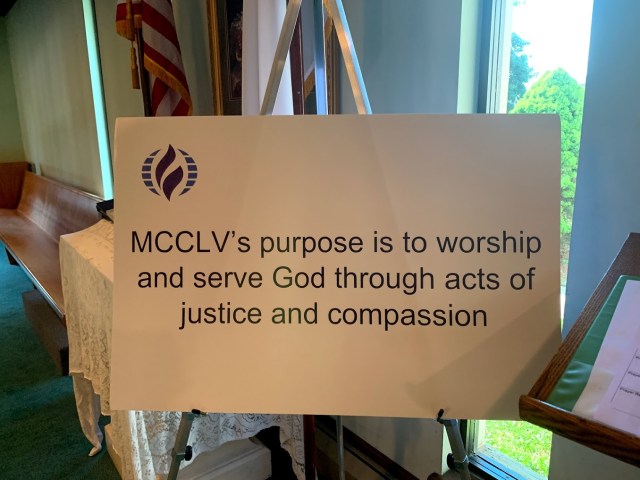
A note—on Sunday I did not have any responsibilities in my own parish family, and so (for the 50th anniversary of Pride) I intentionally chose to gather with my LGBTQIA siblings at the Metropolitan Community Church of the Lehigh Valley in Bethlehem.

MCCLV

This coming Sunday I will return home to be with my church family of Trinity Episcopal Church in Easton, PA.

“Finding God in the ordinary”

“Finding God in the ordinary”

A Sermon for the
Second Sunday after Pentecost
June 23, 2019

Green at Trinity in Easton 2018

There is always a bit of surprise in coming into church this day and seeing green. After all, it has literally been months since we have seen this color. And in those cold days before the beginning of Lent, it was a color that we did not see much of outside in nature. Now, at the beginning of summer we see lots of green-in grass, in trees, in hedges—and in the abundance of flowering plants and bushes. It is, sadly, a color which we have come to take for granted. We see so much of it everywhere that it just becomes routine, even common, and ordinary.

In some liturgical traditions the word “ordinary” is used to describe these days after Pentecost. Originally it did not mean ordinary as we understand the word in daily use. It was derived from the Latin “ordinatus” or “ordo” meaning “counted” or “arranged.” For instance, today is called the “Second Sunday after Pentecost.” Thus it is a counted Sunday. Each of the Sundays and weeks which follow until the end of the Liturgical year will be counted in that order. And then a new liturgical year will begin with the Season of Advent.

I suppose that I prefer “Ordinary” to “After Pentecost” for two reasons. The first is that it gives the hint of an explanation as to what this Season is all about. It is about what happened in the life of the Church following the incredible drama of Holy Week, Easter and Pentecost. After the Apostles recovered from the shock of all those momentous events, they found themselves living the new life in Jesus. It was in that daily reality of becoming the Jesus Movement that they found their ultimate meaning and purpose in life. It was in the proclaiming of the good news of Christ to the very ends of the earth that they found their ultimate mission. It was in going out and teaching, preaching, baptizing and celebrating the Sacramental Life that they welcomed so many others into the Household of God. That, they discovered, was the “new ordinary” ebb and flow of their life. As we saw in our readings today, this hardly seems ordinary to us. But more about that in a minute.

The second reason that I like the word ordinary is that it reminds us of a very significant reality. If we want to find God, we will need to do so where we are. Everything around us has the possibility of revealing God’s presence, love and grace. But to find and experience that presence we will have to take the time to really see our current and ordinary reality. We will literally have to take time to “stop and smell the roses” which are all around us. Otherwise we will be so busy that we do not even notice God’s loving and empowering presence all around us—and in us.

How is it even possible to find God? The first step in this process is to have the mindset of someone who is looking for God. That description of the quest or search for God is at the heart of the monastic vocation. Saint Benedict, in the Holy Rule suggests that the person who is called by God and responds is one who is “truly seeking God.”  The Holy Rule is a guide for the Christian Life, as St. Benedict calls it, a “School of the Lord’s Service.” As such it has meaning and value, not only to monastics, but to anyone who wishes to deepen their relationship with God. I would even go so far as to say that the guidance which it offers is of value to the whole Jesus movement. After all, it has been proven over more than 1500 years as a reliable way to progress in love and faith on the road which leads to union with God.

If we plan then, at each moment which comes to us in the course of the day, to look for and to find God, we may be sure that we will discover amazing things all around us.

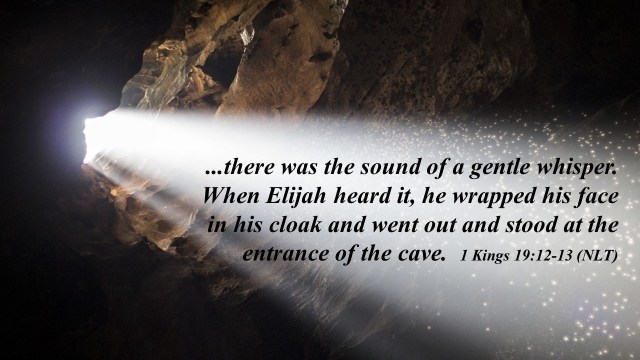
The prophet Elijah gives us an excellent insight into the quest for God. It would be hard to imagine greater drama than witnessing the calling down of fire from heaven. To drive home the point that the God of Israel was far from ordinary, Elijah had a moat dug around the altar of sacrifice and covered the sacrifice on the altar with so much water that it even filled the moat to overflowing. Talk about monsoon season. Everything was so wet that it seemed impossible for fire to even ignite the sodden mess. Yet, when the Man of God prayed, the unexpected occurred. Such a mighty blaze erupted that the sacrifice was consumed, the altar was consumed, and the flames even dried up the water in the moat. One might have been deceived into thinking that this was the real presence of God.

Elijah quickly learned, though, that this was not the final answer in his quest for God. From this moment of victory the tables were quickly turned. Everything unraveled and came undone. The prophet left this moment of unbelievable success—a “mountaintop experience” and ran away into the wilderness. Queen Jezebel was not happy that Elijah had interfered with her agenda. And so, she put a contract on his life. She offered a huge reward for anyone who would bring her Elijah “dead or alive,” and preferably dead. Elijah thought that this was it. He went into hiding and found himself in a cave. From the sounds of his conversation with God, it appears that Eliah was not happy. After all, he had done what God asked and was looking for a happy ending. He thought that God would work everything out according to the “Elijah plan.” When that did not happen, he was confused, shocked, disappointed, and perhaps angry. Interestingly enough, Elijah was also brave enough to “give God a piece of his mind.”

In that cave, though, God opened Elijah’s eyes to see God’s presence in a completely unexpected way. God was not present in all the drama outside the cave. God was not present in the earthquake or in the tornado, or in the inferno—no, God was present in the silence of the cave. That was more than enough to convince Elijah. He realized that God was not finished with him. His career was not over. God had plans for Elijah which could only be fulfilled if he had the courage to leave the cave and go back into the world. God would be with him every step of the journey. Not even the wealth and power of Jezebel would get in the way of God’s plan.  And so, in that moment of seeming defeat, Elijah moved on—trusting in God—to the greatest victory. He saw an astonishing reversal. The mighty were cast down from their thrones and the poor were lifted up. God’s justice was restored.

Another discovery which we make in the readings today, is that the “ordinary” includes everyone. Saint Paul makes that clear to us in the Letter to the Church in Galatia. For my money, the most surprising and powerful words which Paul ever wrote are contained in the passage we heard today: “As many of you as were baptized into Christ have clothed yourselves with Christ. There is no longer Jew or Greek, there is no longer slave or free, there is no longer male and female; for all of you are one in Christ Jesus. And if you belong to Christ, then you are Abraham’s offspring, heirs according to the promise.” Wow! To God, none of the things which we humans spend so much time and energy worrying about matter. God is no respecter or persons. In God’s eyes every person, created in the image and likeness of God, is sacred. How sad that we spend so much time focusing on differences.

This is the very antithesis of the good news. It means that we look for ways to discriminate, and to determine who is or is not worthy of God’s love and acceptance. It means that we intentionally set about to exclude anyone who is different from us or who does not live up to our expectations. With God it is just the opposite. There are no binaries—them or us—male or female—rich or poor—heterosexual or LGBTQI—domestic or foreign—”red or yellow, black or white,” or brown. In fact, all those “differences” are just superficial. They are ultimately not important. The things which we share in common are far more important, meaningful and significant. Each variety offers something unique, special, and precious—something which we desperately need.

In God, In Jesus, there is a new creation. God is at work in the life and heart of every single person—without exception. The call to love and to serve God really means that, among other things, we are called to find God in every single person whom we encounter. Truth be told, we are more likely to find God in people we do not like, do not want to be with, who are different from us, and who challenge our basic notions of how things are supposed to be. Saints have told us that if we do not find God in the beggar on the street, we are unlikely to find God in the Sacrament on the altar. But how? By recognizing the inherent dignity and worth of the “other.” By speaking with them openly and honestly. By allowing them to teach us from their experience and knowledge. And by believing that in their presence and in their story, God has something to say to us.

It is no mistake that our Lord tells us that in reaching out to those who are in need, we minister to him. We must be concerned about the poor and needy. We must feed the hungry, clothe the naked, minister to the widow and orphan, and visit those in prison. We must work to break down barriers which separate and divide. We must work for justice—to end oppression, injustice, abuse and exploitation. We must work to preserve God’s beautiful creation so that there will be enough resources for everyone to have what they need. And, for us to be surrounded by wonder and beauty which reveal the love with which God has placed us in this garden and entrusted it to our care.

We find God, then, all around us. We find God in the beauty of creation. We find God in other people—and especially in the vulnerable, weak and needy. We find God in the oppressed, and those who are discriminated against—for any reason. We find God when we gather in Community. We find God in Holy Scripture, and in Sacrament.  We have thousands of opportunities to find God each and every day.

The prophet Elijah, though, gives us a final insight. If ever there is a moment in which we do not know where to begin to find God, let us enter into silence. There, as we think, and reflect, and pray, we are sure to find God. It will be in the common and ordinary that, like Elijah, we have the most powerful and transformative experience of God.

Today I am not preaching in community, And so, this is a sermon which God thought I needed to hear.

Elijah in the cave--small whisper

“The first time I was accused of heresy.”

“The first time I was accused of heresy.”

A Sermon for the Feast of Trinity Sunday
June 16, 2019

Almighty and everlasting God, you have given to us your servants grace, by the confession of a true faith, to acknowledge the glory of the eternal Trinity, and in the power of your divine Majesty to worship the Unity: Keep us steadfast in this faith and worship, and bring us at last to see you in your one and eternal glory, O Father; who with the Son and the Holy Spirit live and reign, one God, for ever and ever. Amen.

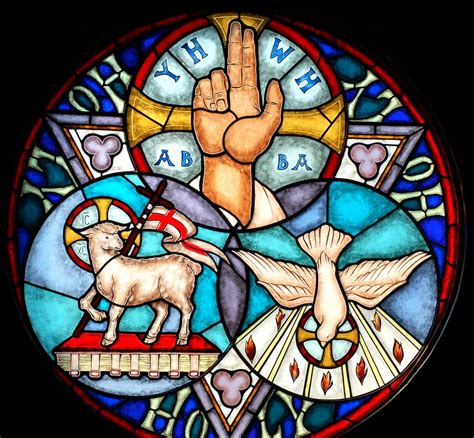
Holy Trinity Graphic

When I was in college at Appalachian State University in Boone, North Carolina, I served as the President of Catholic Campus Ministry. Not bad for someone who had only been Roman Catholic for a few years! I had spent most of my life as a Southern Missionary Baptist and had only been exposed to the Roman Catholic Church a few years previously, when I was selected to attend the Governor’s School, West, at Salem College, in old Salem. I fell in love with the Catholic Liturgy, though, and in my final year in high school made my profession of faith and was Confirmed.

Although the beauty of the Eucharist—I had never experienced this kind of liturgy previously, and honestly had no idea that anything like this even existed—was the thing which first lured me in, it was my discovery of theology which most captivated me and engaged me. Although I came from an intellectually inquisitive family, the church in which I was raised was decidedly anti-intellectual (they were also unabashedly anti-Sacramental, but that is another story). For instance, one of the great heroes was a preacher who had been illiterate until he received the “call to be a minister of the Gospel.” His wife taught him to read and write. There was a real fear of “too much education,” and the very concept of seminary would have been anathema. This preacher, it was believed, received his knowledge from God, and not from humans. As a result, the idea was that his preaching was not contaminated by human thinking and reasoning. It was “dabitur vobis” theology in its purest form. (As an aside, I was closely related to both the preacher and to his wife).

I recall being shocked, at the age of 17 to have been introduced, for the first time, to the dogma of the Trinity. It is entirely possible that I may have heard the word. But I actually doubt that I would have known what it meant. I say that because I recall being stunned! The Church in which I was raised primarily talked about Jesus, or more commonly, “The Lord.” There were occasional references to God (as in “God the Father,”) and even rarer ones to the Holy Ghost. The great irony was that the Baptists of my childhood were afraid that people might accidentally mistake them for Pentecostals, or “Holy Rollers.” And so, there was always more than a bit of apprehension if anyone started sharing too much about the role of the Holy Ghost in their lives. The one thing which would NEVER have ben tolerated was glossolalia or “speaking in tongues.” I suspect that the taking up of serpents might have been more acceptable than that.

The only time that I ever recall hearing a reference to what I later learned was the Trinity was at baptism, “We baptize this our brother in the name of the Father and of the Son and of the Holy Ghost.” Had I asked about the use of the Trinitarian formula, though, I suspect that people would have looked at me like I had two heads. Actually, that was not an uncommon experience for me. They never quite knew what to make of me. Even so, there were so many who loved me and accepted me—even though I confused them regularly.

Leaving aside the Baptist experience, though, and getting back to ASU, the Roman Catholic Diocese of Charlotte had an amazing retreat program for college students. It was called “Encounters with Christ.” I do not know where the program originated. I suspect that it ultimately had a connection to Cursillo, and may well have come from some larger diocese.

Encounters with Christ served two amazing purposes. Perhaps the most important was that it gave interested Roman Catholic students the opportunity to bond. Aa a time in which Roman Catholics were still a small minority in North Carolina–and still experienced hostility and persecution–it gave us a chance to be in a loving, supportive, and affirming environment. In those times together, we really became a family. We did not have to be ashamed of our faith or to be defensive. No one was going to attack us or make fun of us when we were together. There was also an interesting cultural and socio-economic dynamic. Most of the students were either from “the North,” or else their families were. And so, it was a gathering of “Yankees.” I, of course, was fascinated, because I learned from them what it had been like to grow up and to live in places where “we” were in the majority.

We were all in college, and I suspect that I was the only farm boy in the group. Most of them came from families which, on Beech Mountain, would have been considered “well to do.” And so their life-experience was quite different from what I had known. As I came to know a number of the families, I was introduced to wonderful things like “gravy,” “kielbasi,” and tiramisu.

The other amazing thing which this retreat did, though, was to provide opportunities for leadership and for evangelization. It was intentionally designed around a group of themes which had real-life application for college students. On a given weekend, there might be ten presentations. Half were given by the Campus Ministers from the various colleges in the Diocese (in those days there were two Roman Catholic Colleges: Belmont Abbey and Sacred Heart College—all others were either state schools or affiliated with some Protestant denomination).

The other half of the presentations were given by college students. For many of them, this was the first time that they had ever publicly spoken about their faith. Almost all of them shared openly about their own personal experience of God. It was not uncommon for them to share about how they had not really been interested in faith in their childhood and adolescence. But in college, that had all changed. Perhaps it came from having others ask probing questions about their faith. In other cases, they had just been lonely and had started going to Mass again. A few brave souls started attending Campus Ministry (there was always a free meal-often home cooked by parishioners). And before they knew it, they were more active than they had ever expected to be. I have often wondered what happened with those friends? It would be quite interesting to learn how their lives have turned out.

In my Junior year in college, I was on the team which planned the retreat. As a result, I was part of the “test audience .” The students who were going to be speaking at the retreat had to first present their talk to us. Afterwards, we gave them constructive feedback to help them refine and improve their talk. It also meant that they were not speaking for the first time to the large group. They had already had the opportunity to share once. And so, it made them less anxious. I realize now that it also gave the Campus Ministers a “heads up” about what they were going to hear at the retreat. I do not think that there was “censorship” but do occasionally remember the Campus Ministers making helpful suggestions.

I was deeply touched by one of the young speakers. He was a Senior at Belmont Abbey College and was a theology major. He shared with us his ultimate desire to become a Benedictine monk and a priest. Not only did he speak eloquently about the way in which he had experienced God in the Eucharist and in the Divine Office (which he was able to attend with the monks at Belmont), he also spoke of the ways that he had grown in love and knowledge of God through his study of theology. This was all new to me and excited me and frightened me at the same time. It was, perhaps, the planting of that first seed which ultimately led to my own decision, a few years later, to “seek God” in the monastery.

My hope was that this neophyte and I could become friends. And so, I wrote him a letter telling how much I had been touched by his presentation and asking him for prayer as I discerned my own sense of calling and vocation. To my disappointment, he wrote back a very curt and dismissive response. In it he accused me of heresy! He said that my comments about God, in the letter, had been condemned by at least one of the Ecumenical Councils (or perhaps more). Sadly, I no longer recall which heresy it was? Modalism? Subordinationism? I lacked the “theological sophistication” to even understand what he was saying. I was really hurt. But, I was also curious and wanted to know more. Was this a reason for going to seminary? Who knows. But, I have never forgotten the hurt that went along with receiving that letter.

Those who have studied theology are often leery of saying too much about the Trinity. We recognize how easy it is in “unscripted comments” to make casual remarks which we later realize to have been “heretical.” Later in life, I have come to think that may not be such a bad thing, after all. An Adrian Domincan Sister once told me “Every good sermon contains a little heresy.” That may well be true. And since most of us are not going to be professional theologians, I don’t even think that is something we should even spend any time worrying about. St. Anselm said that “theology is faith seeking understanding.” As I wrestle trying to make sense of my faith, I have to use the language and categories which I have. As I struggle to articulate my feeble understanding of the indescribable and incomprehensible, I will no doubt do so in a limited and flawed and paltry way. But, if the alternative is to say nothing, and by so doing fail to give witness to the love and empowerment which I have experienced by being connected to the Triune God, I will speak from the heart and allow others to “clean up the mess” which follows.

God really does have a funny sense of humor! The second Sunday following my ordination as a priest, I returned to Boone, to my home parish of Saint Elizabeth of the Hill Country, for a Mass of Thanksgiving. It was Trinity Sunday. I was the preacher. The Pastor was a Jesuit!

Thankfully, in seminary, I had been forced to read an amazing article by the German theologian Karl Rahner. The very mystifying and confusing title was something like “On the ontology of the Symbol.” It turned out to be one of the most helpful and thought-provoking theological works I ever read! As best I recall, Rahner said something like “for any reality to be real, present, and effective, if has to reach out beyond itself in love.” He then went on to say that this was as true of God as of anyone or anything else. If God had remained “self-contained,” God would not have been real, present or effective. From all eternity, God is love. That generative powerful love reached out-and thus was the eternal Son begotten before time and before creation. The Son, in turn, loved the Father-totally, absolutely and without limitation. The reciprocal and life-giving love between the Father and the Son is the Holy Spirit. For the first time, the Trinity became not just a dogma for me, but an invitation to enter into, to be transformed by, and to become a small conduit of God’s love. This is what I shared at that Mass. The Jesuit approved—no one said anything about heresy! Talk about feeling relieved afterwards.

The Church seems very wise, to me, to conclude the Easter Season with one last Sunday in which we celebrate the Holy and undivided Trinity. Next Sunday we will return to “ordinary time,” and will change again to the color Green. But as we begin to follow the Apostles, fresh from Pentecost, headed out into the streets to carry the good news to the ends of the earth, we will do so knowing that they do so in the “name of the Father and of the Son and of the Holy Spirit.”

In the final commission in the Gospel of Matthew, Jesus made this clear to them: “Then the eleven disciples went to Galilee, to the mountain where Jesus had told them to go. When they saw him, they worshiped him; but some doubted. Then Jesus came to them and said, “All authority in heaven and on earth has been given to me. Therefore go and make disciples of all nations, baptizing them in the name of the Father and of the Son and of the Holy Spirit, and teaching them to obey everything I have commanded you. And surely, I am with you always, to the very end of the age.” (Matthew 28: 16-20).

For those of us in the liturgical traditions, it is second nature to begin every prayer with the Trinitarian words “In the name of the Father and of the Son and of the Holy Spirit.” We end many prayers the same way “We ask this through our Lord Jesus Christ, your Son, who lives and reigns with you in the unity of the Holy Spirit, one God for ever and ever. Amen.” And for those who pray the Liturgy of the Hours, we so often pray the doxology: “Glory to the Father and to the Son and to the Holy Spirit. As it was in the beginning, is now, and ever shall be, world without end. Amen.” That daily invocation of the Trinity can not help but have an effect in our lives. But may this prayer be transformed to enable us in every context in which we find ourselves to become truly real, present and effective.

With all our hearts, with all our minds, with all that we have and are may we truly pray, “Glory to God, Father, Son, and Holy Spirit–from this time forward, now, and always, to the end of the ages. Amen.

Final note: Since I am not preaching in a parish today, I had the freedom to focus on the day, rather than on the Scriptures. A heresy? Perhaps. But this is where God led me.

“If you’ll say this is for me, you shall be filled.”

“If you’ll say this is for me, you shall be filled.”

A sermon for the Day of Pentecost
June 9, 2019

Almighty God, on this day you opened the way of eternal life
to every race and nation by the promised gift of your Holy
Spirit: Shed abroad this gift throughout the world by the
preaching of the Gospel, that it may reach to the ends of the
earth; through Jesus Christ our Lord, who lives and reigns
with you, in the unity of the Holy Spirit, one God, for ever
and ever. Amen.

IMG_6462.jpg

This beautiful banner is the work of artist Patti Pasda
and hangs in the nave of Trinity Episcopal Church in Bethlehem, Pennsylvania.

This weekend I am not preaching. For some time I have considered the option of trying to write a sermon each week, whether I am preaching or not. But, until now, I have not acted on that impulse.

I do find myself in an interesting situation. Each Wednesday, I am honored to preach at the Weekday Eucharist at 11:30 a.m. where I work at Trinity Episcopal Church in Bethlehem. I try to make those sermons very short—no more than five minutes or so. They are a fascinating connection for me to those years that I served as a Roman Catholic priest. The homily plays a different role there. Early on, I came to the realization that, unless it is a very special occasion, the typical Roman Catholic congregation was willing to accept a length of one hour for Mass. Anything more than that was going to make some unhappy—and drive some away. So, that meant that the homily could not normally go beyond 8-10 minutes. Over a period of many years, I learned to work with that limitation.

With two or three exceptions, I never wrote the homily out in advance. And, it became easy to tell when the congregation was growing tired—and to know that it was time to “wrap things up.” From my own personal sense of the liturgy, I believed then—and still believe now—that the actions which recalled the words of Jesus and his own example were far more important than any words I had to offer. So, I invested more time in being a good presider at Eucharist than in being a good preacher.

The Sunday Episcopal Liturgy is another matter. To my delight, Episcopalians seem to operate more on the model of an hour and a half. The joy of that is that there really is no rush. This allows the preacher, and I would imagine, the priest presiding at the Eucharist to be more relaxed. There is no sense that the clock is ticking. It also means that the expectations are higher. I do not really thing that I spend any more time in preparing Episcopal Sermons than I did in preparing Roman Catholic homilies. The Episcopal ones are more polished—and developed in a different way. It seems that 15 minutes would be an appropriate length for an Episcopal sermon.

I have recently given all of this a good deal of thought and consideration, because this Summer, at Trinity in Easton, the preachers are also leading a discussion in the Forum each Sunday. When asked about this, I thought it was a wonderful idea and a great opportunity. Whenever, I have led Bible Study classes in the past, I have learned as much as I have shared. That really is the joy of exploring the Holy Scriptures—Hebrew and Christian in community. There are always new insights gained. Others see things that I do not see. And, at times my own ideas are challenged or validated. Both of which are very good things! In such sessions, I often feel the presence of God. Of course, it takes a willingness to be vulnerable for those studies to be successful. Especially if the participants share their own life-experiences, that means that they have to be unafraid to open up and let people know sometimes very personal things about themselves. I think that is also true of the preacher. The sermons which have moved me most powerfully are ones in which I have connected with the hurts, pains, struggles, and joys of the preacher.

Pentecost, provides a wonderful experience, I think, to reflect on the role and power of the spoken and preached word in proclaiming the good news of Jesus Christ to the world. Our Presiding Bishop and Primate, the Most Reverend Michael B. Curry has shared two vital ideas which have had a powerful impact on my own spiritual life.

The first is “If it’s not about love, it is not about God.” I am convinced that the single greatest longing of every human heart is to be loved. Nothing else is even remotely as important as this. When it happens, that love is truly transformative, empowering and life-changing. Sadly, not everyone has had an experience of being loved. Many people have been hurt, wounded, and feel un-loved. Their experiences have led them, in some cases, to feel that they are not loved. Even, at times to fear that they might be unlovable. They feel flawed, broken, and rejected. They have given up on any hope of every finding love or of being beloved.

This has been so devastating for them that they have withdrawn from life and find themselves existing rather than living. This is especially true of people who have been rejected for who they are. People of Color, people from other parts of the world, those who are Lesbian, Gay, Bisexual, Trans, or Intersex, and those who suffer from various addictions know this all to well. At the very core of their wounded souls is either the fear that “if they really knew me, they would not love me.” Or else, they have been made to fear that they are “less” and not “deserving” of love. Bishop Curry’s message, though, is that God is primarily about love rather than judgement. And, God loves very single person who lives, who ever lived, or who will live. That is the message of hope which needs to be proclaimed. If someone listens to a sermon or homily and does not hear the good news that God loves them—that sermon or homily may be about many wonderful things, but is it about God?

The second important idea is that the Church is really nothing more-or nothing less-than the Jesus Movement! If it is not about Jesus, it is not about the authentic church. That does not mean that we have nothing else to say—or that we have the only answer. It does mean that in Jesus we have found an answer that makes sense to us. An answer that gives value, meaning, and purpose to our lives—as individuals, and as a community of faith. Seen in that light, every single action of the church must be evaluated in light of one question: “Does this lead people closer to an encounter with the loving, healing, saving, and life-giving Jesus?” If not, it may be interesting, and even important, But it will never be essential.

Sadly, we have allowed the fundamentalists to co-opt talking about Jesus. We are afraid that if we do too much of that, we will be thought of as “fanatics.” There has been so much hurt and pain caused by allowing others to hijack and distort the loving message of Our Lord, that there is no time to waste in introducing others to the real Jesus. A Jesus who loved unconditionally, who welcomed everyone, who served the needs that he saw in each person without ever stopping to ask what it would cost him. A Jesus who loved us so much that he endured the passion and crucifixion and the experience of death—not to show us that he suffered to take away sin—but to show that God’s love can never be halted or overcome by hatred or prejudice or cruelty or violence. That love is made especially clear in the power of the Resurrection and in the Outpouring of the Holy Spirit.

It raises the question, then, “How do I come to encounter and to know this Jesus?” How can I experience that limitless and transforming love? Although I have had amazing personal experiences of God—of Jesus—in moments of prayer and solitude, my primary and most powerful experiences of God’s love have come in the gatherings of community of the Jesus Movement. To be very specific—I have found and find God through the Sacraments.

In Baptism, I was claimed and sealed as Christ’s own for ever! I was made a member of the household and family of faith. In Confirmation I was empowered to become an evangelist for Christ—not like the televangelists or even the local preachers in a tent revival. But like every Confirmed Christian, I was anointed with the Holy Spirit—as was Jesus—to be a witness in the world of the reality and power of God’s love. In the Holy Eucharist I received the body, blood, soul, and divinity of Jesus Christ—the “bread of heaven” and the “cup of salvation.” I was invited to become the reality I consumed—to allow it to transform me and to then carry that presence of Christ into the world. In the Sacrament of Holy Orders, a successor of the Apostles laid hands on me and invoked the power of the Holy Spirit giving me a sharing in the Ministerial Priesthood of Jesus Christ, as a Deacon, and as a Priest—to build up the Jesus Movement in conjunction with Bishops in whose dioceses I served—and with the women and men in whose parishes I exercised that ministry. At moments of illness-physical, emotional, and spiritual, I received healing and restored wholeness through the Sacraments of the Anointing of the Sick and the Reconciliation of a Penitent. Until now, God has not gifted me with a husband, and so I have not joined with another in Holy Matrimony. If that is part of God’s plan for me, I welcome it. And, if not, I will be accept that too.

Today, though, I want to say a few more words about Confirmation. For me, Confirmation, is about empowerment. Jesus told his disciples that when the Holy Spirit came upon them, they would receive “power.” To me, it seems obvious that they did not have power! There was something missing, something lacking in their lives. One reading of the texts would suggest that they might have already been baptized, and after that Final Supper/Seder, some claim that they had even been ordained. But before the day of Pentecost they were hiding out in fear in that upper room. After the power of the Spirit came upon them, they became fearless, public witnesses and preachers of God’s love on the streets of Jerusalem—and ultimately to the ends of the earth.

This was not a simple liturgical rite showing that they were now adult Christians. This was not a rite of passage. This was an explosion that rocked them to the core of their being—and which literally changed the history of the world. The Jesus movement was born on the day of Pentecost. Without the power of the Spirit the followers of Jesus would have returned to their old way of living with conflicting emotions. They would never have become the Apostles on whose witness, teaching, and ministry, the Church was built.

It is no mistake that we have been introduced to the idea of “Gifts of the Spirit.” Especially in the writings of Saint Paul. But we often make the mistake of thinking that those gifts only apply to a few people—certainly not to us! Another traditional approach was to speak of the seven “Gifts of the Holy Spirit”—these clearly are intended for each of us: wisdom, understanding, counsel, fortitude, knowledge, piety, and fear of the Lord. Without saying anything about the particular gifts, one way to understand them is that they give us everything that is needed each day to accomplish God’s will in our lives. That is something which Baptism does not give!

In the first year after I was ordained as a priest, I served a year in a parish in North Central Pennsylvania. During that year, I was invited to lead a retreat for a group of High School Students who were preparing for Confirmation. They were wonderful young women and men. And, they took this very seriously! Yet, it was clear to me that, after listening, to them, that they really did not expect that it was going to make much of a difference in their lives. They thought it would be a nice day—and some were looking forward to spending time with relatives that they had not seen in a while. All of them had done many hours of service in preparation for Confirmation. For a few of them, it meant that they were finally going to be finished with catechesis and classes (they were honest enough to admit that). A few of them were not really sure how active they were going to be about Church afterwards. They were finally going to be able to make that decision for themselves when they went away to college the next year!

I honestly felt sad! They expected so very little to come at and after Confirmation. Really, it was not their own fault. No one had ever told them that there was another possibility. There was the possibility that they could have an experience of the Holy Spirit like that which had happened to the Apostles and the Disciples gathered in that upper room. Who was to say that there could not be a mighty rushing wind and tongues of flame or even the gift of tongues? Even if that did not visibly happen, they could have such a powerful experience of God that their lives would be changed forever!

What prevented this from happening? One possibility, I think, is that God will not give us more than we are willing to accept. God is a gentle person. God will not come into our lives uninvited and unwelcome. But, if God is invited and welcomed—anything is possible! All things are possible! Pentecost in the here and now is possible!

There is a lovely Pentecostal hymn which I learned in traveling through the mountains of Eastern Kentucky one summer: “You shall be filled with the power of the Spirit. You shall be filled with the anointing from on high. If you’ll say this is for me, you shall be filled.”

May prayer for all of us on this Day of Pentecost is that we will say “This is for me,” and that we will permit that power promised to us—and gifted to us–in the Sacrament of Confirmation to be unleashed!

I will conclude on a personal note. On June 6, 1991, in the crypt of the Saint Vincent Archabbey Basilica, I presided at the Eucharist for the first time. It was the Vigil of Pentecost. That day I was empowered to serve as a priest in Christ’s one, holy, catholic and apostolic church. Thus, Pentecost will always be for me not only the Birthday of the church—but the day of my rebirth and empowerment for service. That in all things God may be glorified.

“Come Holy Spirit”

“Come Holy Spirit”

A sermon for the
Sunday after the Ascension of Our Lord Jesus Christ
Preached at Trinity Episcopal Church
In Easton, Pennsylvania
June 2, 2019

Veni, Creator Spiritus,
mentes tuorum visita,
imple superna gratia
quae tu creasti pectora.

“Come, Holy Spirit, Creator blest,
and in our souls take up Thy rest;
come with Thy grace and heavenly aid
to fill the hearts which Thou hast made.”

We stand at a liminal moment-we stand at the threshold. We are caught between two realities and are in movement from one reality into another. We are challenged to let go of everything which we know, and which we think we know, and which we hope to know. We are called to surrender, to let go, and to trust. We do not really know what is coming, and yet, we are challenged to believe that even though it may not yet make any sense to us at all, what lies ahead has the possibility be even better than what we have known until now.

In any event, we do not have any choice. The decision has already been made for us. We can not do anything to change it. Events have transpired in a way that we did not want, did not expect, on which we did not plan, and over which we have no control. So, the only options left to us are either to fight against the inevitable or to somehow find a way to accept what is to come.

It really is like the experience of death. And we know all too well those confusing and conflicting emotions which come at the reality of death: hurt, anger, loss, disappointment, sadness, denial, pleading, bargaining and depression.

We are those followers of Jesus, hiding out in an upper room, fearing that, at any moment, someone is going to come knocking at the door, and haul us away to trial, to jail, to torture, and to death. We have run out of options, and possibilities. We are just exhausted. There is only one option-the option which Our Lord gave to us—the option of huddling together in our weakness and confusion—and praying.

The Sunday after the Ascension of Our Lord Jesus Christ is, it seems to me, one of the most fascinating moments in the Church Calendar-in the “Year of Grace.” It seems to have a startling—even shocking—resemblance to Easter Saturday.

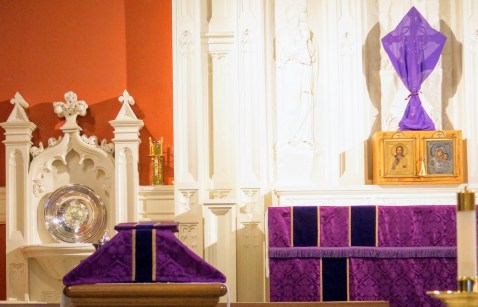
To remind us, Easter Saturday has been described as the most “real” day of the year. It is the day in which everything is reduced to the most basic reality. The events of Holy Week have largely concluded. The church is empty. The altar is stripped. There are no flowers, no decorations, nothing to cover up an overwhelming sense of loss and grief. Everything is revealed as it truly is. Nothing remains hidden!

The Lord has died! We gather at the tomb. There is not yet any hope of Resurrection-something which has not even occurred to us yet. Everything is revealed—nothing is hidden. There are no cosmetic cover-ups. There has been only a moment to catch our breath after the overwhelming horror of the crucifixion and the shock of death. There is just an abyss of grief, of loss and sadness.

Today was a similar day for the friends of Jesus. Following the joy of the Resurrection, they spent 40 days with the Lord. In that time they began to heal and to recover. They re-visited familiar sites and places which had been at the center of their experience of Jesus.

Perhaps, in their own minds, they began to plan and to hope. Perhaps they were like tender buds which begin to bloom-even at time when there is a danger of killing frost. The Lord told them that he would be leaving them again—and this time for good. Did they really believe him? Did they understand the words he said to them about a Comforter, a Paraclete, and Advocate who would be coming?

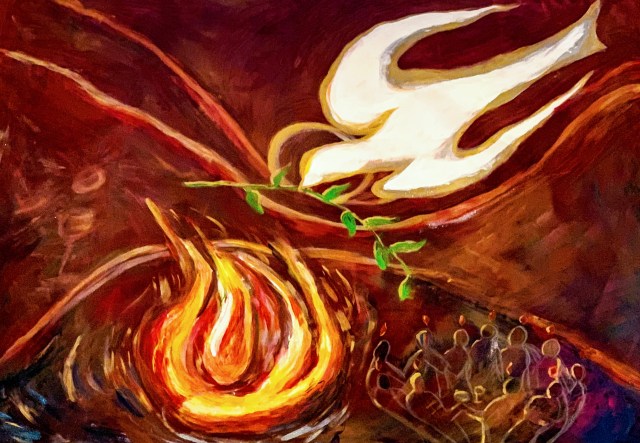
I doubt it. And now, they were alone again. For nine days they hid, and shivered, and wailed in that room. And they prayed. Something was coming, but they did not know what. Someone was coming, but they did not know who it was. Something would happen to change everything, but they did not know that yet. They had not experienced it–it would take them by surprise! It would shake them to the very core of their being. It would transform them, and empower them. It would complete what had already begun. It would be an explosion! It would be Power! And like any encounter with power, it would shock them! It would shake them!

It would energize them! It would give them the courage to run out in the streets and proclaim to everyone, everywhere, the good news—and even in languages which they did not know, did not understand and had never even heard before. It would make them so fearless that they did not care who wanted to arrest them or interrogate them or mistreat them. It would set them on fire. It would be the Holy Spirit falling on them with wind and fire. But it would not happen yet. This was not yet Pentecost, these were those long, frightening, and confusing days following the Ascension.

At this time, there was something which gave them hope. They reflected on those mysterious and often-confusing words which Jesus had spoken to them before his departure. Words of comfort, and hope and love. Words which, even though, they did not fully understand them, seemed to make a kind of sense. And, having no other option, they chose to cling to those words, to try to trust in them, and to risk hoping that they might be true.

We hear again, those words today from the Holy Gospel According to Saint John—from a passage which is called the “High Priestly Prayer.” In these words, Jesus prays for his friends. We are able to eavesdrop on that prayer and to hear what Jesus wanted and asked for on behalf of his his closest friends—of his chosen family. We hear what we wanted them to have, what he knew they most needed—what he wanted them to become, and to be.

“Jesus prayed for his disciples, and then he said. “I ask not only on behalf of these, but also on behalf of those who will believe in me through their word, that they may all be one. As you, Father, are in me and I am in you, may they also be in us, so that the world may believe that you have sent me. The glory that you have given me I have given them, so that they may be one, as we are one, I in them and you in me, that they may become completely one, so that the world may know that you have sent me and have loved them even as you have loved me. Father, I desire that those also, whom you have given me, may be with me where I am, to see my glory, which you have given me because you loved me before the foundation of the world.

“Righteous Father, the world does not know you, but I know you; and these know that you have sent me. I made your name known to them, and I will make it known, so that the love with which you have loved me may be in them, and I in them.”

What an astonishing prayer! Connect these people. Make them one. Unite them to you, help them to reconnect to me. Help them know love! So love them, so empower them, so illumine them, so enlighten them that they will be able to embody love. Make them such powerful and credible witnesses that they world will believe their message. Help the world to realize that I have sent them. And, while you are at it, bless everyone who will hear the message they proclaim. Open their ears to hear the message, their minds to comprehend the message, and their hearts to welcome the message and to give it a home. Help those hearers to be so transformed by that same love that they will be united in you and in me. And then send them out as well. To love, to proclaim, and to share. In this way, draw everyone to me-and to you.

What fascinating words we hear: love, glory. And elsewhere we heard that most amazing word: power. “But you will receive power when the Holy Spirit has come upon you; and you will be my witnesses in Jerusalem, in all Judea and Samaria, and to the ends of the earth.”

My dear friends, the Easter Season comes to a close. In just a few days, the Church will be born at Pentecost. The Jesus movement will begin! Our hearts will be filled with the power of the Holy Spirit and we will become witnesses to the very ends of the earth. As we hope and long for the coming of that reality, let us pray. Let us unite in faith and in belief. Let us ask God, our Loving Parent, to send the Son into our hearts so that we can accomplish the mission which has been entrusted to us. “And now, Father, send us out to do the work you have given us to do, to love and serve you as faithful witnesses of Christ our Lord.”

If you remember it, I ask you now to join with me—in prayer—in the words of that first novena to the Holy Spirit. Let us pray:

“Come, Holy Spirit, fill the hearts of your faithful.
And kindle in them the fire of your love.
Send forth your Spirit and they shall be created.
And you will renew the face of the earth.

Lord,
by the light of the Holy Spirit
you have taught the hearts of your faithful.
In the same Spirit
help us to relish what is right
and always rejoice in your consolation.
We ask this through Christ our Lord.
Amen.

“Jesus did not blame them, nor does he blame us.”

“Jesus did not blame them,
nor does he blame us.”

A sermon for Good Friday
preached at
Trinity Episcopal Church
in Easton, Pennsylvania

Friday, April 19, 2019

Celebrant      We glory in your cross, O Lord,
People          and praise and glorify your holy resurrection; for by virtue of
                      your cross joy has come to the whole world.

Black veiled cross

When I was a graduate student in early modern European history at Fordham, I recall with surprise a comment from one of my professors: “The kind of history we write all depends on what kind of eye glasses we wear when doing the research.” Until that moment, I had a kind of “naïf” view of history. I thought that it was just a matter of doing honest research, allowing all the “facts” to be uncovered and then trying to weave the information together in some interesting way.

It had not occurred to me that the “axis of analysis,” as I came to learn the “eye glasses” for historians is called, determines which “facts” we “see” when we do research. For instance, we were told that “good history” would always include an analysis of at least gender, race, ethnicity, socio-economic status, power structures, and faith. And, there are ways to find those things—one must learn how to “look for” what is not visible at first glance. An analogy, which I came to treasure, is that of the diamond. It has many facets. To tell the “true” story of the diamond, each of those facets have to be taken into account.

Later, I came to realize that the same tools which are useful in history are also useful in theology-and in faith in general. This evening, I would like to ask you to join me in a new exploration of the “good news” of Good Friday.

The call and response which I chose to use at the beginning of the sermon this evening—from the revised version of our Book of Occasional Services—is a paradoxical one. The same conflicting ideas are born out in the very language which we use to describe this day. “Good Friday.” One might well be tempted to ask, “What is good about it?” And what about this day would lead us to adore and bless the very one crucified?

One of the dangers of fundamentalism is that in making the Crucifixion the exclusive focus of faith, everything else becomes distorted. For instance, if Holy Week had ended with this Good Friday, there would not be much reason for hope. It would be a day full of only sadness, fear and distress. It would be a day of escalating tragedy in which events just horribly spun out of control and kept getting worse and worse. It would be a day of disappointment, abandonment, torture and humiliation. It would be a day in which evil, injustice and oppression had triumphed. What a sad day, indeed. And yet, as our scriptures remind us, that is precisely the kind of day which those who “have no hope” experience daily. That is very sad!

In our tradition, though, we celebrate the Sacred Tridiuum—three days in which the mystery of the Passion, death, and resurrection of Our Lord Jesus Christ form a single reality. So, as important as this day is, we do not stop here. We march on in faith and in hope towards the Resurrection. It is the Resurrection—and not just the events of Good Friday which is the cornerstone on which our faith rests. It is the Resurrection which is the ultimate Good News.

At the same time, it is essential that we experience each of these days fully. Today is Good Friday and not Easter Sunday. So, we are challenged to enter into the reality of this day. Previously, I shared with you an invitation to allow each of these days to unfold in our own lives—as they did in the lives of Our Lord and his friends. To take us by surprise. That is what I would like for us to reflect on this night.

We often fail to really “see” what is going on at the Crucifixion. There is so much action, so many things happening that it all becomes a kind of blur to us. There are so many details that we can easily lose focus on what is most important. There is, though, another danger. If we allow pre-conceived notions to blind us, we may not be able to notice what is really happening. To put it bluntly, we have spent so much time looking for someone to blame that we have failed to really “see” what took place.

As you are no doubt aware, tonight is also the First night of Passover. It was a feast of freedom and hope which Jesus, his family, and friends would have celebrated each year. Sadly, it has become a day which was marred over many centuries by acts of cruelty and violence by Christians against our Jewish Sisters and Brothers. That is a fact which we must acknowledge—to our regret and shame. Although there are many causes for this bizarre behavior, one of the primary reasons seems to have been that Christians in earlier times blamed all Jews for the death of Jesus. They left Church on Good Friday and attacked the Jewish ghetto crying out for death to the “Christ-killers.” This was among the very darkest moments in Christian history. That claim of “blood libel” and “deicide” against those of the Jewish faith led to horrible atrocities and may well be at the root of the persistent evil and sin of anti-Semitism in Western Christianity.

In short, the propaganda suggested that the Crucifixion of Jesus was the worst thing which had ever happened in human history! The Son of God was humiliated, tortured and abused. He died alone, abandoned and forgotten on a cross outside of Jerusalem. It was an unforgivable sin, and someone—whoever it was that was responsible—must pay the ultimate price for this horror.

This is a very human way of thinking—and a way which does not represent the best of humanity. In it there is a need for someone to be hurt, to suffer, to experience­—in retribution—all the things that Jesus did. It is the logical progression of “lex talonis,” or “an eye for an eye, a tooth for a tooth.” It cries out for someone to blame—to be punished. This irrational thinking has nothing to with the Faith of Israel or with the Faith of Jesus!

  • There are, of course so many people who could have been blamed:
  • The riled-up mob, which cried for Jesus’ death. Jesus did not blame them.
  • Annas and Caiaphas—the spiritual leaders in Jerusalem. Jesus did not blame them.
  • The Sanhedrin. Jesus did not blame them.
  • King Herod. Jesus did not blame him.
  • The Apostles who got scared and ran away. Jesus did not blame them.
  • Peter, who denied Jesus three times. Jesus did not blame him.
  • Judas Iscariot who conspired against Jesus and caused his arrest. Jesus did not blame him.
  • Pontius Pilate—the only one with the power of life and death. Jesus did not blame him.
  • God, who could have stopped the Passion at any moment. Jesus did not blame God.

In fact, Jesus did not blame anyone! Jesus forgave everyone! What beautiful and compassionate words, “Father forgive them. They don’t know what they are doing.” Jesus was not about playing the blame game. And, even, in his pain and sorrow and agony, he chose to love, to forgive, to heal and to reconcile. He chose love over hate and forgiveness over claims for justice or retribution. Now that is good news!

Why then was Jesus crucified? I suspect that this is one of those questions which everyone will have to answer for herself or himself. After long prayer and reflection, I have come to this understanding. God did not cause, intend or want Jesus’ death. Jesus was more than some sacrificial lamb who had to die to atone for the mistakes of Adam and Eve. Jesus’ death was not necessary to appease an offended God or to pay the price for the sins of fallen humanity.

A reflection on Facebook by a “Southern Pastor’ recently phrased this well:

  • Jesus died on the cross because he offended those in power.
  • Jesus died on a cross because he challenged the status quo.
  • Jesus died on a cross because love would not sit silently by as those who had little were being stepped on, used, and abused by those who had so very much.
  • “Why did Jesus die on a cross?”
  • Jesus died on a cross to show us what love looks like in action.

The answer that I find in the story of Jesus’ passion, is that we humans nailed Jesus to the Cross—all of us. Why?

  • Because we were afraid of the message that Jesus proclaimed.
  • Because Jesus threatened our safe and secure faith.
  • Because Jesus said that we must love the poor and needy.
  • Because Jesus said that we could have no part in violence, racism, misogyny, homophobia, xenophobia, and blaming and still be his followers.
  • Because Jesus said that we had to love and care for everyone.
  • Because Jesus said that we would have to change and grow to fully enter into God’s realm—in a word, conversion.
  • Because Jesus refused to exclude, shame, or condemn anyone.
  • Because Jesus taught that true leadership is found in loving service.
  • Because Jesus put his words into action and modeled what he preached—showing us that it is possible to live the life he spoke of.
  • For all these reasons and a million more, we nailed Jesus to the tree.
  • Because we did not understand Jesus and because we did not know what we were doing!

 Now here is the miracle! Jesus’ loving Abba did not strike us dead, or curse us, or punish us for what we had done to God’s beloved child! God accepted our sacrifice and transformed it. He raised Jesus from the death which we imposed on him. And, he offered us—as he had already done so many, many times in the past—the possibility of a new beginning. God offers us the fullness of life: physical, mental, and spiritual—now and always. God’s unconditional love will not be limited by human frailty, fear and sin. God does not blame us. Just the opposite—God loves us and wants only what is good for us. Now that is good news!

At our recent Bicentennial Quiet Day, Mother Barbara Crafton shared a powerful insight. “It is not that Jesus’ death was worse than the death of anyone else. The important thing is that Jesus’ death was our death.” It is true that there are even worse forms of death than Crucifixion. But what is also true is that God knows what it means to live fully—and totally—as one of us. God also knows what it means to suffer our death. As St. Paul tells us, “in Baptism, we have died with Christ—we also rise with him to newness of life.” We gave death; God gives life!

It is also important to remember that Jesus was not abandoned or alone in his Passion. His mother, the Beloved disciple, and some other women were present to him and ministered to him when he was most vulnerable and afraid. Not everyone ran away! A few loved Jesus so much that no power on earth would have kept them away from him. The arms that held him as a baby in that manger in Bethlehem now held his lifeless body as it was taken down from the cross. As that beautiful hymn, Stabat Mater Dolorosa reminds us, “She beheld her tender Child, saw Him hang in desolation, till His spirit forth He sent.”

Make no mistake. Jesus died and was buried. We do not have to be afraid and run away anymore. Fear is useless. What is needed is trust!

Even on that altar of the cross, Jesus blessed us with healing, forgiving, and reconciling love. From his wounded side flowed water and blood. The healing waters of new life—of Baptism. And the blood of his abiding sacramental presence with us: “The blood of Christ, the Cup of Salvation. The Body of Christ, the Bread of Heaven.”

What can we take away from this? God loves us totally, completely, and unconditionally. Jesus proved that love in laying down his life at our demand. Just as Jesus gave himself over to our death, he invites us to take up his life.

There is a beautiful hymn by Nancy Honeytree which expresses the promise of Good Friday so well, “Live for Jesus. That’s what matters. And when other houses crumble mine is strong. Live for Jesus. That’s what matters. That you see the light in me and come along.”

Jesus does not blame us! Let us be done with blame and guilt! Let us learn to truly live—in Jesus’ resurrected life—as members of God’s beloved community.

“Let me know you in the now.”

“Let me know you in the now.”

A Sermon for the Fifth Sunday in Lent
Preached at Trinity Episcopal Church
Easton, Pennsylvania
April 7, 2019

Almighty and ever living God, in your tender love for the
human race you sent your Son our Savior Jesus Christ to take
upon him our nature, and to suffer death upon the cross,
giving us the example of his great humility: Mercifully grant
that we may walk in the way of his suffering, and also share
in his resurrection; through Jesus Christ our Lord, who lives
and reigns with you and the Holy Spirit, one God, for ever
and ever. Amen.

“Lord, deliver me
Break my heart so I can see
All the ways You dwell in us
That You’re alive in me

Lord I long to see
Your presence in reality
But I don’t know how
Let me know You in the now”
From “Know you in the Now.” By Michael Card

Several weeks ago, Father Andrew preached a very moving sermon. I have reflected on it almost daily in the weeks which have followed. And that, by the way, is a helpful practice which I suggest to you. Each Sunday, try to find one line—or one verse from Scripture to carry with you through the week. He said, “The most radical word that Jesus ever said was “Today.” He went on to share with us how challenging it can be to let go of both the past and of the future so as to fully live in the present.

Many of us, when we honestly look at our lives, come to realize that one of the reasons that we do not accomplish the things which are important to us is that find it difficult to really live in the here and now. We sometimes are so afraid of the past that we can be incapacitated by guilt about past mistakes, failures, and sins. We worry so much about what “might happen,” that we find that today has slipped away without our lives being any different than they were before.

On this last Sunday in Lent, perhaps it is time for us to take an inventory of this Season of Lent. Did we get out of this Lent what we hoped we would? As a result of the things which we either gave up or else took on, are we different people? Have we grown closer to God? Have we grown closer to others? Have we appreciated and valued the gift of God’s creation? I very much hope that the answer to each of these questions will be a resounding yes. But, if not, it is never too late!

In my first year of Seminary, I had a class called “The Mystery of Salvation.” We had it right before lunch and so the seminarians—who are often witty and cynical at the same time–called it “The Misery of Salivation.” Later, I came to realize that they might have been more profound than they realized. Are we invited to be so hungry for God that we literally salivate? I reflected on this the first time that I ever attended the Orthodox Divine Liturgy of Saint John Chrysostom and saw that they actually use a kind of “liturgical bib” when receiving Holy Communion. Of course, in their case it makes sense because the leavened bread is dipped in wine and then communicated using a kind of “liturgical spoon.”

In “The Mystery of Salvation,” our professor told us, “There are really only three essential questions: Where do we come from? Where are we going? What are we responsible for along the way?” It seems to me that the last question can give us some insight into how it is that we come to find God in the here and now.”

A word, which I find either used or suggested throughout our readings today is “new.” New things, when we first encounter them, can take us by surprise. They challenge our preconceptions and often cause us to see things in a new way. We do not always like that. It can be easy to think or to say, “But I have always done it that way. The truth is that the way we have always done things has not always worked out so well for us.

The Prophet Isaiah tells us that “God is doing something new.” God certainly took the people of Israel by surprise when, through Moses, he told them that they would be delivered from slavery. I can imagine that message was received with great skepticism. After all, slavery was all that they knew. When we listen to their complaints in the wilderness, afterwards, it seems clear that it was almost impossible for them to really trust that God could provide for their needs in the here and now. Instead of recalling that slavery had been cruel, oppressive and dehumanizing, they occasionally longed to return to what was “safe and dependable” even if it meant eating onions and bitter herbs. Because of that fear, they said “no” to God’s invitation to enter the land of Promise. They had to wander there for forty long years–until every living person who had a “slave mentality” had died. Only then, would it be possible for God to do something new for them, with them, and through them.

The writing from Isiah, though, is written at a later time, a time in which the prophets begin to speak of God doing something truly new—and for those who heard the message this “new thing” was unwelcome—God’s message of hope, love and covenant would be a message for the whole world, and not only for the People of Israel. That was a hard message for them to hear. Even today it is a hard message for us to hear. When the Episcopal Church boldly proclaims that “everyone is welcome,” each of us are challenged to let go of our own prejudices and discomforts. If God calls someone to be part of our community, who are we to say no? And then, we are called to not only tolerate their presence, but to actually learn to love them!

The tone which I hear in the Psalm is a response to that invitation to the new, “What wonderful things God has done.” But I think it could also be “what wonderful things God is doing here and now.” They are wonderful to behold. Let us truly be glad and rejoice in them.

Saint Paul shares with his favorite community, the Church in Phillipi, his own surprising experience of finding God in the new. The contrast which he makes between his “old way of life” and the “new way of living” could not be more pronounced. In this beautiful passage he reflects on the unbelievable way in which his life was transformed. He shares how it came about that his focus shifted. To put it quite simply, in his old life the focus was on him. And in the new life, the focus is on God.

There was a very clever meme on Facebook that said, “Humility is not about thinking less of myself; it is about thinking of myself less often.” When Paul learned to place his focus on God, he discovered God’s presence in the here and now. And that changed everything! It was that realization that God was truly with him in every circumstance of his life that gave him the courage to persevere and to press forward. He learned too, that he did not have to worry about what was coming. His life was one in process. With God’s help he was making daily progress towards his goal. He did not have to worry that he had not yet arrived. If he allowed God to be in control of the journey, it would all work out as God wished—and, in fact, would be better than anything he could have come up with on his own.

In this final Sunday in Lent, we come to a pivotal moment of transition. In just a week we will enter into Holy Week. And at that time, we will begin an amazingly fast-paced journey through the most important moments in the life of Christ and into the mysteries which lie at the very core of our personal and collective faith. In the reality of the passion, death, and resurrection, we will encounter the fullest expression of God’s all-encompassing love. Remember the saying, “Holy Week is not so much about how much Jesus suffered, it is rather about how much Jesus loved.” It will be a week that, if we allow it to do so, could change our lives completely.

How is that possible? One way, I think, it to seize hold of the notion that each day must be fully experienced on its own merit. Let us fully enter into each day—but in doing so, let go of all the others. Let us forget what is coming and allow each day to take us by surprise—as they did to both our Lord and to his friends. On Palm Sunday and Maundy Thursday forget that Good Friday is coming. On Good Friday and Holy Saturday morning, forget that there will be a Resurrection. And at the Great Vigil of Easter (which I invite each of you to please attend), be surprised that the Light of Christ has conquered the darkness of sin, death, and hatred. Be astonished at the Easter Proclamation” “Christ is Truly Risen.” What wonderful new news indeed!

The Gospel passage we heard today is one of my all-time favorites. Jesus returns to his home-away-from-home in Bethany. This is a place where he can just “be himself,” It is a place where he can relax and let go of all the problems that he faces. It is a place, as we could say, where he is “family member” and not just a friend. He once again shares a lovely evening with his dear friends Lazarus, Mary, and Martha.

With them he shares the unexpected gift of life which has been returned to Lazarus. He feasts on another incredible meal prepared by that five-star-cook, Martha. And, he receives perhaps the most personal and loving gift that he ever received in his entire life. His friend Mary shares with him what might well be her life’s savings. She breaks open a bottle of outrageously expensive perfumed oil and anoints his feet with her hair. The room is filled with the fragrance of that oil. It is such a loving, intimate and personal act of generosity and love there is really no other experience in his life with which it may be compared.

This anointing restores and refreshes the Lord’s tired, worn, and calloused feet. It offers, as oil always does, healing and strength—but this time, for his last journey. Perhaps it is this act of love and generosity which empowers Jesus to enter into that Holy Week, with the knowledge that he is deeply, totally, and unconditionally loved.

In this selfless gift, Mary models what Jesus will do, in turn, when at that Last Supper, which is soon coming, he will share the gift of his abiding presence in the elements of bread and wine. He will show that true leadership is about loving service when he washes the feet of his own disciples.

The aroma of that loving home in Bethany will go with him, through that entire Holy Week which is coming—through his passion and death and into his Resurrection.

Today, and in the coming days of Holy Week, may God break open our hearts with his love so that we truly see—and know that God is with us “in the now.”

anointing-his-feet-2

“Blessed is He who comes in the Name of the Lord.”

“Blessed is He who comes in the Name of the Lord.”


A Sermon for the Second Sunday in Lent
March 17, 2019
Preached at
Trinity Episcopal Church
in Easton, Pennsylvania

Gracious God, the comfort of all who sorrow, the strength of
all who suffer: Let the cry of those in misery and need come
to you, that they may find your mercy present with them in all
their afflictions; and give us, we pray, the strength to serve
them for the sake of him who suffered for us, your Son Jesus
Christ our Lord. Amen.

Baruch haba b’shem Adonai
Blessed is He who comes
Baruch haba b’shem Adonai
Who comes in the name of the Lord

This chorus is from my favorite Messianic Jewish hymn. I first discovered it, I think, not long after I moved to New York City in the early 90’s. I had been sent there to pursue a Ph.D. in Early Modern European History (which, as it turns out, I chose not to complete). But while there, I also worshipped for a number of years in Messianic Jewish Synagogues—first in White Plains, and later in Manhattan.

This song was very important to me. It was the first song which I learned which had lyrics in Hebrew. It seemed to me to be a most powerful song with a kind of haunting minor melody. Right away, I realized that these were words which Our Lord Jesus Christ himself had spoken—in the place where we hear it today in the Gospel According to St. Luke. Later, these words are heard again—in the mouths of those who greet Our Lord and welcome him to the Holy City of Jerusalem on that Passion Day when he was greeted with Palms.

I did not realize at that time, how important this Gospel passage would become to my own understanding of God, though. And that is something which I would like to share with you today.

Now you might be well tempted to ask, “Why was it that someone who was raised as a Southern Baptist in Western North Carolina and then became a Benedictine monk would choose to Preside at Eucharist on Saturday evening or Sunday morning and also schlepp off to Synagogue on Saturday morning?” Well, if you know me, you know that religion—in all its varieties and expressions, has always fascinated, intrigued, and delighted me. But, when I was in college, I discovered—to my shock—that my Mammaw Cook’s family—the Bunten/Bunton family—might well have originally been Jewish. That discovery launched me on a quest to try to understand Judaism.

The life-changing realization in all this is something which is completely obvious—but which had completely passed right by me. Jesus was Jewish! His mother was Jewish. His foster-father was Jewish. His disciples and his Apostles were Jewish! Almost everyone he ever knew, who he shared his life with and loved was Jewish. Wow! Jesus was not a Christian! That changed everything!

In the course of the years which followed, I made another huge discovery. Almost everything which I had ever been told or taught about Judaism was either wrong—or else distorted. Even worse, much of the theology which I had learned as a young person was laced with anti-Semitism. Judaism was viewed through a fundamentalist lens which saw it only as being useful as a preparation for Christianity.

The very language which was used spoke of Judaism as the “old” and of Christianity as the “new and improved.” There were horrible distortions which portrayed Judaism as a religion of “law and wrath” and of Christianity as a faith of “love and mercy.” And of course, in this view, the Westernized and sanitized Jesus was the opponent and even enemy of a backward-looking Judaism. He was the good person and his enemies the Pharisees were blind, ignorant, mean, and even evil.

Later, I came to realize, that this perspective was derived from a very selective reading of the Hebrew Scriptures (please note that I intentionally avoid the use of the term “Old Testament” which is offensive to Judaism) and a focus on the more polemical aspects of the life and preaching of Saint Paul. Clearly, the folks who taught me had not invested time in reading the writings of the Prophets or the Gospels in their entirety. They picked and chose. And they chose the worst passages which supported their views.

When they read today’s Gospel, for instance. They focused on the negative:
—King Herod was an evil fox who wanted to kill Jesus. If he is typical of other Jews or of most Jews that is a very frightening belief! It certainly goes a long way towards understanding how supposed People of Faith committed such atrocities against Jews for millennia.
—Jerusalem is a city which kills the prophets and is most important for having killed the Lord. In this view there is none of the joy which Jesus experienced in “making Aliyah” or going up to the Holy City. There is none of the beauty of this city in which God’s temple was located. There is no sense of the longing which Jews everywhere felt, “if I forget you Jerusalem,” or “next year in Jerusalem.”
—Even worse, they focused on that one line—“You were not willing!” This focus is truly terrifying because it completely demeans Judaism and suggest that Jewish believers then—and later—were intentionally blind, stubborn and, duplicitous. It sowed seeds—really weeds—of bigotry, racism, xenophobia and prejudice.

The saving grace for me in this—and I mean that quite literally—was to read this passage clearly! And then, from all the less important and less significant words emerged this one astonishing verse: “How often have I desired to gather your children together as a hen gathers her brood under her wings.”Mother hen with chicks

Now that is a surprising image! It is a Jewish image. It is an image that someone from the country—from a small town—knew well. It is not an image which makes as much sense to city-dwellers. It tells us a great deal about Jesus. It also reveals something amazing about the God of Abraham, Sarah and Hagar, of Isaac and Rebekah, and of Jacob and Leah and Rachel.

In this image, God is maternal! God is loving, kind, caring, and compassionate. How interesting. Jesus did not say that he was like a rooster—with claws and beak—to use in fighting for and to protect his chicks. He did not say that he had a loud cry. to warn of danger, and perhaps frighten the enemy away. He did not say that he was an angry person making a list and checking it twice to find out who was naughty. He did not say that he was looking for evil sinners and law-breakers to send to a hell which they richly deserved.

No, he used a motherly image. Imagine the surprise of picking up the hen and discovering that she was covering all those little chicks. With her arms, she was keeping them close to her—keeping them warm and safe. Making them feel loved and secure—even treasured. That is the image which Our Lord Jesus Christ used to speak of himself. That is the image which he used to speak of God. And that is the invitation which he offered—and offers to us today. I think, as Bishop Curry might say, that is the Good News in this Gospel. “If it isn’t about love, it isn’t about God.” And that is what about Bishop Curry’s plea to us to become a “Beloved Community” is all about.

This past Thursday, I was blessed to have lunch with a wonderful and delightful man. He is a musical director at a historically African-American congregation. His own story is truly amazing. He was raised in the deep South and is the child of a family which recently came from Africa. And so, he comes from a very distinct context. Southern, and black, but not a descendant of slaves. He spent his childhood in the South, but the rest of his life has been lived here. He has many “homes”: Nigeria, Louisiana, and Northeastern Pennsylvania. He is a person of tremendous faith. That has exposed him to a wide variety of religious experiences—the Anglican/Episcopal tradition of his childhood, Charismatic and Pentecostal worship as a young adult, and finally a home in the African Methodist Episcopal Church.

Winston shared with me a beautiful story. When he was in college, he worked in a home for foster-children who were in transition. Many of the children there had been in the system for their entire life. They had moved from house to house and through various institutions as well. Their experience reveals a dark side of all this. The young people in that home often had experienced the very worst of a flawed and failed system.

Winston encountered a young black man who was troubling to the predominately caucasian staff. They feared that there was something wrong with him. He seemed to be fixated on his hair. From their perspective, he constantly scratched his head and pulled on his hair. They feared that he could have a psychological problem. They wondered if he needed counseling, treatment or even medication?

Winston knew what the problem was—almost immediately. This young man had dry skin and was in need of moisture. His dry scalp had become irritated and no doubt was painful. It hurt and annoyed him. Like any wound which we have, he could not leave it alone! And so, it became a major irritation. The other care givers just did not understand because this was foreign to their experience. Winston went on to tell the amazing story of his caring for this young man. He massaged a soothing and healing ointment into the scalp. He knew to do this because his mother had often ministered to him in ths same way,

My first thought was, “That young man did not have anyone to love him. No one understood him, or took him seriously. No helped him.” And then Winston came along. Winston loved him! His action changed everything. My faith tells me that Jesus was present in that touch. It was Jesus, through Winston, whose touch comforted, consoled, soothed, and healed that young man. That was God! This was a God who like a loving mother hen gathered that young man to his chest.

The very next day, with that story still fresh in my memory, I learned of the massacre with had taken place at two Mosques in New Zealand. The horror deepened with each successive hour. More than 50 people in two houses of prayer—in  Mosques in which they had come to worship Allah were slaughtered by a white supremacist.

There have been so many of these horrible incidents—and yet this one had an impact that none of the others had (though sadly each of them should have had the same impact). For me, this was the first time, since knowing and loving the Muslim community of the Lehigh Valley, that something like this had happened. I could easily imagine my friends at the Lehigh Dialog Center and Respect Graduate School at worship in their beautiful mosque on Industrial Drive. And so, it felt personal to me.

But for this to have happened in New Zealand—a peaceful and inclusive country—did not make sense to me. It is a country which has intentionally welcomed and valued immigrants. A haven for the oppressed. Why there? It pains me to say it, but in our own country this has become so commonplace that it no longer surprises me. But not New Zealand.

My faith has given me an insight into this horrible reality. Those who were slaughtered—at worship and prayer in Emmanuel African Methodist Episcopal Church in Charleston, South Carolina by a white supremacist were not victims—they were martyrs. And Jesus was present with them in their passion. He was the mother hen who gathered them to his chest.

Those who were slaughtered—at worship and in prayer—at Temple Tree of Life – Or L’Simcha in Pittsubrgh by a white supremacist were not victims—they were martyrs. And haShem, Adonai Elohenu was present with them in their passion. He was the mother hen who gathered them to his chest.

Those who were slaughtered—at worship and in prayer—at the Grand Mosque of Quebec City by a white supremacist were not victims—they were martyrs. And Allah was present with them in their passion. He was the mother hen who gathered them to his chest.

Those who were slaughtered—at worship and in prayer—at the Al Noor mosque and the Linwood Islamic Center in Christchurch, New Zealand by a white supremacist were not victims—they were martyrs. And Allah was present with them in their passion. He was the mother hen who gathered them to his chest.

Blessed are these martyrs for faith who come to us in God’s name. May they know the fullness of God’s light, love and peace—now and forever. And may we on behalf of God the merciful, the compassionate, work tirelessly to create Beloved Communities in which these acts of violence will never again be possible. Baruch haba b’shem Adonai.

What is Lent all about, anyway?

Lent in EastonWe all have axes to grind–here is mine. I am convinced that Lent has far more to do with preparing to celebrate THE RESURRECTION (than only Good Friday). It reminds us more of the practice of the early church to prepare Catechumens for complete incorporation into the Body of Christ (Baptism, Confirmation and Holy Eucharist) than with the “reconciliation of notorious sinners”.

Here is the invitation to Lent which we are given in the Book of Common Prayer (pp. 264-265)

“Dear People of God: The first Christians observed with great
devotion the days of our Lord’s passion and resurrection, and
it became the custom of the Church to prepare for them by a
season of penitence and fasting. This season of Lent provided
a time in which converts to the faith were prepared for Holy
Baptism. It was also a time when those who, because of
notorious sins, had been separated from the body of the faithful
were reconciled by penitence and forgiveness, and restored to
the fellowship of the Church. Thereby, the whole congregation
was put in mind of the message of pardon and absolution set
forth in the Gospel of our Savior, and of the need which all
Christians continually have to renew their repentance and faith.”

Thus, I am often troubled (and yes annoyed) by the almost exclusive focus on penance! Even so, our Book of Common Prayer (p. 265) gives some excellent advice about how to get something out of Lent:

“I invite you, therefore, in the name of the Church, to the observance of a holy Lent,
-by -self-examination and repentance;
-by prayer,
-fasting,
-and self-denial;
-and by reading and meditating on God’s holy Word.”

(I broke up the passage to emphasize the five suggested steps.)

By the way–a much better word, I think, is “conversion”–“turn away from sin and be faithful to the Gospel.” Lent is a season of Revival, a time of renewal, a time of discovery, and a time for growth. Seen in that light, these tools are amazingly helpful. The ultimate questions for me each year are these; How am I alienated or isolated from God, others, and creation? In what ways am I wounded, hurt and broken? What steps can I take to be more deeply and fully connected, integrated, healed and loved?