“What is needed is trust.”

A Sermon for the Seventeenth Sunday After Pentecost

Preached at
Trinity Episcopal Church
in Easton, Pennsylvania
October 6, 2019

 
O God, by whom the meek are guided in judgment, and
light rises up in darkness for the godly: Grant us, in all
our doubts and uncertainties, the grace to ask what you
would have us to do, that the Spirit of wisdom may save
us from all false choices, and that in your light we may see
light, and in your straight path may not stumble; through
Jesus Christ our Lord. Amen.

If you had faith
Small as a mustard seed within you,
So says the word of the Lord.
If you had faith
Small as a mustard seed within you,
So says the word of the Lord.

Then you could say to any mountain,
“Get up and fly, get up and fly.”
Then you could say to any mountain,
“Get up and fly, get up and fly.”

And then the mountain would fly away
Fly away, fly away.
And then the mountain would fly away
Fly away, fly away.

“Si tuvieras fe, If you had Faith.”
Translated by Rory Cooney

Just in case you are paying too close attention, please ignore the fact that the Gospel of Mark speaks of the “mountain” and the Gospel of Luke of “a tree.” Let us not allow a small detail like that to prevent me from using a great song to illustrate a point. After all, I hope that it grabbed your attention!

Sycamore roots

The disciples approached the Lord and made a request of him, “Lord increase our faith.” What a fascinating request! It tells us two very important things. First that they were aware of faith—and they had it, at least in some form, and appeared to understand how very important it was for them. They liked it and wanted more of it! Secondly, they had reason to think that Jesus had the power—and even the willingness to help them.

Jesus did not respond in the way that they expected. He did not perform an act of magic. He did not wave his hand or snap his fingers and say “There, I just increased your faith by 1,000 percent.” Instead, as he often did, he gave them a confusing and unexpected response. It is another of those sayings which caused them to ask, “What does this mean?” It forced them to do the hard work, to search for meaning and for direction. In responding to them in this way, Jesus showed himself, once again, to be the best of teachers. He gave his students the tools which they needed to find an answer for themselves.

As anyone who has served in the ministry of educator knows, students will always remember answers which they discover for themselves—even if they remember nothing of what the educator shared with them. Why? Because they do the work. Because they look deep inside themselves. Because they reflect on their own experience. Because they have an epiphany, a breakthrough, a moment of insight or revelation.

What were the building blocks which Jesus gave his students? He used a primary concept or tool, “Faith.” He then added a qualifier to that primary tool, the “mustard seed.” He then gave them a challenge or an insurmountable obstacle, “the tree.” He concluded by giving them a shocking outcome, “uprooted and planted in the sea.”

Jesus intentionally turned the tables on them by starting out with the very term they had used, “faith.” He appears to have used that term in a way that they were not expecting! In fact, he challenged them to explore what the word even meant for them in the first place.

A casual reading seems to suggest that they were looking for “answers.” Their poor heads were exhausted from too much thinking. They wanted an easy out. They wanted a kind of reference source, like a book, that would make things easy for them. “Tell us how to know what to do in every challenging situation that we find ourselves. This is a hard test and we want the answer book. We want the sheet that gives us the answers—not so that we do not have to do the work to solve the questions (as truly lazy students wish) but so that we will know that we have come up with the “right answer.”

But were they thinking of faith as a kind of intellectual check list? Were they thinking of a statement of faith or a creed? Yes to A, yes to B, yes to C. Check the items off the list one by one. The correct answer is “E:” Yes to all the above! Were they thinking that faith is a matter of intellectual consent? “Much of this does not make any sense to us, help us to agree to this list of things which we should believe!”

Jesus presented “faith” in a new way. Rather than viewing faith as an “intellectual assent” to a laundry list, Jesus described something which sounds much more like “trust.” Now that is a surprise! “Faith is trust.” Imagine for a moment the look of consternation on their faces as they reframed the question in this new way, “Lord, increase our trust!”

They no doubt remembered a comment which Jesus had made at another time, “Fear is useless, what is needed is trust.” They might have also remembered that question Jesus posed to someone who asked him to heal a family member, “Do you believe?” It would be hard to forget the reply which that question provoked, “Yes, I do believe, help my unbelief.” Jesus challenged his disciples to ask themselves hard questions. “Do I trust? How deeply do I trust? Am I willing to trust? What will it mean for me if I really trust?”

They examined the first tool, “the mustard seed.” In that time and place it was an ingredient which suggested the “tiniest visible thing” that one could imagine. Without a microscope, it is hard to imagine anything smaller. The mustard seed is so tiny that it has to be looked for carefully to even find it. If one has a handful of them, they seem visible. But an individual mustard seed, a single mustard seed! Without my glasses, I doubt that I would see one at all—and even with them, it might be a challenge!

The mustard seed could seem inconsequential. It could seem so small and insignificant that it would be useless. What value could a single mustard seed have? It would be easy to dismiss it! That is just the point. If one has even the tiniest amount of trust that one can muster (pun intended), it might just be enough.

Here is the rub! Rather than allowing his disciples to continue thinking that the trust that they had was worthless, Jesus invited them to think that it might amount to something after all. He presented them with a challenge. “What do you have to lose by giving trust a chance?” It is an infinitely pragmatic question. “Why not give it a try? If you try trust and it does not work, you will not have really wasted much time, energy or effort. But what if you try it and it does work?” Wow, that could be life-changing!

Trust–especially at the beginning, can be fragile. It can feel like a tiny mustard seed. It can easily be overwhelmed by the obstacle of fear! It can be so easy to think (even if we never say the words out loud), “My trust is too tiny and too small to ever amount to anything. When I find myself if difficult situations, it will not be adequate. It will not sustain me. I am afraid that if I trust I will be hurt and disappointed. It also means that I have to give up control! I have to admit defeat. I have to say that I am not able to solve problems on my own. I have to turn it over to God. How do I know that God will come through for me? It means that I have to make a ‘leap of faith.’ I do not know if I can trust—or if I want to trust! I may be too afraid to really trust! What will happen to me if I risk trusting?”

To drive home the point, Jesus gave them an obstacle! Some scripture scholars suggest that the best translation for the “tree” is sycamore rather than mulberry. So, a tiny insignificant seed is contrasted with the tallest and strongest tree that one can imagine! Even worse, sycamore trees have the strongest and most fully developed root systems. To grow so tall, they have roots that may be twice as long underneath the ground. In fact, the Rabbis commented on this in Mishnah 7: “A tree may not be grown within a distance of twenty five cubits from the town, or fifty cubits if it is a carob tree or a sycamore tree.” The explanation seems to be that if a sycamore tree gets too close to a well, the roots will cause the wall of the well to collapse!

Try to uproot a sycamore tree? It is almost impossible! Was that tree referred to in the first Psalm a sycamore? “Like a tree planted by the water, I shall not be moved.”

What an illogical comparison this must have seemed to those disciples! Jesus told them that something which they thought was useless, worthless, and inconsequential was actually so powerful that it had the capacity to move what they thought was an impossible obstacle—and to do something even more incomprehensible—to plant it in the sea!

I can imagine what they might have thought when this became clear to them. “Well, that is not me! I do not have that kind of faith. I do not have that kind of trust. I am not that kind of a person. That rules me out. If the sycamore trees in my life need to be planted in the sea, I am out of luck. Someone else will have to do that.” I think that this is the reason that so few people are able to view this saying as an affirmation  of hope rather than a put down–they think that it might possibly be true for a few exceptionally holy people–but not for them. So, it is no surprise that some people explain this passage as a way of Jesus “putting the disciples in their place” because they did not have enough faith.

What if there is another possibility? What if this passage was intended to be a powerful word of encouragement—and not a “put down?” What if this is Jesus way of telling us, “Your faith, your trust is stronger than you think. You think it is worthless and inadequate. What if you are wrong? What if your faith, your trust is more than sufficient for any situation, for any problem, for any crisis that you encounter?”

What if we removed that “if” at the beginning of the sentence—and changed the rest of the sentence into an unabashed affirmation “You already have faith, even if it appears to be small as a mustard seed. You can say to this sycamore tree, ‘Be uprooted and planted in the sea,’ and it will obey you.”

But there is an important caveat. Our faith, our trust is like a muscle. No one from the outside will be able to make it stronger or to increase it. Only we can do that! It is by trusting and by choosing to believe–over and over again–that our faith and trust increase. If we begin by turning small things over to God, we will quickly progress and will soon be able to turn ever bigger things over to God. In doing this, we will discover the power of God at work in our lives.

Rather than encountering happy “coincidences,” we will see God acting in our lives. Why? Because we will come to realize that God loves us, that God cares for us, and that God truly wants what is best for us. That is the message which Jesus addresses to us-and not only addressed to those clueless disciples some two thousand years ago.

It is not magic! If we ask God to uproot a sycamore tree, God will probably give us a saw to cut it down, and then a spade to dig up the roots. God may ask us to borrow our neighbor’s donkey to help yank up those thick roots out of the ground! God may challenge us to reach out to others for guidance, love and support—experience, strength, and hope. God may remind us that we are not alone—but rather are part of a community of faith. God may invite us to realize that we, in turn, are able to assist others with our time, talents and efforts. We may be called to be part of the solution for someone else—or for our community at large.

If we are willing to take the risk of trusting in God, though, as the Spirituality of the Twelve Steps tell us: we will come to realize that “God will help us if we ask.” We will discover that God is, in fact, “doing for us what we are not able to do for ourselves.”

There is another hymn which I remember from my childhood. I will not sing it to you but will conclude by sharing the lyrics of the first two verses:

‘Tis so sweet to trust in Jesus,
Just to take Him at His Word
Just to rest upon His promise,
Just to know, “Thus saith the Lord!”

Jesus, Jesus, how I trust Him!
How I’ve proved Him o’er and o’er
Jesus, Jesus, precious Jesus!
Oh, for grace to trust Him more!

I’m so glad I learned to trust Him,
Precious Jesus, Savior, Friend
And I know that He is with me,
Will be with me to the end.

Jesus, Jesus, how I trust Him!
How I’ve proved Him o’er and o’er
Jesus, Jesus, precious Jesus!
Oh, for grace to trust Him more!

“Religion, Politics, and Money.”

“Religion, Politics, and Money.”

A Sermon for the Eighth Sunday after Pentecost
August 4, 2019

Preached at Trinity Episcopal Church
In Easton, Pennsylvania

Heavenly Father, we remember before you those who suffer
want and anxiety from lack of work. Guide the people of this
land so to use our public and private wealth that all may find
suitable and fulfilling employment, and receive just payment
for their labor; through Jesus Christ our Lord. Amen.

I remember hearing as a young person in the Blue Ridge Mountains of Western North Carolina that “there are three things one ought to never discuss in polite company: religion, politics, and money.” Later, I came to realize that those were the very three things that people in the mountains enjoyed discussing most. Of course, the context there was one of extended family or close community. In such a case, I am not sure that it could be accurately described as “polite company.”

So, there, the cat is out of the bag. Today, I want to reflect with you about money. In particular, I want to ask for your patience as we explore, together, what it might be that God would like to communicate with us through Sacred Scripture and Tradition. We will then conclude by asking how we can apply whatever that message is–in a way that makes God’s love real, present, and effective in the various worlds in which we live, move, and have our being.

I am often surprised by strange notions we hear when the worlds of faith and finance collide. The first is that “true followers of Jesus” are not concerned with money at all. Whenever I hear the ways in which this is played out, I am tempted to wonder what planet these people are on. To give one example, I remember hearing someone say that “money is the root of all evil.” That person had not read the First Letter to Timothy clearly. The actual text is that “the love of money is the root of all evil.” It does not say anything at all about the morality of money–in itself. It points out that the “love” of money is a kind of addiction. And those who are addicted to money will never really be satisfied. They will never have enough money! As with any addiction, the acquisition of money satisfies only temporarily. Jesus warns us about this: “Take care! Be on your guard against all kinds of greed; for one’s life does not consist in the abundance of possessions.”

There is also an unimaginable fear—the money could be lost of taken away. And that thought impels the money addict to protect their lucre by any and all means necessary. If ever they come to feel that their wealth is threatened, violence is not an unimaginable option. My grandparents lived through the Great Depression. They never overcame the fear that the banks could fail and that they would lose their money and would be forced to make do without it. We used to hear about people from that generation who were so fearful of bank collapse that they hid their money in odd places in their homes. This was often discovered by their families who, after their death, cleaned the house.

Our Lord spoke about this in subtle and not so subtle ways. He spoke about a kind of naiveté which Christians can have, “the children of this world are in their generation wiser than the children of light.” But he also told us that “You can not serve God and money.”

It does not make sense to pretend that money does not matter or that we can live without it. Every person has basic needs—food, clothing, and shelter. Those needs are essential and non-negotiable. Somehow, we have to provide for those needs.

There was a crisis in the very early Church. Some people had become convinced that since Jesus was going to return almost immediately, there was no point in worrying about doing anything as mundane as working for a living. In fact, they thought that work might be a distraction!

Saint Paul dealt with them very directly. He told the Community at Thessaloniki not to enable this irrational behavior, “if they will not work, they shall not eat.” Now the important thing to note here is that they were capable of working, that they could have worked if they chose to do so. There is the suggestion that these people were taking advantage of the generosity of others. Like that beautiful song from Jesus Christ Superstar said, “they had too much heaven on their minds.” This passage must never be taken out of context, as some have, to suggest that we should not care for the needs of others. Saint Paul went on to suggest that, for whatever reason, the return of the Lord has been delayed. So, while hoping for the fullness of God’s reign at some point in the future, we must all work tirelessly to make it a reality in the here and now.

The second surprising idea is that everyone is called to Apostolic poverty! Nothing could be further from the truth. The advice which Jesus gave to the rich young man, was advice to the rich young man! Jesus recognized that for him, wealth was a distraction which kept him from answering his own calling. So, Jesus told him to sell what he had, to give to the poor, and to then come follow. Sadly, this passage has been used to make most others feel that they are second-class Christians. Those who are called to poverty, chastity, and obedience should say yes. But not everyone is called to these vows. If one is not called to the Religious Life, then one should have a different approach to money.

What attitudes should “regular” or “every day” Christians have? The first thing that occurs to me is the famous “attitude of gratitude.” We should be thankful and grateful that our needs are met. At the same time, we must acknowledge that oftentimes this is a result of “privilege.”

Most of us came from a background in which we were more likely than not to live a comfortable life. We are natives of this country. We came from families which were able to provide for our basic needs and for our health care.

Until the recent past, most of us received an education or professional training which prepared us for a successful career–without having to incur an insurmountable and enslaving debt. We fit into the culture in such a way that we were given opportunities for growth, advancement, and promotion. We are able to negotiate the various “systems” to obtain what we need.

In most cases, those basic opportunities were provided for us because of who we are, and not because of anything we have personally done. Very few of us received great inherited wealth. Most of us have had to work to make a living—and at various points in our lives, may have had to work in jobs which we did not enjoy and may even have found demeaning and exploitative. But we were able to earn a living and to have our basic needs be met. That is not true of everyone! And so, we truly should be thankful that we did not know abject poverty, were not homeless, and were in generally good health.

A more helpful attitude is to view money as a tool rather than as an end-in-itself. I remember encountering what I think is a very healthy attitude towards wealth and possessions not long after I entered the monastery. The monks used a fascinating expression about things which others might think “belonged to them.” They said that they held the item “ad usam.”

This literally meant that they claimed to have the “use” of the item but did not “own it.” I came to understand that what they were saying was that they had the use of the item–it did not have control or ownership of them. There was an understanding that they should only hold onto the item so long as it really was useful. If at some point they no longer needed it, they should pass it on to someone else who could make better use of it. They did not want to permit any “thing” to become useless clutter, a distraction, or a stumbling block. If they did discover someone else who needed it more than they did—or who could make better use of it than they could–they had an obligation to either share it—or else to see if there was not some way that they could use it to help provide for the obvious need of the other person.

The Christian understanding is that we are stewards rather than owners. We use things over which we have control to provide for our needs, the needs of those for whom we are responsible, and for anyone else who is in need. Thus, we are called to practice stewardship! We are called to be good stewards.

The third idea is that we must recognize the various levels in which we find ourselves. St Bart’s, in Manhattan, used to speak of three primary communities: the city, the nation, and the world. They recognized a need to be light, salt, and yeast in each of those three places. I think that this kind of view challenges us to recognize that we are invited to use money responsibly on all these levels. I suspect that most of us contribute to Church, and/or to various charities. We also pay taxes which are used for various things locally, on a state level, and nationally. Through our elected representatives we have a say in how those funds will be allocated.

What do we do to provide for the needs of the members of our own parish family? What about poverty and need in Easton and in the Delaware and Lehigh River Valleys? What about Pennsylvania? What about the United States of America? What about the Americas? What about the world? We play a role in allocating funds and in determining policy in each of these communities. How do our values and priorities as People of Faith impact those decisions?

Can we choose to ignore things which disrupt our world? Can we ignore prejudice, poverty, injustice, violence and oppression? Can we ignore earthquakes and floods and heat and cold? These things create confusion, chaos, and uncertainty. Can we hide our talents or bury them in the ground? Can we turn a blind eye to those in need? Not if we are followers of the Jesus who made it clear that whatever we do the “least of these,” we do to Him.

The final idea is that there is some magical formula, percentage, or proportion which applies to everyone. This is not true! Each of us has a unique context and situation-in-life. The ideal that we find in that model Christian community depicted in the Acts of the Apostles is that everyone was so generous with what they had that the needs of all were provided for. Some people have more–they are in a position to share more. Some people have less—they are able to share less. But each of us can give something. Each of us can make a difference. While we can all give of our time and talents. We can all also give of our money.

My Grandmother Storie was an amazing, and often quite unconventional person. She lived on a fixed income and other people would probably have considered her to have been poor. She was amazingly generous! Anyone who was hungry would have been received with joy at her table (and the food was delicious). Later in life, after a time of prayer, she made the decision to stop giving her tithe to her Church. She saw that so many people there were giving and that the Church was able to do all the things that they needed to do. She came to feel that she was called to share her tithe with several of her grandchildren who lacked essential things. For years, while I was in college and in seminary, she sent me her tithe each month. This made a huge difference in my life! I am not in any way suggesting that is what any of you should do. But that is what Mammaw felt that God had called her to do. I was powerfully helped, supported, and upheld by her loving and generous giving.

Jesus talks about families fighting over money and possessions in the passage from the Gospel According to Saint Luke which we heard today. This is so common that I can’t think of more than a few families of which this has not been true. How sad! As a result, families are torn apart. Relationships are destroyed. And, in the end, no one is happy! It only leads to anger, resentment, and alienation. Surely this is not what those who left the wealth ever wanted or intended!

What challenging words Our Lord speaks, “And the things you have prepared, whose will they be?’ So it is with those who store up treasures for themselves but are not rich toward God.”

Dear Ones, may we learn ways to use our treasures wisely, and in doing so to become truly rich toward God and toward others. Whether or not we are in “polite company,” let us not be afraid to discuss ways to better use our personal and collective resources to make a positive difference—in our families, in our parish family, in our community, in our country, and in our world.

“Your Kingdom Come.”

“Your Kingdom Come.”

A Sermon for Pentecost 7C
July 28, 2019

O God, the creator and preserver of all mankind, we humbly
beseech thee for all sorts and conditions of men; that thou
wouldest be pleased to make thy ways known unto them, thy
saving health unto all nations. More especially we pray for
thy holy Church universal; that it may be so guided and
governed by thy good Spirit, that all who profess and call
themselves Christians may be led into the way of truth, and
hold the faith in unity of spirit, in the bond of peace, and in
righteousness of life. Finally, we commend to thy fatherly
goodness all those who are in any ways afflicted or distressed,
in mind, body, or estate; [especially those for whom our prayers
are desired]; that it may please thee to comfort and relieve
them according to their several necessities, giving them patience
under their sufferings, and a happy issue out of all their
afflictions. And this we beg for Jesus Christ’s sake. Amen.

“So be like lights on the rim of the water
Giving hope in a storm sea of night
Be a refuge amidst the slaughter
Of these fugitives in their flight
For you are timeless and part of a puzzle
You are winsome and young as a lad
And there is no disease or no struggle
That can pull you from God, be ye glad”

Be ye Glad by Glad, The Acapella Project

If we are praying the Lord’s Prayer at least once a day—and perhaps more, if we are praying the Divine Office–it seems fair to say that it is the single most important prayer in our lives. That is not to suggest that we are only praying liturgical prayers, but of the liturgical prayers that we pray, there really is nothing else that could compare to this one prayer.

This makes perfect sense to me, because this prayer is the one—and the only one—which Our Lord Jesus Christ taught us and asked us to pray. So, it certainly should have an exalted status in our prayer lives as individuals and community.

There is a serious danger, though. It is so easy to fall into the routine of “rattling off this prayer” without hearing it, or without taking time to think about the words which we are saying. I know that this is very true of me! It seems that it takes something to jar us out of our complacency. In the past few years there has been a good deal of controversy surrounding the translation of this prayer. The problem, it seems, is that many of the translations appear to be derived from secondary languages (like Latin) rather than Greek. There is also somehow a conception that this prayer is “inviolate” or “so sacred” that it cannot be re-translated—or better translated. Pope Francis discovered this when he requested that the formula “and lead us not into temptation” was a poor translation—both linguistically, and theologically. Since I do not think that even the Jesus Seminar would guarantee the exact wording, it seems to me to be a very good idea to look at the language.

I can not help but wonder if that very translation is the cornerstone on which the idea that God is “constantly testing us to make us better and stronger” is derived? If so, then—please change it immediately. As someone involved with pastoral ministry over many years, it would be impossible to describe how painful and destructive that interpretation has been. No, that is not the way that God chooses to interact with us. If anything, God is with us in our trials and difficulties—loving us, supporting us, encouraging us, empowering us. Not testing us! In my own tradition, the newer translation is “Save us from the time of trial, and deliver us from evil.” That makes far more sense to me!

Whole volumes have been written on each of the lines of this prayer. In a short time, not too much can be said. However, there is always something to say, and hopefully it will be of use to someone who may read these words.

I began with a quote from a hymn by a favorite group of mine, Glad. In a very confusing and frustrating world, there lyrics speak of hope and resurrection. They remind us that God is in control. And yet, they also challenge us to remember that as the old Carmelite saying has it, “We are God’s hands and feet.” If we expect anything to change, we must become agents of change and transformation.

In my Lectio today, I reflect on the first three ideas contained in this prayer: “hallowed be your Name, your kingdom come, your will be done, on earth as in heaven.” After addressing God in the most intimate personal way, “Daddy,” Jesus sanctifies or blesses God, “the name,”; prays for the coming of God’s kingdom; and prays that God’s will may be done here and now. Each of those ideas should be fully developed, but for today, I want to reflect with you on what God’s kingdom is all about.

In the United States, we pride ourselves that we are citizens of a Republic—not subjects of a kingdom. We have elected officials, not a hereditary monarchy based on “the divine right of kings.” And yet, many of us also claim dual citizenship—we are also part of “God’s kingdom.” We may prefer a less patriarchal word like realm, but whatever word or term we use, the reality is the same. More and more, I prefer the term “The Jesus Movement,” which has been proposed to us by our Presiding Bishop and Primate in the Episcopal Church, the Most Reverend Michael B. Curry.

The Jesus Movement has a way of disarming fears and worries—and perhaps even disagreements. It avoids fights over differences in theology, polity, and ecclesiology. It is a lovey invitation to “return to our roots” and to get rid of unnecessary and unhelpful ideas like “The one true Church,” or even more perplexing, “Christendom.” Like the writings of the Hebrew Prophets, it holds up a mirror to us to ask how faithfully our current reality reflects God’s values, priorities, and plans. It challenges us to let go of structures and constructs which limit, compete against, and even struggle against God’s hopes and dreams for us.

Many years ago, I remember hearing a powerful comment from a sermon which a Roman Catholic Religious Sister, “When God’s Kingdom comes, our kingdoms must go.” While I believe she was speaking about us as individuals, the same is true of our concepts of nationality—and of nationalism.

What would God’s reign be like—if it was revealed in its fullness–and what would it be about? The first hint is that it would be a reversal of the wounded world which resulted from the actions of Adam and Eve. The result of sin, they discovered, was three forms of alienation: alienation from God, alienation from other humans, and alienation from creation. In God’s kingdom there would be reconciliation, healing and reconnection of these three primary relationships. Humans would work together in cooperation with God to complete and fulfill the healing of creation.

The second hint is the reversal of Babel. Because humans would be working for the common good and for the glory of God, instead of for personal glory and in competition against each other, they would be united rather than divided. The military industrial complex and prison for profit would be replaced with a banquet table in which all would dine in peace and unity. Everyone would be fed.
The Passover gives another hint. The very concept of slavery and oppression would be unthinkable. So there would be no need for the death of the firstborn, for the slaughter of a paschal lamb, or for fleeing before the bread has time to rise. And the competition between peoples would end.

The Hebrew prophets give a hint. The relationship between God and humans would be so intimate that hearts would be turned from stone to flesh. And everyone would be invited to God’s presence—all the ends of the earth. No one would be excluded or treated as a second class citizen.

Perhaps the most important hint comes from the preaching of Saint Paul. In God’s reign all the binaries collapse: female and male; slave and free; people of a particular faith and people of none; people of any ethnic or cultural background, and those of the “in group.” We could take this farther: LGBTQIA and cis, and native and foreigner. In short the distinctions between “us” and “them” whatever and whenever those terms are used.

The final hint is from the words of Our Lord, “fear is useless, what is needed is trust.” One way to analyze the actions and words of politicians and of people which are incongruous with the Jesus movement is the degree to which those actions and words are motivated by fear. They operate out of a mentality of scarcity (and of greed). If we freely share there will not be enough for everyone. If I share, I will go without. Trust in God reveals that there is an abundance-even a surplus. Five loaves and fishes are enough for everyone to have all that they want and there is still more than enough left over after everyone has eaten their fill.

Borders would cease to exist. Everyone would be provided the opportunity to learn, to grow, to contribute, to love and to dwell in peace and security. Not only would the lamb and the lion cuddle in peace, former enemies would make peace. We would have a vested interest in helping others succeed and be happy, because in so doing we would make the world better. And in serving the needs of others we would find our greatest fulfillment.

Internment camps would be a thing of the past. The stranger would be welcomed as family. The most vulnerable would receive the greatest care and support. The gifts of every language, culture, and faith would be celebrated and shared. “They” would all be “our” mothers and fathers, sisters and brothers, and “our” children. “We” would look for ways to welcome, receive, and fully integrate “them.”

This is not a fantasy or a dream. God’s reign will come in its fullness—but with our work it will come sooner. Even now, we can choose to live as if though it was fully present. In doing so, we become yeast, light, and salt.

I conclude with those words from Glad:
“So be like lights on the rim of the water
Giving hope in a storm sea of night
Be a refuge amidst the slaughter
Of these fugitives in their flight.”

If we do these things, God’s will shall be done here and now, as in heaven.

Lectio Divina reconsidered and freshly applied

Lectio Divina reconsidered and freshly applied (thanks to the Reverend Deacon Fran Hlavacek)

It is easy to become complacent, or even worse, “smug” and “comfortable” with things which we decided that we know well. Even worse, we might make the mistake of thinking that we have mastered them. There is a reason that professionals like doctor and lawyers are said to “practice” their profession. It is a subtle reminder that there is always room to grow and to become better at what one does.

In the novitiate at Saint Vincent Archabbey, I was introduced to the concept—and to the practice of Lectio Divina. This traditional Benedictine spiritual practice (we were taught) has three stages: lectio, meditatio, and contemplatio.

Lectio, the beginning stage begins with choosing a very short passage. That was the suggestion which Saint Benedict made in the Holy Rule—and I quickly found it to be a wise one. While he seems to have envisioned the passage as one which came from the Sacred Scriptures, I learned that a practice which some monks had used through the centuries was to choose a small excerpt from the daily reading of the Holy Rule (in earlier times, this chapter was read aloud to the monks in a special room designed for that purpose called the “Chapter Room.” It also served as the space for the community meetings—and so the assembly of the community was called the “monastic chapter.”). And so, for the rest of the novitiate and at times in the juniorate I would practice Lectio with a reading from the Holy Rule as well as readings from Scripture. It is interesting that this came to serve as a tool of discernment for me at various times—when at a moment of confusion or crisis I would try to decide which choice to make.

The interesting thing about lectio, or this initial stage, though, is that one was asked to read the passage aloud. In that way, it was thought, one would “consume the word” both visually and orally.

Meditatio, the second stage used a term which was not especially helpful to me! I was not sure then, and remain unsure even now what “meditation” was. I suppose that it might be something about which Merton wrote in greater detail, but I was confused by the word because I had encountered so many different (and conflicting) ideas about it.

Having come from a fundamentalist evangelical background, I suspect that I was unduly suspicious of the concept. I remember hearing at least one sermon which warned us to beware of “Satanic” practices which were practiced by “Eastern Religions.” While that was long in the past by the time I came to Saint Vincent, I was still impacted by the prejudice, no doubt.

I continued to consult monastic sources which discussed Lectio, and in one of the scholarly tomes I discovered some author (I do not remember which it was) who said that an alternative word which had been suggested was ruminatio. Ruminatio sounded far less “mystical” and far more practical to me.

The very clever analogy which the author used was that of a cow “chewing its cud.” What a fascinating idea! In lectio, we consume the passage and in ruminatio we chew it and chew it and chew it until we have extracted every vitamin and mineral which it possessed. We then allow it to break into essential parts in our interior until we begin to absorb into our being all the rich treasures which it had to offer.

Now here is the interesting idea. The first two stages involve our action. We pick the passage, we read it aloud, we hear it proclaimed. We take it in. We slowly, carefully, and methodically chew it and begin to digest it. But then something wonderful happens. As we begin to absorb it and to be finally fed by it, the process passes beyond our control or our ability to influence.

Where the nutrients go into our system, how they impact our muscles, bones, and cartilage is not something that we control. That is something which God has organized for us. Had we not done the work thus far, we would not be fed. And yet, the “magic” of the chemical and organic process is in God’s hand.

It is like those beautiful barakah prayers at the offertory prayers during the Liturgy of the Eucharist which celebrate the collaboration between the human and divine. “Blessed are you, Lord our God for this bread and for this wine which we offer; fruit of the earth and the work of human hands. They will become for us the bread of life and the cup of salvation.”

Contemplatio, the third stage, or contemplation. After we have finished our work, we wait in silence, like that “Man of God,” the Prophet Elijah. We turn our efforts and the whole process over to God. Just as we can not control what happens when the crushed grapes begin fermentation, or what happens when the kneaded dough is placed in the oven—we can not control what happens in this stage.

This stage is not about us at all. We rest. It is a Sabbath for us. And in quiet, peace, and trust, we wait for the movement of God—for the still small voice. Above all, we are called to listen! It is no mistake that the first word in the Holy Rule is “listen.”

Perhaps the most important virtue at this stage is that of patience. God moves as God wills, how God wills, and at what time God wills. At times there are moments of insight, and even revelation. At times, it seems that nothing happens. Though, experience has taught me that insight often comes later in the day—or at some later time. For many, the take-away, is to hear a word. What word is God giving me in this time of prayer? What does that word mean to me?

This past Sunday at the Forum at my home parish of Trinity in Easton, the Reverend Deacon Fran Hlavacek led us through a new variety of Lectio. I was both delighted and fascinated by her take on the practice.

It must be said that Deacon Fran is currently a Fordham Ram. While she has not been a student at the Jesuit University of the City of New York for a long time, I began to wonder if she has “Jesuitical” leanings or tendencies (I hope that she does!). I will certainly watch going forward to see how they manifest.

The life-professed Jesuits may make a fourth vow—to accept any mission which the Pope may ask them to undertake. And the method which Deacon Fran introduced to us had a fourth step—how do I use or apply this going forward?

Although I do not honestly think that this addition to the traditional method is derived exclusively from Jesuit spirituality, I believe that one of the goals of the Spiritual Exercises is to discern God’s call in one’s life. That provides a very practical application for Lectio which I had not previously considered in this focused way. In other words, I now see a very practical way in which Lectio may be applied as a tool for discernment—both individual and collective.

One of the joys of the Forum last Sunday, was that as a gathered community we engaged in Lectio together. In my own personal practice over many years, it had been a solitary discipline. I did have a very few experiences of Centering Prayer in which it was used in a communal fashion. But, for the most part, it was just me. Certainly, in the monastic experience, I do not recall the intentional use of Lectio as a communal practice.

In the Episcopal Church, though, we are much more accustomed to thinking of group discernment—though primarily, as I have seen it, in the context of vocational discernment. Suddenly, I am able to conceptualize other interesting ways in which this practice could be applied. I pray that I will be given the opportunity to pursue that.

I conclude by thanking Deacon Fran for opening the door to this new idea. Perhaps it is possible to teach an “old monastic” a new application for Benedictine Spirituality after all!

“Tell her to help me.”

“Tell her to help me.”

A Reflection for the Sixth Sunday after Pentecost
July 21, 2019

Almighty and everlasting God, by whose Spirit the whole
body of your faithful people is governed and sanctified:
Receive our supplications and prayers, which we offer before
you for all members of your holy Church, that in their vocation
and ministry they may truly and devoutly serve you; through
our Lord and Savior Jesus Christ, who lives and reigns with
you, in the unity of the Holy Spirit, one God, now and for ever.
Amen.

Martha and Mary

It was claimed that the author of The Holy Gospel According to Saint Luke was a physician. Historians could easily claim that he (and I suspect that the author was most likely male because of the era in which the work was written) was a historian because the Acts of the Apostles in the second volume of this opus (and the two works together present the history of salvation in three stages: the stage of Israel, the stage of Jesus, and the stage of the Church).

In recent years, I have come to feel that Luke is equally gifted as a psychiatrist. Now I do not use this term in our modern sense of the word any more than those who call Luke a doctor or a scholar would use it. And yet, there is clearly the understanding that the way in which the information is presented to us comes with an insight and perspective which resonates with the talent and skill of one who is experienced—and even gifted with a more than ordinary level of knowledge. I would not have the audacity to suggest that the Gospels were “written by a committee.” However, it does seem likely that each community remembered and celebrated unique stories about Jesus. If there was a redactor who, at the end, wove all of this together, then there might well be strands which he drew from oral traditions told from various perspectives–and then made his own contributions as well.

A theme which interests me is that of persons who believed themselves to be doing the will of God and who were then confused and unhappy when others who, from their understanding, were not doing God’s will, and who appeared to be rewarded. The most obvious case in Luke is the elder brother of the Prodigal Son. Another fascinating example, though, is Martha—who is the protagonist in the unusually brief Gospel passage we hear today.

The context of this passage is an interesting one. The tenth chapter of Luke is a very busy one! The Mission of the 72 “Apostles.” The Parable of the Good Samaritan. And then the story of a domestic scene between Jesus, Martha, and Mary.

In each of these cases, Jesus interacts with people who want him to do something. They are unhappy with someone or something and expect that Jesus is going to agree with them. I suspect that they are all surprised, and perhaps even shocked, to discover that does not happen. Why is that?

Perhaps it is because Jesus chooses to challenge them—and I intentionally avoid words like correct, or scold. Jesus cares about them as deeply as about anyone else. He chooses to dialogue with them and to suggest that there might well be a deeper insight which they have not yet realized. He listens to what they have to say. He often asks probing questions—both to prove to them that they have been heard and understood, as well as to invite them to consider an alternative perspective. In each of these passages it seems to me that one possible common theme is that we really do not know or understand other people, places, or things as clearly as we might imagine that we do. While we might be willing to dismiss or write others off, God wil not! God will not concur with our own prejudices or preconceptions and will invite us to conversion-to see, to love, to value each and every person as God does. Even presented in a caring and loving fashion, this can be a “hard pill to swallow.”

Of all the people whom we encounter in the Gospels, three of the most significant are the residents of the home at Bethany. The three siblings: Lazarus, Martha, and Mary, are perhaps the closest that Jesus ever comes to having a family of choice. Their home is a refuge for him. A place where he can come and get away from the demands of ministry. It is a place where he can truly be en famille, as the French say. It is his home too. As a result, there is an intimacy here, a connection, which is amazingly profound. These four people know each other very well.

Consequently, Luke does not give us any background. He does not need too. We see at various times how close these bonds are. At various times each of the family members expresses deep emotion as does Jesus—who is even moved to tears at the sadness which comes to this family later.

It is interesting that Lazarus is not mentioned in this passage. It could be that he is so accustomed to the bickering between Martha and Mary that it just goes over his head. Or, perhaps, he is just relieved that Jesus is getting dragged into the squabble, rather than him. Perhaps he is smiling on the side, wondering how Jesus is going to “get out of this one.”

Clearly, both Martha and Mary are so comfortable with Jesus that they feel free to say exactly what they think. Clearly, they both have a close relationship with him. Clearly, they both know that they are important to him. The problem is that they are unique persons and show their love in different ways. They do not understand each other! Like siblings who have lived in the same homes all their lives, tensions and-–perhaps unresolved—conflicts lead to “flair ups.” It is fair to say that Martha is probably not just complaining about Mary not helping to cook the meal or set the table. There are most likely deeper issues here. And these issues often come from a failure to really understand each other. I suspect that Martha and Mary are actually quite close. They may well have a deep and loving relationship. And yet, there is a level of mystery in which they do not quite “get” each other. Sadly, we do not hear Mary’s words here, but really we do not need to. Because this story is about Martha more than it is about Mary.

From a patriarchal perspective, Martha is depicted as a whiner and complainer. She is cast as the villain of the story. Mary is the “good girl,” the person with the “higher insight.” And Martha is threatened by her. In a very extreme attempt at exegesis, this story was used to describe the tension between two competing vocational lifestyles. Mary allegedly represented the “contemplative vocation” and Martha the “active” or “apostolic.” Thus it was argued that a religious calling was superior to a lay one. Even within the world of the religious life, there was a clearly defined hierarchy, with the contemplative cloistered “nun” being “superior” and the active “Sister” being “inferior.”

Is that what this passage is really about? Seen from another lens, Martha seems to ask important questions. Isn’t hospitality an essential ministry? If so, how is it to be accomplished? Shouldn’t everyone be expected to contribute of their time, talent, and resources to contribute? The fatted calf is not going to cook itself, after all. Doesn’t Jesus want supper? Isn’t he hungry? If we all kick in and do the work, we will all be able to enjoy the good meal together. Is Mary “hogging” Jesus? And, of course don’t even get me started on that lazy Lazarus who never does anything around the house. Because he was a boy he was always Momma’s favorite and got away with murder. Now he expects to be waited on hand and foot!

Yes, I admit that I am putting words into Martha’s mouth. Perhaps I am projecting? Martha sounds to me a lot like an elder child, Mary like a middle child, and Lazarus must be the baby of the family! As the “baby” myself, and as the younger brother of two older sisters, I have some idea what that is like.

What is the interaction with Martha all about, then? Why is this story recalled? It would be easy to say that it is to set the stage for the later passages which relate the Raising of Lazarus from the Dead and the Anointing of Jesus’ feet in preparation for the passion. There is another possibility.

Jesus could be inviting Martha to let go of her need for perfection. It will not matter what is served, when it is served, or who serves it. The important thing is that the friends are spending time together. If the fatted calf is over-cooked or under-cooked the world will not end. The house does not have to be spotless. Martha does not have white gloves or a vacuum cleaner after all. This is a family gathering, for goodness sake, there is no need for formality—no need to use the good china and silver! Relax. It will all be fine!

Jesus could be inviting Martha to relax. It sounds as if though she is so agitated and frustrated that she is about to have a break-down. Jesus is really concerned about her. His words are not at all dismissive. He recognizes that she is worked up, and his answer is actually intended to calm her down. Time out, Martha, sit down here with us for a few minutes, don’t worry about anything else. I have an idea that I would like for you to take a minute and consider. Can you take the time to do that? Ok, take a deep breath.

Jesus invites Martha to avoid unhelpful comparisons. The danger with comparisons is that someone has to come out on top and someone has to come out at the bottom of the heap. There is always a good and a bad. There is always a better and a worse. There is always a right and a wrong. In order to feel justified, Martha has fallen into the trap of “odious” comparisons. As a result, she has shifted her attention from what she is doing to what someone else is not. I suspect that Martha may well have been the “Martha Stewart” of her day. She probably threw the best party in Bethany. But, she paid a huge personal price for her success. It takes a toll on her. Because she wants this meal to be the best one that Jesus has ever had, she is unhappy that Mary isn’t following her orders! Mary is wasting time and slowing things down. Let Lazarus entertain Jesus for a few minutes until things get under control. When Mary doesn’t meet her expectations, she calls her out.

Jesus is not comparing the responses of Martha and Mary. Could it be that he is asking Martha to stop comparing too? Mary has chosen the part that is better for Mary. Martha has chosen the part that is better for Martha. Both choices should be valued, affirmed and supported. If Martha tried to be Mary, she would be miserable. If Mary tried to be Martha, she would need Prozac. And if Martha continues to try to force Mary to be something other than what she truly is, she will never understand the unique and beautiful things which Mary alone is able to offer. Hospitality and love can be shown in many different ways. Each is essential. Each contribute to the total experience.

We do not know what happens after this conversation. Based on what we read later, it sounds as if though not too much changes. That is sad. But then, we do not know what happened to the lawyer after Jesus told the story of the Good Samaritan. We do not know what happened to the elder son in the story of the Prodigal son. Perhaps we come up with an ending that makes sense to us.

The lesson to be gained from all this is that God is far more loving, encouraging and inclusive than we are. We are called to grow and change and become more like God. That is conversion—and is an essential part of the Christian vocation. In a balanced life, in a whole and complete life we are all called to be Mary, Martha, and Lazarus. May we be willing to let go of our own way of thinking and trust that God truly knows and wants what is best—for us individually, for our families, for our communities of faith, and for our world.

God’s hospitality makes room at the table for everyone. God’s hospitality needs everyone, in every way, in every place and time in order to be made real, present and effective.

N.B. Because I am not preaching in community today, this is really a reflection more than a sermon. And yes, I am aware of the dangers of psychoanalyzing the people mentioned in the Scriptures.

Do we have the right to use the word “America” to self-identify?

I recently shared a thought on Facebook which, to my surprise, engendered a good deal of interaction—some of it rather heated: “It is disappointing to hear so many people speak of “America” and “American” when they clearly mean U.S.A. and citizen of the U.S.A.”

The comment was a response to some of the “bashing of the four” which I had read recently suggesting that “if they did not like America they should leave it.”
Until then, I had not actually been willing to buy into the fact that for the U.S.A. to use the word “America” as an “exclusive” label which “belongs to us” was that big a deal. I did realize, of course, that for so many Latinos, it is a hurtful and offensive term. And yet, like many others, I thought that the circumlocutions were too time consuming and burdensome. I guess that I do have to admit that in this thinking it really was “all about me.”

When confronted with the claim that “that is what the dictionary says,” I came to realize that this is a serious problem. It is a problem because the dictionary in question (and I suspect it was written in English and published by a major Northeastern U.S. company) is making an arbitrary decision that this word may be primarily claimed by one country out of all the other countries of the Americas—and I would certainly include the islands of the Caribbean in that mix as well—and that all the other countries will just have to accept the loss of something which equally describes them. That sounds like imperialism to me. In such a case, I am forced to confront the unpleasant truth that something which ought to be an impartial and unbiased source of knowledge (a dictionary) is clearly biased. And to insist on such a claim certainly seems to be a case of “grab and conquer.”

It is also a problem because the mere raising of the issue caused a desire to shut down the discussion by appealing to an “authority.” The dictionary was being used to shut me up and to end the argument.  Roma locuta causa finita. This does not often happen to me. Friends who are Women, who are Black, who are Latino, or who are Indigenous, tell me that this happens to them all the time. It certainly helps me to understand their experience more fully. And that is a good thing, indeed.

One of the blessings of having earned advanced degrees in theology and in history is that the educational formation opened my eyes to the reality of the “biases contained in source materials.” Any author goes to the trouble to write because she has something to say that she thinks is important and well-worth hearing. Her life story, her experience, her “world view” influences her perspective.

Or, perhaps his research is funded by persons who want to have certain information presented in a specific way. In most cases, scholars are able to maintain a certain level of objectivity–or else their peers will call the work into question. However, donors do not always fund research out of a purely altruistic desire to expand the knowledge base. More often than not, there is some other more self-serving reason for wanting a scholarly opinion to be published and circulated. That is just the way things work.

But, make no mistake, even “reputable companies” which publish texts do not always go the additional step to make sure that all opinions are included in the mix. This is truer of reference works that just about anything else I can imagine. There are many marginalized and oppressed groups who find that their story and experience are excluded (intentionally or unintentionally) from these sources. Or if included, it is sometimes not in the best of ways. If they attempt to challenge negative images, stereotypes, or perspectives which only tell part of the story they find themselves attacked because they call the predominant paradigm into question.

As a gay man, for instance, I am going to read anything written about the LGBTQIA experience carefully. If a source does not resonate with my own lived experience, you can be sure that I am going to call it into question. That is a relatively easy thing for an adult man of mature years to do. I have grown accustomed to encountering push back when I raise these issues. But what about LGBTQIA youth who consult these sources, desperately looking for answers, for help, and for hope (as I did back “in the day”). What do they do when they find sources that demonize them or only support and reinforce negative stereotypes, bias, and prejudice?

Even there, I have to admit that the majority of pro LGBTQIA things written are done so from the perspective of the gay male. Lesbians, Bisexuals and Trans persons are rarely given a voice. My own community is as imperialistic and exclusive as any other. This became especially clear to me in the recent commemorations of the fiftieth anniversary of Stonewall. The heroes of that revolt were people of whom the “mainstream” gays of that era were ashamed—“drag queens,” “gender benders,” and persons whom we now know to have been Trans. They were the ones who stood up for our rights when their cis gay Brothers primarily wanted to be assimilated and accepted. And yet, there was little mention of them!

These days I am increasingly troubled by language and rhetoric which is used to justify the mistreatment and exclusion of Blacks, Latinos, Indigenous Peoples, Foreigners–and especially the members of those groups who are women! These attacks use seemingly innocent words but twist them to decide who will be included and who will be excluded. This is vicious, malicious, and cruel.

The most obvious example is to suggest that Latinos on our Southern Border should be prevented from coming to “America.” They left other parts of America which are in chaos, largely as the result of actions by the U.S. government. As Malcolm X suggested, it really does seem that these are our “chickens coming home to roost.” If there is political instability, repressive regimes, violence, and abject poverty in those countries, we have been a huge part of the equation. We seem to be unwilling to admit the role that we have played or to do anything to try to make amends. Even worse, racist and xenophobic language has been used to dehumanize these refugees—and from the highest levels of power in this country! This is accomplished through a sly and cunning distortion and co-opting of words. Language matters!

Why are we so afraid and unwilling to even listen to the experiences of vulnerable minorities? What words do they find troubling? How are those words used to hurt them, to exclude them, or to attempt to “keep them in their place?” It is especially important to consider that words and symbols which to us seem “harmless” have a radically different meaning for them. They invite us to let go of our power and privilege and to understand their lived experience—which will prove to be profoundly different from our own.

I grow weary of being accused of an unrealistic “political correctness.” I would prefer to think that because I care about other people and because I find them to be worthy to be treated with dignity, respect and love, that I make an effort to use language-words—which make that more likely to happen. And, that I make every effort to avoid the use of words and symbols which for others undermine or even render impossible the ability for those goals of inclusion, welcome and respect to take place. Isn’t that what people of faith are supposed to try to do?

I invite you, dear reader to please be willing to listen and to consider what they say before just trying to dismiss them or shut them down.

A final thought, I have not devoted much energy here in speaking of symbols and of their power. I hope to do so soon.

“Unpleasant questions”

“Unpleasant questions”

A sermon for the Fifth Sunday after Pentecost
July 14, 2019

“Hear, O Israel, the Lord is our God, the Lord is One. Blessed be the name of the glory of His kingdom forever and ever. You shall love the Lord your God with all your heart, with all your soul, and with all your might. And these words which I command you today shall be upon your heart. You shall teach them thoroughly to your children, and you shall speak of them when you sit in your house and when you walk on the road, when you lie down and when you rise. You shall bind them as a sign upon your hand, and they shall be for a reminder between your eyes. And you shall write them upon the doorposts of your house and upon your gates.”

Good Samaritan

In the Summer of 1995, I was in Paris on the 14th of July-Bastille Day. I was spending the Summer studying written French at the Catholic Institute of Paris. After having lived in New York City for several years at that point—in the Throgg’s Neck Section of the Bronx, I had decided that Paris was a rather “tame” city by comparison.

All of that changed on Bastille Day. All at once if felt as if though the city “exploded.” Suddenly the streets were unusually full of people. There was a kind of martial fervor which seemed to me to be decidedly “un-French.” The tricolor seemed to hang from every balcony, window, and door. It was a sea of Red, White, and Blue. And then there were the parades—they seemed to take over almost every neighborhood which I visited during the day. Even more astonishing was the view of the Champs-Élysées. At first it was full of sirens from police cars, ambulances, and fire trucks. But then, it was crowded with tanks—and their “wheels” were chewing up the street as they processed towards the Arc de Triomphe. And, then the planes flew overhead with tricolored plumes of smoke trailing behind. And all around were bands—soldiers in uniform, marching and playing “La Marseillaise.” The police officers on the sidewalks and the soldiers who were not playing instruments were loaded to the gills with munitions-bayonets, rifles, and submachine guns. What had happened to the cultured, sophisticated, and genteel French citizenry that I thought I knew and understood? How had they been replaced by this frenzied crowd crying that the “bloody standard has been raised!”? Remember that this was in the days before September 11th. And so, I had never seen anything like this in my life.

Bastille Day helped me to realize that there was another France. A France which was the product of the Revolution—of the Reign of Terror. It was a country of storming prisons and guillotines in the public square. And Paris was the epicenter of that reality. When the Revolution broke out the largest and most elegant public square was called the Place de Louis XV. In the days following the storming of the Bastille, the statue of Louis XV was torn down and the square was renamed the Place de la Révolution. On this site Madame guillotine reigned and the streets overflowed with the blood of aristocrats including that of Louis XVI and Marie Antoinette. At the end of the Revolution as a cry for peace, healing and reconciliation the square was renamed the Place de la Concorde, “The Square of Concord,” so close to the Church of Saint Mary Magdalene. Each of the names of this square tell us something about the reality of France. It is almost like witnessing one of those shows in which three persons claiming to be France are interviewed and try to convince us that they are the “real France”-the old regime, the revolution, and the new France. Will the real France please stand? Paradoxically, all three rise to their feet!

Truth is not always easy to accept. It is at times more complex and nuanced than we would wish. It is filled with both good and bad—with moments of bliss and with moments of despair. There is often light, but at the same time there is darkness—and many shadows. So much depends on what we look for, on what we choose, and on what we allow ourselves to see. It depends, in fact, on the questions that we allow to be asked of us—and on how we choose to answer them.

There are two pivotal, inter-connected and painful questions in our Scriptures. There may in fact be more, but these two are really at the heart of our self-understanding and form the foundation on which our awareness of morality is based. At first glance they appear to be simple questions. We are well catechized to give the correct answer. We know what it is, or at least what we are expected to answer. And because both questions are part of a story about someone else, it is quite easy to miss the point that the stories raise. These are not simple questions at all. And they are not ultimately stories about anyone else. They are stories which force us to stare the mirror and to ask, “What does this story say about me as an individual and about the various communities of which I am a part?”

The first story from the Hebrew scriptures, from the fourth chapter of the Book of Genesis, is the story of the first murder-of the first fratricide. It is based on that question which God addresses to Cain regarding his brother whom he has brutally murdered in a fit of rage and jealousy. “Then the Lord said to Cain, “Where is your brother Abel?” He said, “I do not know; am I my brother’s keeper?” And the Lord said, “What have you done? Listen; your brother’s blood is crying out to me from the ground!” Am I my brother’s keeper? What an unpleasant and difficult question for Cain. The very last question he wanted to hear. Because the truth was more than he could accept or endure, he tried to avoid answering by asking a question to relive him of responsibility. Am I responsible for Abel? God, though, would not let him off the hook. He forced Cain to admit the truth. He had killed his brother. Was this premeditated murder? It certainly seemed planned. And yet, who knows? Did anger, and resentment and jealousy so cloud his judgement that he acted in ways that he never meant to do? The only thing which we do know is that God did not demand Cain’s death as well. He was punished—by exile but was given a mark of protection to prevent anyone else from doing to him what he had done.

The answer to this story is that yes, we are our Sister’s and Brother’s keepers! Yes, we are connected to every living person—they are family to us. If we fail to love them, and care for them; if we fail to respect their intrinsic worth and treat them with dignity; we have failed the moral test. The danger is to try to find an easy way out. Oh, we could say, this is a reference to our biological families. I am obligated to care for and to love the children of my parents. I have a responsibility for them. Others, though, can take care of their family, of their people. I am not responsible for the care of everyone! We know, of course, that this is the kind of splitting of hairs—of casuistry—that gives law codes a bad name. This kind of thinking looks for a loophole, and exemption, a way out. This does not apply to me, or to us. I am not responsible; we are not responsible. And so, this lets us off the hook. I will care for my family, my friends and my neighbors as best I can. Someone else will have to take care of that situation. A very amusing modern way of articulating this is “not my circus, not my monkeys.”

Between Genesis and the story which we hear today in the Gospel according to Saint Luke is the account of the giving of the Law on Mount Sinai. The “Law of Moses,” we are told by Orthodox Jewish Scholars, actually contains 613 laws. Then ten, which are included in the story of the tablets, really are a summary. They want to make a clear point: as individuals and as a community of faith, we are connected to God and to each other. And so, this summary of the ten commandments tries to make sense of what that connectedness is and of what it means for us. The danger, of course, is that for those who are looking for an escape or a loophole, they can claim that these laws only apply to their community. They only prescribe responsibilities to those who are their neighbor. In this narrow legalistic, casuistic view, these commandments say nothing about connectedness to those outside the community as it is legally understood. To be clear, the prophets utterly and totally reject that view. Jesus was by no means the first person, nor the last, in the Jewish context to broaden the notions of family and of community. And yet, for those who would be his disciples and followers he does in a way that is clear, unambiguous, and binding.

For Jesus, no loophole is ever acceptable. Every person is our family member, and every person is our neighbor. Case closed!

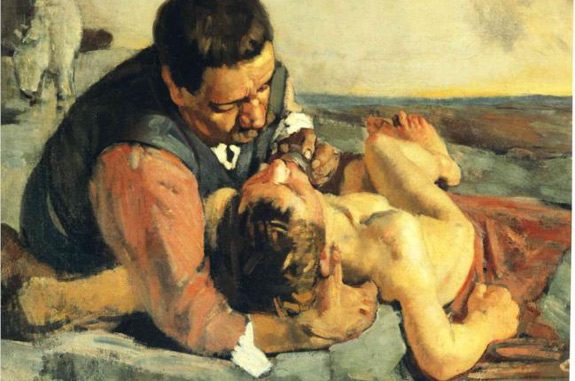
I find it fascinating that the story of the good Samaritan is told in response to an interaction with a lawyer who wants to “justify himself.” Avoiding the temptation to say anything at all about lawyers—one of my dearest friends is a lawyer, and also a priest, and a monk!—the lawyer is brave enough to ask the question which everyone is thinking, “what do I have to do to inherit eternal life?” Jesus’ answer takes us by surprise. He asks the lawyer what the Torah, what the law says. This is one of those amazing interactions in which Jesus connects with someone in the perfect way. He allows the lawyer to enter into the discussion using concepts and ideas which make sense to him. He is most comfortable speaking about the law—after all, he has spent years thinking and studying the law. He has no doubt seen all the ways in which the law has been applied and used. But, our text tells us that the lawyer asks the question to test Jesus! Perhaps the lawyer is taking the risk of seeing if Jesus’ teaching will make any sense in his own world. Will Jesus be able to speak to his life, and his experience, and to his concerns in a way that will make a difference. Or, will he discover that Jesus does not understand him at all. So, all things considered, this is a very important question.

The lawyer’s response is both simple and profound. It is clear that he is a person of deep faith who understands the imperative of the Shema, which he prays every day, “You shall love the Lord your God with all your heart, and with all your soul, and with all your strength, and with all your mind,” But the, he takes it a step farther and adds, “and your neighbor as yourself.” In doing so, he shows that the understands both the story of Cain and Abel and the meaning of the Commandments.

When Jesus praises his response, the lawyer is happy. After all, lawyers are not accustomed to having people say nice things about them—then or now. But, Jesus takes the risk of pushing him further. He challenges the narrow and comfortable boundary which the lawyer has set up so that he can consider himself a good and compassionate person. He asks him to think outside the box, beyond the law, in ways that he has never done previously. He asks him to take those two concepts which he does understand—“love” and “neighbor” and to view them from God’s perspective. In doing so, I suspect that he shakes the lawyer to his core. Jesus invites the lawyer to realize that in God’s eyes, there are no limitations, no boundaries, no loopholes. Every person, without exception, is a family member and a neighbor. This is especially true of those who do not know, do not understand, do not like and perhaps fear! Not only are they deserving of love, they are also deserving of compassion and mercy!

I can not help but feel that we are all like this lawyer at times. We would like to be good, and to be thought of as good. We are prepared to do what we can, as long as we can do so safely and with protections. We are willing to occasionally volunteer and to make a small donation here and there for some good cause. But we really do not want to be inconvenienced. We have our plans for the day, and for our lives, and do not want to allow anything to interrupt those plans or to throw us off the path. And so, we plead our case. We believe that we are doing the best that we can with what we have—within the safety of our “comfort zone.”

Jesus challenges us to do more. He invites us to cast aside our fears, our worries, and our reluctance. He invites us to realize that we are more than able to meet whatever opportunity which presents itself to be agents of encouragement, love, compassion, and mercy. I can not help but reflect on the very practical reality of the Samaritan. He knows exactly what to do. Why? Has he been beaten, and robbed, and abused? Or has this happened to people that he knows and loves? Has he learned not to leave home without a basic emergency kit? Does he not know what it means to be held and comforted and sheltered when he is hurting and in pain?

Perhaps the most important question is, “Who is the man travelling from Jerusalem to Jericho?” Is it Jesus? Is it our Sisters and Brothers who are Black or Brown? Is it our Sisters and Brothers who are LGBTQIA? Is it our Sisters and Brothers who are from other countries who speak other languages? Is it our Sisters and Brothers who are Jewish, Muslim, Buddhist, Hindu, agnostic of atheists? Who is this person? Could it be someone travelling from El Salvador, Guatemala or Honduras to escape violence, oppression, and abject poverty? Could it be a child locked up in a detention center on our border?

As our Presiding Bishop and Primate has often told us, “If it is not about love, it is not about God.” May we learn to love freely, fearlessly, and unconditionally. May we lean to love without expecting anything in return. May we learn to throw aside our plans and ask God, “What do you want me to do today? Help me to be useful. Show me how to make a difference for whoever is most in need.”

Jesus concludes with a plea to each of us and to us as a community of faith: “Go and do likewise.”

Note: Since I am not preaching in a community today, I had the freedom to take a different approach than I might normally do. This is what God is challenging me to hear today—and in church, I am sure that other words will strike me as well. That in all things, God may be glorified.

A Happy and Blessed Feast of Holy Father, Saint Benedict.

23e74be5-f0f8-4dc1-956d-5c3617b538f7

“Holy Father Benedict, the Man of God. Blessed in word and in deed.” On this Solemnity of our Holy Father among the Saints, Benedict of Nursia, Patron of Western Monasticism, I send peace and love to all who honor the life and legacy of Benedict. Through his prayers may we seek and find God. That in all things God may be glorified.

Eternal God, you endowed your holy servant Benedict
with gifts of discernment and power to be a true and faithful guide
in the way of Christian perfection.
Instill in our hearts the virtues of stability and concord,
that our prayers may be fixed on you and our judgements may be formed
according to your great commandment of love;
through Jesus Christ our Lord,
who is alive and reigns with you and the Holy Spirit,
one God, now and forever. Amen.

From For All the Saints: Prayers and Readings for Saints’ Days According to the Calendar of the Book of Alternative Services of the Anglican Church of Canada.

“Sustain me, 0 Lord, as you have promised.”

“Sustain me, O Lord, as you have promised.”

A Sermon for the
Weekday Eucharist at 11:30 a.m.
July 10, 2019

The Feast of Saint Benedict,
Patron of Western Monaticism
480-547

Trinity Episcopal Church
In Bethlehem, Pennsylvania

HPSB 07-10-19

On the eleventh day of July at the Eucharist to commemorate the Solemnity of Holy Father, Saint Benedict of Nursia, the Patron of Western Monasticism, the monk who is to make his Solemn Profession of Vows kneels before the Archabbot of Saint Vincent in front of the altar in the Archabbey Basilica. He places his hands in those of the Archabbot and “in the presence of his Father in Christ and the monks of that community,” he professes to God the Solemn Monastic Vows—binding for life—of stability, of obedience (according the Holy Rule of Saint Benedict and the laws proper to the American Cassinese Congregation) and of conversion of life.

He then goes to the altar with the Archabbot and, after both sign the vows formulary, it is laid on the altar to symbolize the offering of the Vows to God.

Afterwards the now Solemnly Professed Choir Monk returns to stand in front of the altar. With the Community standing in unity with him, he holds up both hands to God and sings the Suscipe: “Sustain me, O Lord, as you have promised that I may live. And disappoint me not in my hope.” This song of offering and commitment is sung three times, each time on a slightly higher note.

The notion that God is the one who sustains the “one who is truly seeking God,” is at the very heart of the understanding of the monastic vocation. It is derived from the personal experience of Benedict who dwelt in solitude in the cave until he was called forth to serve others as a guide and to lead them on the path that leads to God.

This is the foundation on which Benedict founded the “School of the Lord’s Service,” as he described the monasteries which he founded. But above all, it is in the actual quest-for-God that the monastic calling is upheld and sustained.

Benedict was unique in the practical way that he explained how God could be sought and found. Deeply impacted by the experience of the Prophet Elijah, that first “Man of God,”—who, following his greatest success found himself on the run from the evil Queen Jezebel (who had hired hit men to bring him in “dead or alive”),—hid out in a cave. Frightened for his life and shivering in that cave, Elijah discovered that God could not be found in dramatic external events like tornadoes, earthquakes and infernos. No, Elijah powerfully found God in quiet peace and solitude.

Benedict suggests that God may be found in community, in prayer, in quiet solitude, in work, in generous and loving hospitality and in service to others. Each of these elements offer an opportunity to become aware of the loving presence of God. Unless one is focused and knows where and how to search, God’s subtle and gracious presence could be missed. The quest-for-God requires discipline, focus, and—asculta,” that one  learn to “listen.”

Of all these elements, though, the most surprising might be “work.” As then, many today regard work as a “necessary evil.” As a popular song puts it “we work hard for our money.” In a society in which so many do not have a reliable employment which pays a living wage, work can be viewed as something which one is “forced to do to endure” in order to “just get by”—to “survive.” I recall, for instance, my Grandfather Cook telling me, when I complained about hoeing tobacco in the hot Summer sun, that it “was the punishment that Adam and Eve had brought upon us for sinning against God.”

Benedict, though, had a far more hopeful and optimistic view. For him work was something which should be joyous and fulfilling. One should be able to use talents, gifts, and abilities to be artistic and creative in producing something of beauty and value. He even goes so far as to suggest that an ordinary implement like, for instance,  a hoe which a gardener uses (or a farm boy in the mountains uses in a tobacco field) should be treated with the same respect that is given to the chalice on the altar. And if one is able to produce a surplus, it can then be used to share with those in need “so that in all things God may be glorified.”

In the Prologue to the Holy Rule, Benedict encourages us: “Do not be daunted immediately by fear and run away from the road that leads to salvation. It is bound to be narrow at the outset. But as we progress in this way of life and in faith, we shall run on the path of God’s commandments, our hearts overflowing with the inexpressible delight of love.”

On this feast of Saint Benedict, Patron of Western Monasticism, may we have the grace to seek and to find God. May God bring to completion the work we undertake to empower the Jesus Movement.

As we “progress on the road which leads to salvation” in this faith community, may God indeed sustain us in our call —as God has promised to faithfully do.

“El obrero merece su salario.”

El obrero merece su salario.”

A Sermon for the
Fourth Sunday after Pentecost
July 7, 2019

Preached at Trinity Episcopal Church
in Easton, Pennsylvania

Almighty God, who created us in your image: Grant us
grace fearlessly to contend against evil and to make no peace
with oppression; and, that we may reverently use our freedom,
help us to employ it in the maintenance of justice in our
communities and among the nations, to the glory of your holy
Name; through Jesus Christ our Lord, who lives and reigns with
you and the Holy Spirit, one God, now and forever. Amen.

Nuestra Senora de Guadalupe

In the summer of 1985, I had completed my first year as a seminarian for the Roman Catholic Diocese of Charlotte and was assigned to serve as the Director of the Greensboro Vicariate Migrant Ministry Program. I lived at Our Lady of Grace Church in Greensboro, but the office was located at Holy Infant Church in Reidsville. It was an amazing experience—in so many ways a life-changing one. I spent a good deal of time driving in a beat-up car along the back roads visiting the migrants and learning about their lives.

Each Sunday afternoon, there was a Spanish Mass at Holy Infant. Various Priests from the Vicariate would come and preside and preach. In many cases, the parish in which they served would also come and bring a collection of food and clothing which the parish had assembled. And, they would provide a home-cooked meal for the migrants. It was a mini weekly fiesta. They were always a lot of fun.

Early one week, I received a surprise call from the Priest who planned to come that Sunday. In a very humble conversation, he shared with me that he was going to come that week because no one else was available. He admitted that his Spanish was pretty bad. He was willing to make an effort to “say the Mass” in Spanish, but thought that there was no point in even attempting to preach. He recognized that the needs of the migrants would not be served by having a sermon in English. So, he said, “I am willing to make you a deal. I will come and preside if you will preach.”

It was the last thing on earth I ever expected to hear! In those days, the formation program required five years of study–one year of philosophy and four years of theology. I had just completed the year of philosophy at St. Mary’s Seminary and University in Baltimore. I had not even had any “official” classes in Scripture or Homiletics. I felt completely unprepared! Then too, I had no idea what to say. I felt comfortable that I would be understood in Spanish but was not sure that I had anything to offer that was really worth hearing. The kind priest told me to give it a try. And so, I did.

God often surprises me by working things out in ways that I do not expect. The sermon for that day was from the tenth chapter of Luke. I honestly can not remember a single word that I said that day. I will never forget what happened during that inaugural sermon, though. All at once I saw that congregation in a shockingly different way. As I looked out at those familiar faces which I had come to know over the few weeks that I had served in that community, I heard those words from the Gospel and they spoke to me in a most powerful way: “See, I am sending you out like lambs into the midst of wolves. Carry no purse, no bag, no sandals; and greet no one on the road.”

It was as if my eyes were almost literally opened. I suddenly realized that those words, to me, were speaking about these people whom I had come to know, to admire, to love, and to respect. Many of them had shared horror stories of their journey from the middle of nowhere in Mexico to the middle of nowhere in the Piedmont of North Carolina.

They had shared stories of leaving behind everything and everyone they knew. They came to a new place—a place where they did not speak the language, were treated as sub-human, worked exhausting hours under the burning sun working in fields from sunrise to sunset. They took jobs which no one else wanted, lived in horrible conditions, and were paid very little. They did this to escape even worse situations at home—because they had to provide for their family. Or, because there was not work where they had lived before.

I suddenly realized that they were people of amazing and incredible faith. My own faith paled by comparison with theirs. They had literally done what the Lord said. They were able to bring nothing with them on a dangerous journey. And somehow, even without “purse, bag, or sandals,” they trusted that God would protect them and give them what they needed. I did not have that kind of trust in God. It was one of those transformative moments which completely changed my understanding of what ministry was all about.

I also realized that these were my Sisters and Brothers in Christ. They were members of my church—of my family. They had as much right to be present in that congregation on that day as I did—or as anyone else did—it was their church too! For them it was perhaps even more important to be there than it was for me. This was the one place where they were truly welcome and at home. Here they were not strangers, or aliens or foreigners. The fact that they were born in another country did not matter at all. I had a much clearer understanding of the universality, inclusiveness, and diversity of the “kingdom of God.” Suddenly things like national borders and boundaries seemed irrelevant and insignificant in God’s eyes—and in my own eyes as well.

As the summer progressed, I reflected on that gospel passage so many times! As I visited with the migrants—often in the evenings after the workday was over, I learned important lessons about hospitality and generosity. I was shocked to discover that my coming to see someone was a “big deal.” I was used to thinking that I was not all that important. For the migrants, though, I was “Padrecito,” or “el gordo.” And both of those terms were spoken with love—an endearment of the best kind because it was spoken with love.

They would so often stop whatever they were doing and throw together a meal. It might have been very simple—sometimes rice and beans served with fresh tortillas. But it was delicious! And they always made sure that I was served first—and had an ample serving. They had nothing! And yet, they delighted in welcoming me and in sharing whatever they had.

I came to realize that there was another passage from that Gospel that was just as important: “Whatever house you enter, first say, `Peace to this house!’ And if anyone is there who shares in peace, your peace will rest on that person; but if not, it will return to you. Remain in the same house, eating and drinking whatever they provide, for the laborer deserves to be paid

These loving lambs, working among wolves in rural North Carolina and being shamelessly exploited—because they had no legal protection at all—were the very embodiment of peace. But that last line, continued to haunt me—I remember the words in Spanish, “el obrero merece su salario,” “the worker deserves his wage.” It was at that point that I really began to understand the reality of injustice and exploitation. It was at that moment that I became convinced of the need to work for justice! These long-suffering, hard-working women and men (in a few cases, families traveled together), were not receiving a just, fair, or equitable wage. And that was wrong. That was a violation of the Gospel as I heard Jesus speak those words to me so clearly.

As I advanced in my theological studies, I was exposed to the rich history of work for social justice in the Roman Catholic Church. I read several encyclicals from various Popes, written over a period of more than one hundred years. I read some of the writings of John Paul II. He spoke about the need for families to earn a “living wage.” In his vision, each family would find work that they were qualified to do, which allowed them to use their gifts and talents, and which would pay them enough for adequate food, clothing, shelter, health care and education for the family. They would not have to work two jobs or three jobs. They would have time to rest and to spend with the family. They would be treated with dignity and respect—and especially if it was a less than desirable job which no one else wanted to do. I got it. I knew that he was speaking about my migrants!

I completely understand that we live in the tensest political world that I can ever recall. People in our country are divided in a way that I have never seen before. The lack of civility and actual viciousness and “meanness of discourse” is unprecedented. I am not here today to speak about partisan politics. The Good News of God’s love for us in Jesus Christ, though—as Saint Paul might say, “impels me” to share with you what I hear God saying about the reality of migrants on our borders and in our country. To love you and to be sincere with you, I have to share that truth. You are free to disagree with me—and I respect that. But here is what I have come to believe to be true.

Our Presiding Bishop and Primate, the Most Reverend Michael Curry recently expressed his understanding of what God is saying to the Episcopal Church in these words: “’We are children of the one God who is the Creator of us all. It is our sisters, our brothers, our siblings who are seeking protection and asylum, fleeing violence and danger to children, searching for a better life for themselves and their children. The crisis at the border is not simply a challenge of partisan politics but a test of our personal and public morality and human decency.’

Even as I am preparing this text (on Wednesday evening) our own Bishop Kevin just sent us a letter in which he wrote:

“I write to you this day broken-hearted. Vulnerable people, especially children are being mistreated, neglected, and are, tragically, even dying at our nation’s border. What is happening at detention centers is inhumane, deplorable and counter to the teachings of Jesus Christ, who tells us, “just as you did it to one of the least of these who are members of my family, you did it to me.”

Since being called as your bishop, I have gathered with so many of you. As we have renewed our baptismal promises, I am often indicted by the words “will you strive for justice and peace among all people, and respect the dignity of every human being.” I have been struck by your commitment to the communities you serve and your generosity of spirit. I imagine as you see news of these tragedies occurring within our own country that you may be confused, hurt, and seeking ways to ensure all people, and especially vulnerable children, are safe, secure, and receiving the care that they need.”

He goes on to provide simple and direct ways in which we can individually and collectively make a difference:

  • Partner with the Diocese of Texas to send supplies to the Humanitarian Respite Center in McAllen, TX.
  • Support Immigration Ministries in the Diocese of West Texas.
  • Join Partners in Welcome, an online learning and networking community from Episcopal Migration Ministries that works to support refugees and asylum-seekers.
  • Learn more about immigration and refugee resettlement from the Episcopal Church Office of Government Relations.

Bishop Kevin concludes with this appeal: “And I also encourage you to pray–pray for the people who are being detained, especially the children. Pray for those who are entrusted with providing care. Pray for the people who are ministering to them. Pray for our country and its leaders.

Let us continue to reach out in love and strengthen the bonds that unite us.”

Dear friends, let us truly be a community of prayer. Let us also be a community of action. The worker deserves a fair and just wage. The migrant deserves to be treated with love and respect—and with welcome! This is Wisdom. May we be truly attentive.